How to Compare GLP-1 Medicines for Type 2 Diabetes
Your glucose goal, heart or kidney history, daily routine, and other medicines can all change which option makes sense.
There’s no single best GLP-1-based medicine for everyone with type 2 diabetes. Compare the evidence for the specific product and your goal, then consider its tablet or injection routine, stomach side effects, and how it fits with medicines you already take. Pregnancy plans matter too: injectable semaglutide has a planning interval, while tirzepatide has a specific warning about oral contraception. 467
Start with the result you’re trying to get
If you’re discussing a GLP-1-based medicine, start with a more useful question than “Which one is strongest?” Are you mainly trying to improve blood glucose? Do you also have established cardiovascular disease? Is chronic kidney disease part of the picture? Those answers change which results matter most. In a network meta-analysis of randomized trials involving people with type 2 diabetes and established cardiovascular disease or high cardiovascular risk, several GLP-1-based treatments reduced the combined outcome of cardiovascular death, nonfatal heart attack, or nonfatal stroke compared with placebo. That doesn’t make them interchangeable or establish one universal winner. 2
Weight may be one of your goals, too, but it shouldn’t crowd out the others. If heart or kidney outcomes matter to you, look at results for the particular medicine being proposed, not just the GLP-1 category. A separate review found that cardiovascular and kidney findings varied by outcome and that longer-term head-to-head trials are still needed. 3
Compare the medicine, not just the drug family
These are practical distinctions between products and trial results:
- Injectable semaglutide (Ozempic) is taken once weekly. In a trial of adults with type 2 diabetes and high cardiovascular risk, the combined cardiovascular outcome occurred in 108 of 1,648 people assigned semaglutide (6.6%), versus 146 of 1,649 assigned placebo (8.9%), over a median observation time of 2.1 years. Both groups received standard care. A separate trial in people with type 2 diabetes and chronic kidney disease found fewer combined kidney or cardiovascular-death events with injectable semaglutide than with placebo. Those findings concern the injection and the populations studied, not every semaglutide product. 4
- Oral semaglutide tablets offer a different routine, not simply an injection without the needle. They’re taken daily, with a morning routine that includes waiting before food, drink, or other medicines. Confirm the instructions for the exact tablet product being proposed rather than assuming they match the injection. 9
- Liraglutide (Victoza) is a once-daily injection. In its cardiovascular trial, conducted alongside standard care in adults with type 2 diabetes and cardiovascular disease or specified risk factors, the combined cardiovascular outcome occurred in 608 of 4,668 people assigned liraglutide (13.0%), versus 694 of 4,672 assigned placebo (14.9%), over a median 3.5 years. These percentages shouldn’t be compared directly with semaglutide’s: they come from different trials. 6
- Tirzepatide (Mounjaro) acts on both GIP and GLP-1 receptors and is a once-weekly injection. In a 40-week trial of adults whose glucose was not adequately controlled with metformin, tirzepatide produced greater average reductions in HbA1c and weight than the semaglutide injection dose studied. That is a comparison of those regimens for those outcomes, not proof that tirzepatide is better for every goal. In a separate cardiovascular trial involving people with established cardiovascular disease, tirzepatide met the trial’s standard for being no worse than dulaglutide on the combined cardiovascular outcome; superiority was not established. 78
Dulaglutide and exenatide may also come up. Dulaglutide was given once weekly as the comparator in tirzepatide’s cardiovascular trial. Basal-insulin studies have included different exenatide regimens, so the name “exenatide” alone isn’t enough to establish a routine. These trial descriptions do not replace the instructions for a proposed product. Comparative analyses include both medicines, but they don’t supply a universal ranking for your glucose, cardiovascular, and kidney goals. 2710
The other diabetes medicines you take matter
If you use insulin or a sulfonylurea, such as glimepiride, low blood sugar needs to be part of the plan. The prescribing information for injectable semaglutide, liraglutide, oral semaglutide, and tirzepatide warns about increased hypoglycemia risk with insulin or an insulin-releasing medicine. Tirzepatide trial results also show why the setting matters: low-glucose events were reported differently when it was studied on its own versus when it was added to basal insulin. Don’t change an existing diabetes medicine on your own to make room for a new one. 4567
Tolerability deserves the same attention as glucose results. Nausea, vomiting, and diarrhea are reported with several of these medicines, often during dose escalation. Their adverse-effect percentages come from separate trials with different participants and shouldn’t be used as a head-to-head ranking. If you already have significant stomach symptoms, mention them before choosing: injectable semaglutide and liraglutide are not recommended for people with severe gastroparesis. Severe or persistent stomach symptoms while taking semaglutide, liraglutide, or tirzepatide warrant a call to your prescribing care team. Persistent or severe abdominal pain, sometimes reaching the back, needs prompt assessment because pancreatitis is a warning for these medicines. 46789
One more history can change the semaglutide discussion: in its cardiovascular trial, diabetic retinopathy complications were reported more often with injectable semaglutide than placebo. Its prescribing information calls for monitoring people with a history of diabetic retinopathy. Tell your care team if that applies to you. 4
Pregnancy plans and contraception can change the choice
If pregnancy is possible or planned, settle the glucose-treatment plan before changing medicines. Poorly controlled diabetes itself carries pregnancy risks, while human pregnancy data for these medicines are limited. The instructions aren’t identical: US prescribing information says to stop injectable semaglutide at least two months before a planned pregnancy because it remains in the body for a long time. Liraglutide’s and tirzepatide’s prescribing information describes potential fetal risks based on animal studies. If you’re considering either medicine, ask your care team about pregnancy planning rather than applying semaglutide’s interval to another product. 467
Tirzepatide raises a separate contraception question even when you aren’t planning pregnancy. Because it delays stomach emptying, it may reduce the effectiveness of oral hormonal contraceptives. Its US prescribing information advises switching to a non-oral method or adding a barrier method for four weeks after starting tirzepatide and for four weeks after each dose increase; it says non-oral hormonal methods should not be affected. That specific warning should not be assumed to apply in the same way to every GLP-1 medicine. 7
Put the evidence in your own context
For example, if you’ve had a heart attack, the useful comparison is the cardiovascular evidence for each proposed product, not just which one lowers HbA1c most in a glucose trial. If you have kidney disease, ask whether a result concerns a kidney measurement or a clinical event such as progression to kidney failure. Injectable semaglutide has a trial of clinical kidney and cardiovascular outcomes in people with type 2 diabetes and chronic kidney disease; a change in a kidney measurement reported for another regimen is not automatically equivalent evidence. 34
Your routine and access count as well. A daily injection, a weekly injection, and a daily tablet with morning timing requirements ask different things of you. Once you have a specific product in mind, check its coverage and your out-of-pocket cost with your insurer or pharmacy rather than assuming products in the same family will cost you the same.
Finally, don’t assume broad trial findings answer every question about women. The injectable semaglutide kidney trial reported that its primary result was generally consistent across biological-sex subgroups, but most of the comparisons above report results for their overall study populations. They do not establish that one of these medicines is generally best for women. Pregnancy planning and tirzepatide’s oral-contraceptive interaction are more immediate women-specific distinctions for many readers. 247
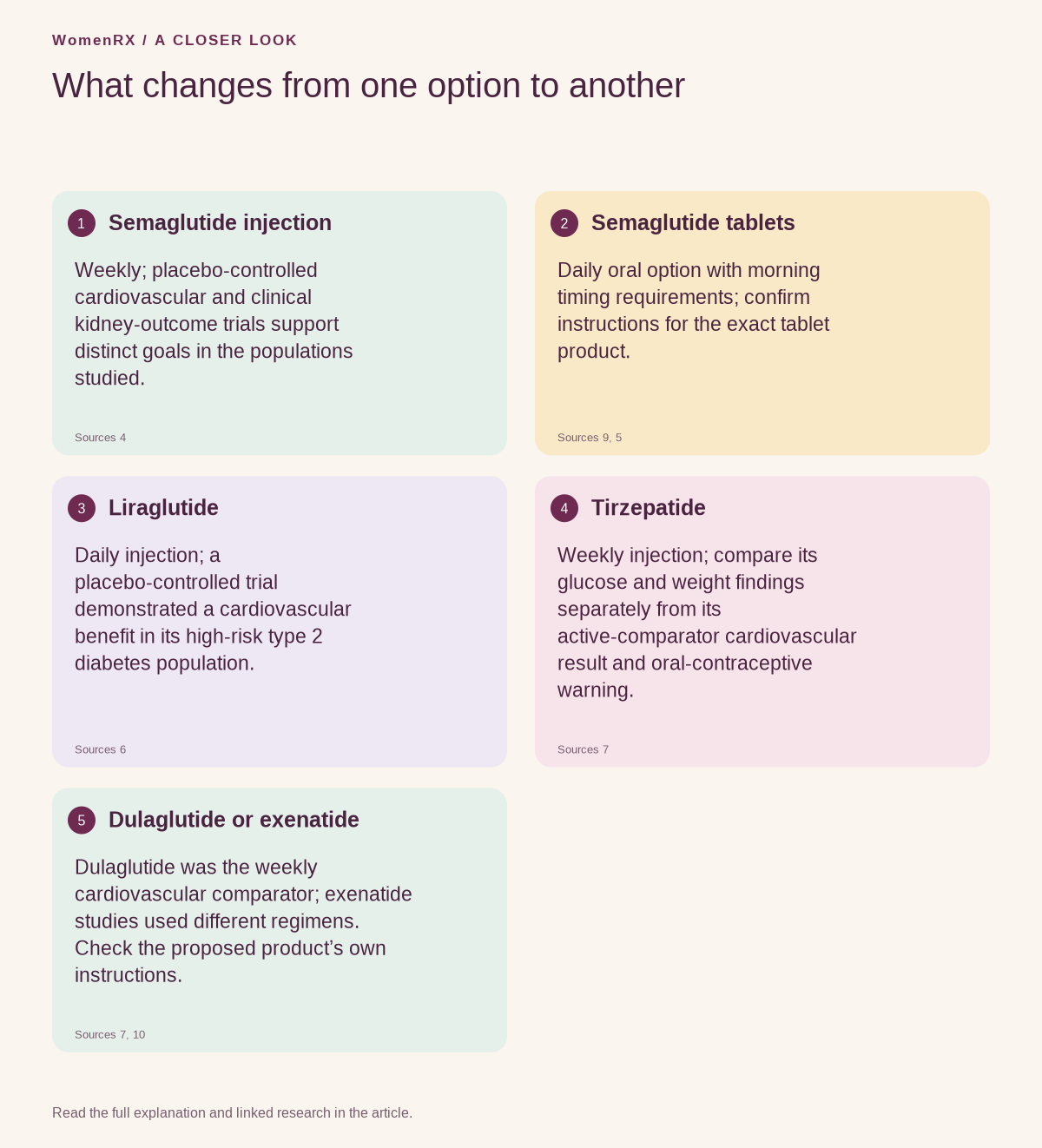
What changes from one option to another
Semaglutide injection: Weekly; placebo-controlled cardiovascular and clinical kidney-outcome trials support distinct goals in the populations studied.4
Semaglutide tablets: Daily oral option with morning timing requirements; confirm instructions for the exact tablet product.95
Liraglutide: Daily injection; a placebo-controlled trial demonstrated a cardiovascular benefit in its high-risk type 2 diabetes population.6
Tirzepatide: Weekly injection; compare its glucose and weight findings separately from its active-comparator cardiovascular result and oral-contraceptive warning.7
Dulaglutide or exenatide: Dulaglutide was the weekly cardiovascular comparator; exenatide studies used different regimens. Check the proposed product’s own instructions.710
Read the figure as text
Compare the named product’s routine and the kind of outcome evidence that matches your goal; trial regimens are not universal product instructions.- Semaglutide injection: Weekly; placebo-controlled cardiovascular and clinical kidney-outcome trials support distinct goals in the populations studied.4
- Semaglutide tablets: Daily oral option with morning timing requirements; confirm instructions for the exact tablet product.95
- Liraglutide: Daily injection; a placebo-controlled trial demonstrated a cardiovascular benefit in its high-risk type 2 diabetes population.6
- Tirzepatide: Weekly injection; compare its glucose and weight findings separately from its active-comparator cardiovascular result and oral-contraceptive warning.7
- Dulaglutide or exenatide: Dulaglutide was the weekly cardiovascular comparator; exenatide studies used different regimens. Check the proposed product’s own instructions.710
More questions, answered
If one GLP-1 medicine hasn’t met my glucose goal, should I switch to another?
Not automatically. A panel from 11 Asia-Pacific countries conditionally recommends against switching to another GLP-1 receptor agonist when response is inadequate, based on very-low-certainty evidence. Its guideline also considers other strategies, including switching to a dual GIP/GLP-1 treatment or adding basal insulin. The next step depends on glucose needs, low-blood-sugar risk, weight goals, and your preferences; discuss any change with your prescriber. 1
Sources you can check
- Guideline on treatment intensification with injectable therapies beyond GLP-1 RA based therapies in type 2 diabetes.Luo Y, Xia J, Yao X, Jahed SA, Bee YM, Chen L, Chan SP, Deerochanawong C, Shan Kong AP, Nguyen KT, Li X, Lim S, Loganadan NK, McGill M, Trejo SE, Yabe D, Yan L, Li P, Zhao Z, Chen ... · Diabetes research and clinical practice · 2026Return to first citation
- Preferred Glucagon-like Peptide-1 Receptor Agonists in Adults With Type 2 Diabetes and Established Cardiovascular Disease or High Cardiovascular Risk: A Network Meta-analysis of Randomized Trials.Abomohsen M, Rifai M, Gadelmawla AF, Alghzawi HM, Elgendy MS, Bakr HM, Friedman A, Idries IY. · Canadian journal of diabetes · 2026Return to first citation
- Relative Efficacy of Next-Generation Incretin Therapies for Cardio-Renal Protection in Type 2 Diabetes: Evidence From a Network Meta-Analysis.Pham TP, Vo TM, Nguyen TA, Dao TP, Ngo NP, Le TT, Tran TT, Pham TH, Huynh DM, Ha HA. · Diabetes, obesity & metabolism · 2026Return to first citation
- OZEMPIC (SEMAGLUTIDE) INJECTION, SOLUTION [NOVO NORDISK PHARMACEUTICAL INDUSTRIES, LP] | US prescribing information and patient instructionsAccessed 2026-09-25Return to first citation
- OZEMPIC (ORAL SEMAGLUTIDE) TABLET RYBELSUS (ORAL SEMAGLUTIDE) TABLET [NOVO NORDISK PHARMACEUTICAL INDUSTRIES, LP] | US prescribing information and patient instructionsAccessed 2026-09-25Return to first citation
- VICTOZA (LIRAGLUTIDE) INJECTION [NOVO NORDISK] | US prescribing information and patient instructionsAccessed 2026-09-25Return to first citation
- MOUNJARO (TIRZEPATIDE) INJECTION, SOLUTION MOUNJARO KWIKPEN (TIRZEPATIDE) INJECTION, SOLUTION [ELI LILLY AND COMPANY] | US prescribing information and patient instructionsAccessed 2026-09-25Return to first citation
- Tirzepatide: a medicine to manage type 2 diabetes and treat obesity - NHSAccessed 2026-09-25Return to first citation
- Semaglutide: a medicine to manage type 2 diabetes or treat obesity - NHSAccessed 2026-09-25Return to first citation
- Efficacy and Safety of Tirzepatide Compared with GLP-1 RAs in Patients with Type 2 Diabetes Treated with Basal Insulin: A Network Meta-analysis.Osumili B, Sapin H, Yang Z, Ranta K, Paik JS, Blüher M. · Diabetes therapy : research, treatment and education of diabetes and related disorders · 2025Return to first citation