Bloating on GLP-1 Medicines: What May Help?
Bloating is reported with liraglutide, a GLP-1 medicine, but your bowel pattern and other symptoms help determine what to do next.
Liraglutide prescribing information lists abdominal distension, constipation, and nausea among reported effects. If you feel bloated while taking a GLP-1 medicine, notice when it starts, whether you’re passing stool and gas, and what else has changed. Smaller meals and addressing constipation may help, but persistent bloating deserves a conversation with your prescriber. Get urgent assessment if you can’t pass stool or gas, or have severe abdominal pain. 12
Bloating is a symptom, not a single diagnosis
A full, tight, or swollen feeling is sometimes reported during treatment with liraglutide, a GLP-1 medicine. In adult trials of liraglutide for weight management, people reported abdominal distension, gas, constipation, nausea, and other gastrointestinal symptoms more often with the medicine than with placebo. GLP-1-based therapies can also slow stomach emptying, which may change how comfortably you eat. Neither fact means every episode of bloating has the same cause. 23
The useful question is what’s happening alongside the bloating? If you’re having fewer bowel movements than usual, constipation may be contributing. If you feel especially full after a meal, meal size may matter. Gas from fizzy drinks or certain foods can add to the discomfort whether or not you take a GLP-1 medicine. These are possibilities to sort through, not diagnoses to make from one symptom. 12
Match what you try to the pattern
For mild bloating, start with changes that fit what you’re noticing rather than adding several remedies at once. If larger meals leave you uncomfortable, try smaller meals. If fizzy drinks seem to coincide with gas, cut back and see whether that changes anything. If constipation is part of the picture, water, movement, and foods with soluble fiber, such as oats, are general measures that may help. 1
A new or higher dose may also be relevant. A review of obesity-treatment studies found that gastrointestinal effects often appeared during dose escalation, although that pattern can’t tell you what’s causing your bloating. If symptoms persist or make eating difficult, contact your prescriber rather than changing the medication yourself. Dose timing or treatment adjustments are decisions to make together. 45
Keep a short record that separates the clues
You don’t need a perfect food diary. A few notes over the days when you feel bloated can make a conversation much more useful:
- Timing: When did bloating start? Does it follow a meal, a medication start or change, or a particular part of your menstrual cycle? If pregnancy is possible, note that as context too, without assuming it explains the bloating.
- Bowel pattern: Are you passing stool and gas as usual? Note constipation or diarrhea, not just the feeling of fullness.
- Food and fluids: Did a larger meal, fizzy drink, or a change in how much you’re eating or drinking coincide with symptoms?
- Other symptoms: Note nausea, vomiting, pain, and whether you can keep food and fluids down. Don’t wait to finish tracking if a warning sign appears. 123
Some people feel bloated around their period, so cycle timing is worth mentioning rather than automatically calling it a medication effect. The cited adult-trial passage from liraglutide prescribing information lists abdominal distension but gives no sex-specific rate, so those results cannot establish whether women experience it more often. 12
When not to watch and wait
Get urgent medical assessment if you cannot pass stool or gas, particularly with a swollen abdomen. That is different from simply going less often than usual. Bloating with vomiting or abdominal pain also needs prompt assessment. If your abdomen is swollen and the pain is severe and comes on suddenly, seek emergency care. 1
Persistent or severe abdominal pain during liraglutide treatment, sometimes spreading to the back and with or without vomiting, is a warning sign in its prescribing information. Contact a medical professional promptly for that pattern rather than treating it as routine bloating. Repeated vomiting or bloating that keeps returning or doesn’t go away also warrants assessment. 12
Most importantly, you don’t have to decide on your own whether the medicine is responsible. The combination of timing, bowel changes, eating patterns, and other symptoms gives your clinician a better basis for deciding what needs attention.
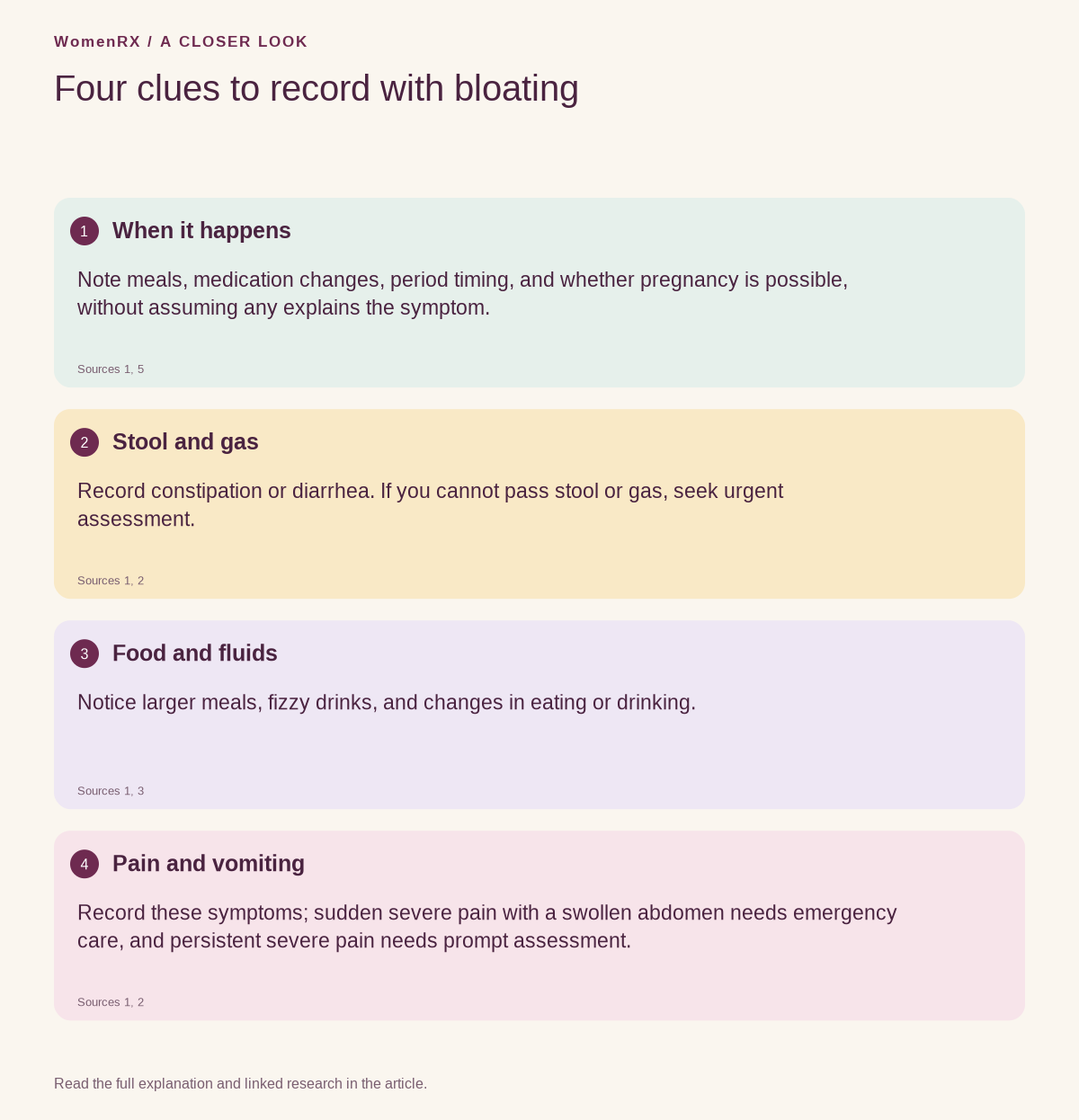
Four clues to record with bloating
When it happens: Note meals, medication changes, period timing, and whether pregnancy is possible, without assuming any explains the symptom.15
Stool and gas: Record constipation or diarrhea. If you cannot pass stool or gas, seek urgent assessment.12
Food and fluids: Notice larger meals, fizzy drinks, and changes in eating or drinking.13
Pain and vomiting: Record these symptoms; sudden severe pain with a swollen abdomen needs emergency care, and persistent severe pain needs prompt assessment.12
Read the figure as text
These notes help distinguish a possible digestive pattern from a symptom that needs prompt assessment. This is not a diagnostic score.- When it happens: Note meals, medication changes, period timing, and whether pregnancy is possible, without assuming any explains the symptom.15
- Stool and gas: Record constipation or diarrhea. If you cannot pass stool or gas, seek urgent assessment.12
- Food and fluids: Notice larger meals, fizzy drinks, and changes in eating or drinking.13
- Pain and vomiting: Record these symptoms; sudden severe pain with a swollen abdomen needs emergency care, and persistent severe pain needs prompt assessment.12
More questions, answered
Should I take a gas remedy or a laxative?
It depends on what’s accompanying the bloating. A pharmacist can help you discuss an option for gas or constipation, but a gas remedy won’t address every cause of a swollen feeling. If you cannot pass stool or gas, seek urgent assessment instead of trying to treat it yourself. 1
Sources you can check
- Bloating - NHSAccessed 2026-09-25Return to first citation
- SAXENDA (LIRAGLUTIDE) INJECTION, SOLUTION [NOVO NORDISK PHARMACEUTICAL INDUSTRIES, LP] | US prescribing information and patient instructionsAccessed 2026-09-25Return to first citation
- Nutritional considerations for glucagon-like peptide-based therapies: An Asian Indian consensus recommendation.Joshi SR, Misra A, Mithal A, Saboo B, Seshadri KG, Chowdhury S, Bantwal G, Sethi B, Kesavadev J, Bhattacharya AD, Baruah MP, Budhwar A, Thakor P, Shende S, Mohan V. · Obesity pillars · 2026Return to first citation
- Nutritional, functional, and psychological considerations for incretin-based therapies in adults-an EASO, EFAD, and ECPO Consensus Statement.Dobbie LJ, Tolvanen L, Alves D, Baker JL, Bez NS, Birney S, Bogl LH, Brown A, Bullo M, Clare K, Duncan EL, Govers E, Mooney V, Mulrooney H, Mercado DO, O'Malley G, Oppert JM, Pilli... · The lancet. Diabetes & endocrinology · 2026Return to first citation
- Gastrointestinal Symptoms in Obesity Therapy: Mechanisms, Epidemiology, and Management Strategies.Witaszek T, Biesiada A, Iskra-Trifunović J, Babicki M, Mastalerz-Migas A, Kłoda K. · Biomedicines · 2025Return to first citation