Acid Reflux on GLP-1 Medicines: What May Help
Smaller meals and staying upright after eating may ease heartburn, but persistent or severe symptoms deserve more than routine self-care.
GLP-1 medicines are associated with a higher chance of gastroesophageal reflux in clinical trials, though the absolute increase was small: about four additional cases per 1,000 people compared with placebo. If symptoms start, notice whether they follow larger meals or lying down, try smaller meals, and discuss persistent symptoms with your prescriber. Liraglutide prescribing information warns that severe or persistent abdominal pain, especially pain spreading to your back, needs prompt medical attention. 3 1 2
Why reflux can show up during treatment
Heartburn is a burning feeling in the chest when stomach contents travel upward; a sour taste can come with it. Symptoms may be worse after eating, lying down, or bending over. 1
A 2025 review of 55 placebo-controlled trials, involving 106,395 participants, found that GLP-1 receptor agonists probably increased gastroesophageal reflux disease (GERD): about four more cases per 1,000 people than placebo, with a relative risk of 2.19. That is a pooled trial result, not a prediction of what will happen to you or proof that every episode of heartburn is caused by the medicine. The review’s abstract does not report sex-specific results. 3
These medicines can affect stomach emptying. That may be one piece of the picture when someone has reflux symptoms, but a delayed-emptying effect does not by itself establish why a particular person has heartburn. The available review evidence supports an association with GERD; it does not establish which meal habits prevent symptoms during GLP-1 treatment. 4 5 3
Use the pattern to choose a first step
For a few days, note when symptoms happen, what and how much you ate, and whether you lay down or bent over afterward. This is a practical way to spot a possible pattern, not a diagnostic test.
If symptoms tend to follow a large meal, try smaller meals rather than pushing through a portion that leaves you uncomfortably full. If lying down or bending after eating seems to bring on burning, stay upright when you can and see whether that changes the pattern. Smaller, more frequent meals and raising the head of the bed are general heartburn measures that may help; extra pillows alone may increase pressure on the belly and make symptoms worse. 1
These steps may reduce symptoms, but they are not proven ways to prevent GLP-1-related reflux. No specific food or strict meal schedule is established as a solution for everyone.
When to bring in your prescriber
Contact the clinician managing your medication if reflux keeps happening, is getting worse, or is interfering with eating or sleep. Share when it began in relation to treatment and whether it clusters around meals or lying down. Ask whether your symptoms call for a medication review or another approach. Don’t change your treatment plan based only on a symptom log.
Heartburn-like discomfort can overlap with problems that should not be treated as routine reflux. Seek prompt medical attention for persistent or severe abdominal pain, particularly if it spreads to your back; nausea or vomiting may or may not be present. Liraglutide prescribing information identifies this pattern as a possible sign of pancreatitis and also warns that severe gastrointestinal reactions can occur. 2
Do not assume new, severe, or unusual chest pain is heartburn or manage it as routine reflux.
If pregnancy may be part of the picture
The trial summary above does not report pregnancy-specific results, and it does not separate medication-associated reflux from reflux during pregnancy. If you are pregnant or could be, tell the clinician managing your care rather than guessing at the cause or applying general medication advice to your situation.
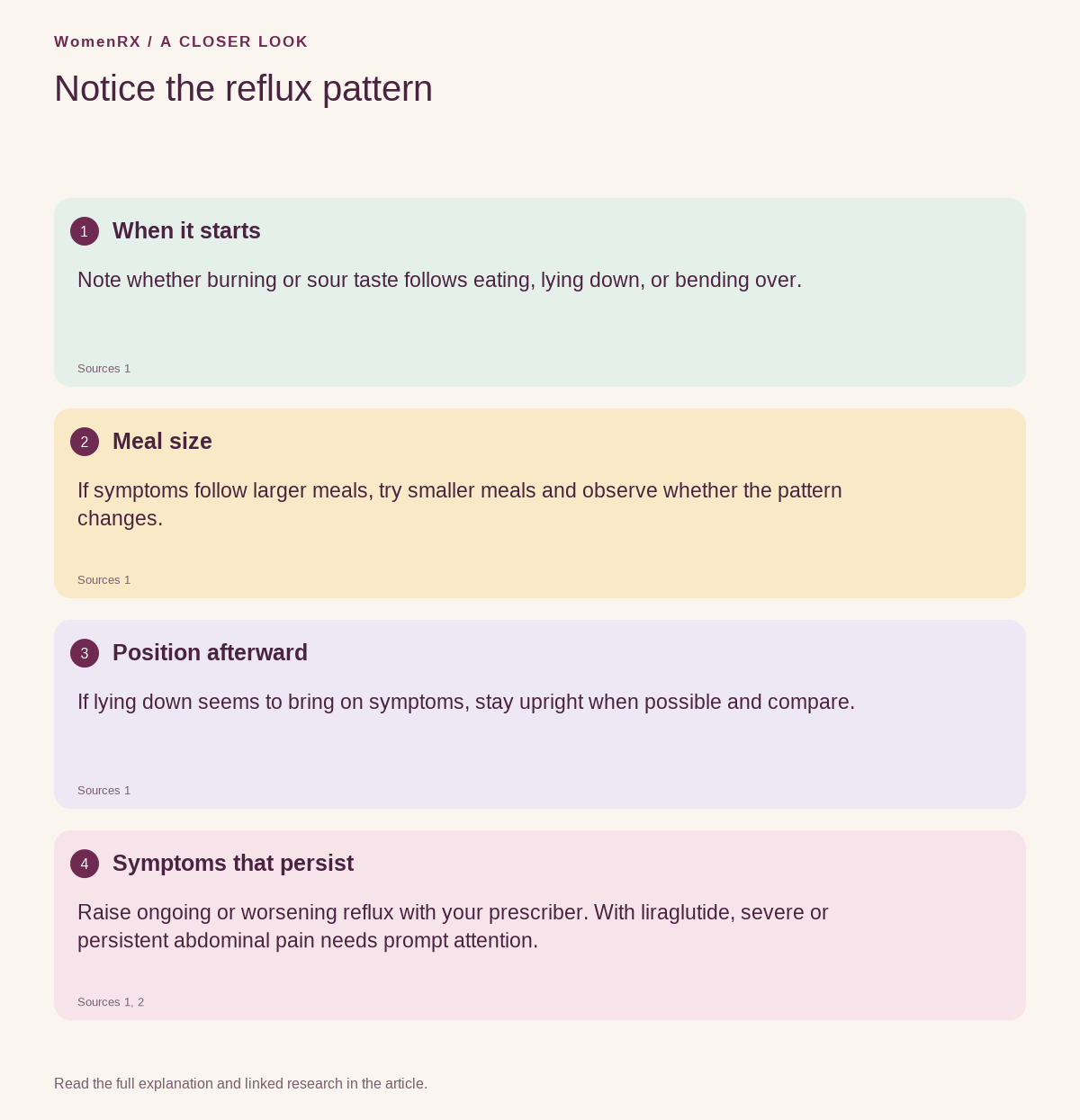
Notice the reflux pattern
When it starts: Note whether burning or sour taste follows eating, lying down, or bending over.1
Meal size: If symptoms follow larger meals, try smaller meals and observe whether the pattern changes.1
Position afterward: If lying down seems to bring on symptoms, stay upright when possible and compare.1
Symptoms that persist: Raise ongoing or worsening reflux with your prescriber. With liraglutide, severe or persistent abdominal pain needs prompt attention.12
Read the figure as text
Use these prompts to see whether symptoms cluster around meals or position and to recognize when routine self-care is not enough.- When it starts: Note whether burning or sour taste follows eating, lying down, or bending over.1
- Meal size: If symptoms follow larger meals, try smaller meals and observe whether the pattern changes.1
- Position afterward: If lying down seems to bring on symptoms, stay upright when possible and compare.1
- Symptoms that persist: Raise ongoing or worsening reflux with your prescriber. With liraglutide, severe or persistent abdominal pain needs prompt attention.12
More questions, answered
Does reflux mean the medicine has slowed my stomach too much?
Not necessarily. GLP-1 medicines can affect stomach emptying, but reflux symptoms alone do not establish delayed gastric emptying or identify the cause of your symptoms. Persistent or worsening symptoms are worth discussing with your prescriber. 4 5
Sources you can check
- Heartburn and acid reflux - NHSAccessed 2026-09-25Return to first citation
- SAXENDA (LIRAGLUTIDE) INJECTION, SOLUTION [NOVO NORDISK PHARMACEUTICAL INDUSTRIES, LP] | US prescribing information and patient instructionsAccessed 2026-09-25Return to first citation
- Glucagon-Like Peptide-1 Receptor Agonists and Gastrointestinal Adverse Events: A Systematic Review and Meta-Analysis.Chiang CH, Jaroenlapnopparat A, Colak SC, Yu CC, Xanthavanij N, Wang TH, See XY, Lo SW, Ko A, Chang YC, Song J, Hsia YP, Chiang CH. · Gastroenterology · 2025Return to first citation
- Review Article: The Evolving Role of GLP-1 Receptor Agonists in Gastroenterology Practice.Pomenti S, Gerber A, Katzka D, Camilleri M, Hur C. · Alimentary pharmacology & therapeutics · 2026Return to first citation
- A Scoping Review of GLP-1 Receptor Agonists: Are They Associated with Increased Gastric Contents, Regurgitation, and Aspiration Events?Chang MG, Ripoll JG, Lopez E, Krishnan K, Bittner EA. · Journal of clinical medicine · 2024Return to first citation