GLP-1 Medicines and Gallbladder Disease: What the Evidence Shows
Trials point to a real but generally small increase in gallstone risk, while weight loss and limited sex-specific reporting complicate what that means for any one person.
Randomized trials link GLP-1 medicines with more gallstones and related gallbladder or biliary events. One recent analysis estimated about 2 additional cases of gallstones per 1,000 people compared with placebo. That pooled estimate isn’t a prediction for an individual; other reviews report differing relative risks across trial settings, doses, and durations. The available summaries don’t show whether women or people with pregnancy or postpartum history face different treatment-related risks. 3 4 5
The short answer is yes: randomized trials suggest GLP-1 medicines are associated with a higher chance of gallstones and some gallbladder or biliary problems. The increase is small in absolute terms in one recent analysis, but it is worth understanding, especially if you’re having upper abdominal pain. The evidence does not tell us whether a gallbladder event in one person was caused by the medicine, by weight loss, or by other factors. 3 4
A relative increase can still mean a small absolute change
A 2025 review of 55 placebo-controlled trials, with 106,395 participants, found a higher relative risk of gallstones among people taking GLP-1 receptor agonists. Its estimate was about 2 additional cases per 1,000 people compared with placebo. That’s a pooled estimate across trials, not a prediction for an individual or a guarantee that every treatment setting carries the same risk. The review found that the increase was more pronounced in some subgroups, including trials of medicines used for weight loss and higher-dose formulations, but those subgroup differences were not statistically significant. 4
A separate 2022 review of 76 randomized trials found a higher risk of the combined outcome of gallbladder or biliary disease. In trials for weight loss, the relative risk for that combined outcome was higher than in trials for diabetes or other conditions. The result is a relative comparison, not an absolute count of extra events, and it doesn’t show how much of the difference came from the medicine itself versus weight loss. 3
These reviews aren’t identical: they examined different trial sets and outcomes. One found an increase in gallstones but probably little or no effect on several other biliary events; the other found increases in a broader combined outcome, including gallstones and gallbladder inflammation. That makes the evidence strongest for a gallstone association, while estimates for other specific complications are less consistent. 3 4
The medicine, weight loss, or both?
Trials of weight-management strategies, including pharmacotherapy and bariatric surgery, found an association with increased gallbladder and biliary events. These findings make weight loss a possible contributor to the signal seen with GLP-1 medicines, but they don’t isolate how much weight loss itself contributed or separate its effects from those of a specific medication. It would be too certain to say that either one explains an individual case. 5
The trial evidence also suggests that the association may vary with treatment context. In the 2022 review, higher-dose and longer-duration treatment groups had higher relative risks than lower-dose and shorter-duration groups. Those comparisons describe patterns across trials; they don’t establish a particular dose or length of treatment as safe or unsafe for you. 3
A gallstone found while someone is taking a GLP-1 medicine doesn’t, by itself, prove the medicine caused it. The studies compare groups, not the cause of each person’s event. Existing gallbladder history and other personal health factors matter to an individual discussion, but these studies don’t quantify how those factors change the medicine-related risk.
What this evidence says about women
Women were included in the 2022 trial review: they made up 40.5% of participants. But the review summary reports the overall results, not separate gallbladder risk estimates for women and men. That means the evidence supports a risk association in the combined study populations, not a precise women-specific estimate. 3
The trial summaries also don’t provide pregnancy- or postpartum-specific estimates. If pregnancy or recent postpartum history is relevant to you, it’s reasonable to include it in a conversation about your personal gallbladder history and treatment choices, without assuming these studies establish how it changes risk.
Which symptoms deserve attention?
A medication guide for liraglutide names upper-stomach pain as a possible gallbladder-problem symptom and advises telling the prescriber right away if it occurs. Suspected gallstones may warrant gallbladder evaluation and follow-up. 2
Pain alone can’t tell you whether the cause is a gallstone, another digestive problem, or something else. Severe or persistent abdominal pain also appears in liraglutide labeling as a possible sign of pancreatitis, sometimes with pain radiating to the back and with or without nausea or vomiting. That’s a different concern, but it’s another reason not to dismiss significant abdominal pain as an expected medication effect. 1
If you’re weighing treatment, the useful question isn’t simply whether gallbladder risk exists. It’s how the trial-level increase fits with your treatment goals, weight-loss plan, and personal history, and what symptoms your prescriber wants you to report promptly.
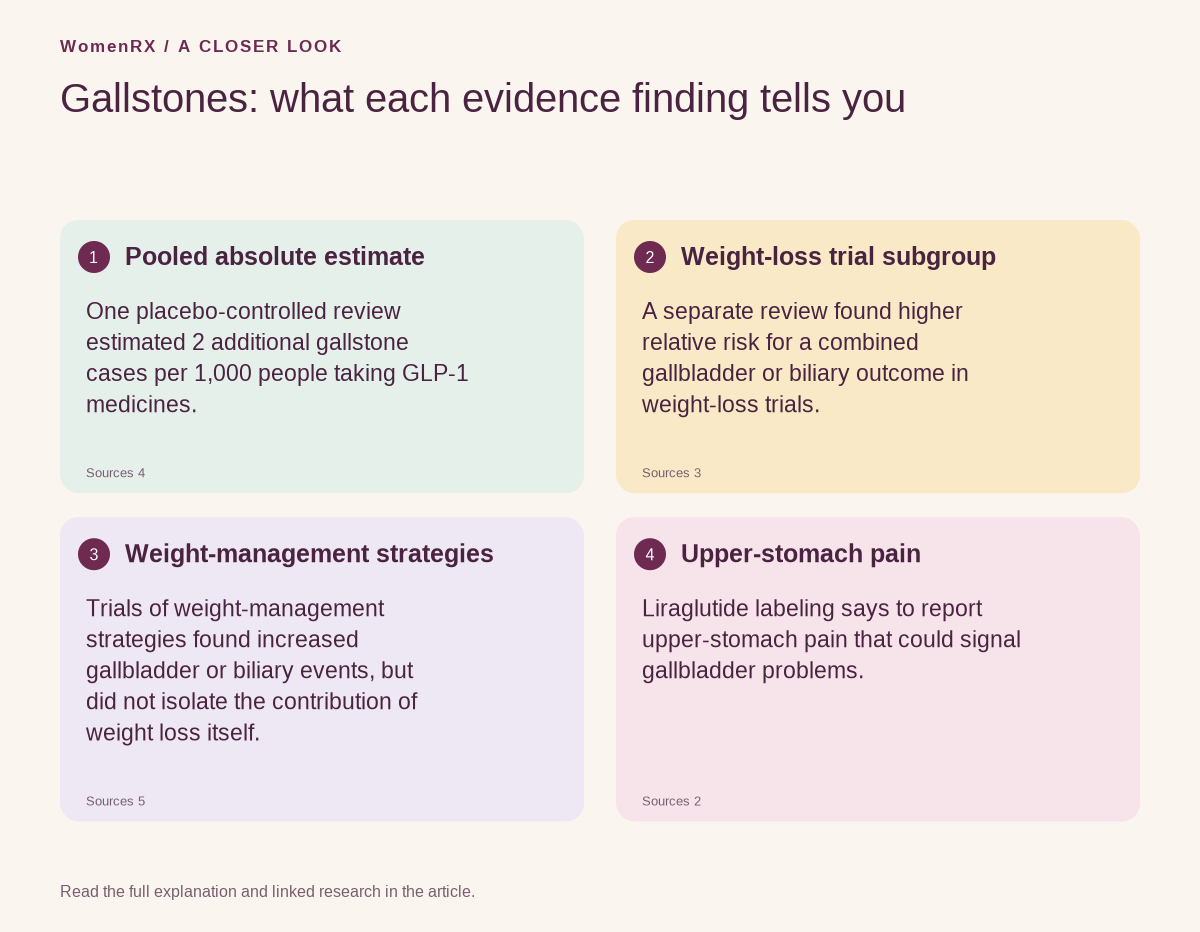
Gallstones: what each evidence finding tells you
Pooled absolute estimate: One placebo-controlled review estimated 2 additional gallstone cases per 1,000 people taking GLP-1 medicines.4
Weight-loss trial subgroup: A separate review found higher relative risk for a combined gallbladder or biliary outcome in weight-loss trials.3
Weight-management strategies: Trials of weight-management strategies found increased gallbladder or biliary events, but did not isolate the contribution of weight loss itself.5
Upper-stomach pain: Liraglutide labeling says to report upper-stomach pain that could signal gallbladder problems.2
Read the figure as text
These findings describe different comparisons and outcomes, so they shouldn’t be read as one universal risk estimate.- Pooled absolute estimate: One placebo-controlled review estimated 2 additional gallstone cases per 1,000 people taking GLP-1 medicines.4
- Weight-loss trial subgroup: A separate review found higher relative risk for a combined gallbladder or biliary outcome in weight-loss trials.3
- Weight-management strategies: Trials of weight-management strategies found increased gallbladder or biliary events, but did not isolate the contribution of weight loss itself.5
- Upper-stomach pain: Liraglutide labeling says to report upper-stomach pain that could signal gallbladder problems.2
More questions, answered
Does a gallstone mean the GLP-1 medicine caused it?
No. Trials show a higher average risk among treated groups, but they can’t establish what caused an individual person’s gallstone. Weight-management strategies are also associated with gallbladder events, but the findings don’t isolate the contribution of weight loss itself. 3 5
Do the studies show that women have a higher medication-related risk?
The 2022 trial review included women, but its reported results don’t provide separate gallbladder risk estimates by sex. It therefore can’t establish a women-specific difference. 3
Sources you can check
- SAXENDA (LIRAGLUTIDE) INJECTION, SOLUTION [NOVO NORDISK PHARMACEUTICAL INDUSTRIES, LP] | US prescribing information and patient instructionsAccessed 2026-09-25Return to first citation
- VICTOZA (LIRAGLUTIDE) INJECTION [NOVO NORDISK] | US prescribing information and patient instructionsAccessed 2026-09-25Return to first citation
- Association of Glucagon-Like Peptide-1 Receptor Agonist Use With Risk of Gallbladder and Biliary Diseases: A Systematic Review and Meta-analysis of Randomized Clinical Trials.He L, Wang J, Ping F, Yang N, Huang J, Li Y, Xu L, Li W, Zhang H. · JAMA internal medicine · 2022Return to first citation
- Glucagon-Like Peptide-1 Receptor Agonists and Gastrointestinal Adverse Events: A Systematic Review and Meta-Analysis.Chiang CH, Jaroenlapnopparat A, Colak SC, Yu CC, Xanthavanij N, Wang TH, See XY, Lo SW, Ko A, Chang YC, Song J, Hsia YP, Chiang CH. · Gastroenterology · 2025Return to first citation
- Weight reduction and the risk of gallbladder and biliary disease: A systematic review and meta-analysis of randomized clinical trials.Yang W, Wu H, Cai X, Lin C, Luo Y, Hu S, Li Z, Jiao R, Bai S, Liu G, Yang X, Ji L. · Obesity reviews : an official journal of the International Association for the Study of Obesity · 2024Return to first citation