GLP-1 Medicines and Gallbladder Symptoms: What to Watch For
Gallbladder problems are uncommon, but new upper-abdominal pain during weight-loss treatment deserves attention.
GLP-1 medicines are associated with more gallbladder problems in clinical trials, and substantial or rapid weight loss can raise gallstone risk too. You can’t tell which factor explains an individual case. If you develop upper-abdominal pain, especially with fever, yellowing of your skin or eyes, or pale stools, contact your clinician right away for assessment rather than assuming it’s a routine stomach side effect. 34
The medicine and the weight loss both matter
If you’re starting a GLP-1 medicine, the useful distinction is this: losing a substantial amount of weight quickly can increase the chance of gallstones, but weight loss doesn’t appear to explain every gallbladder event seen during treatment. In adult weight-reduction trials of Wegovy (semaglutide) injection, gallstones were reported in 1.6% of treated participants versus 0.7% receiving placebo. Gallbladder inflammation, called cholecystitis, was reported in 0.6% versus 0.2%. The prescribing information says acute gallbladder disease remained more frequent with Wegovy even after accounting for the degree of weight loss. 3
The pattern isn’t identical for every medicine or every outcome. In two weight-reduction trials pooled for Zepbound (tirzepatide), gallstones were reported in 1.1% of treated participants versus 1% receiving placebo, while cholecystitis was reported in 0.7% versus 0.2%. Acute gallbladder events were associated with weight reduction in those trials. These figures describe different studies, not a head-to-head test of semaglutide against tirzepatide. They can help you understand the size of the reported risk, but they can’t predict what will happen to you. 4
Why might both treatment and weight loss matter? Gallstones can form when the makeup of bile changes or bile sits in the gallbladder longer. Rapid weight loss is one contributor. Researchers have also proposed that GLP-1 medicines may affect gallbladder movement, but the exact mechanisms haven’t been settled. That’s why a new symptom needs assessment, not a guess about whether the medicine or the weight loss caused it. 1
When stomach pain isn’t something to wait out
Nausea and other digestive symptoms can occur during treatment, which makes it tempting to dismiss abdominal pain as more of the same. But pain in the upper abdomen can be a sign of a gallbladder problem. The Zepbound patient information says to contact your healthcare provider right away if you develop upper-abdominal pain, fever, yellowing of the skin or eyes, or clay-colored stools. Gallbladder inflammation can cause severe pain and tenderness in the upper right abdomen, sometimes with fever. These symptoms call for prompt assessment, not a wait-and-see approach until your next routine visit. 341
Severe abdominal pain that won’t go away, sometimes reaching the back and with or without nausea or vomiting, is also a warning symptom of pancreatitis, a different condition that needs prompt medical attention. You don’t need to identify the cause yourself before seeking help. Tell the care team which medicine you take and describe where the pain is and whether you have fever, yellowing, or a change in stool color. 34
What can you do before symptoms appear?
Know the warning symptoms before you need to make a decision about them. If gallstones or gallbladder inflammation are suspected, clinical evaluation may include gallbladder studies and follow-up. That is a decision to make with your care team, not a reason to arrange testing on your own when you feel well. 34
It’s reasonable to ask how your treatment plan accounts for weight loss and gallbladder concerns, particularly if you’ve had gallbladder problems before. Being alert isn’t the same as expecting a problem: in the trials above, most participants did not report these events. What matters is not writing off a new pattern of upper-abdominal pain because digestive side effects are familiar. 34
What do the findings tell women?
Women were well represented in the cited Wegovy injection weight-reduction trials: 71% of treated participants were female. The gallbladder percentages reported here, however, are for the trial groups overall, not a separate estimate for women. A retrospective study comparing GLP-1 medicines with another class of diabetes medicines likewise reports overall gallbladder outcomes, not a women-specific estimate. These findings support taking symptoms seriously, but they don’t tell an individual woman her personal likelihood of developing gallbladder disease. 32
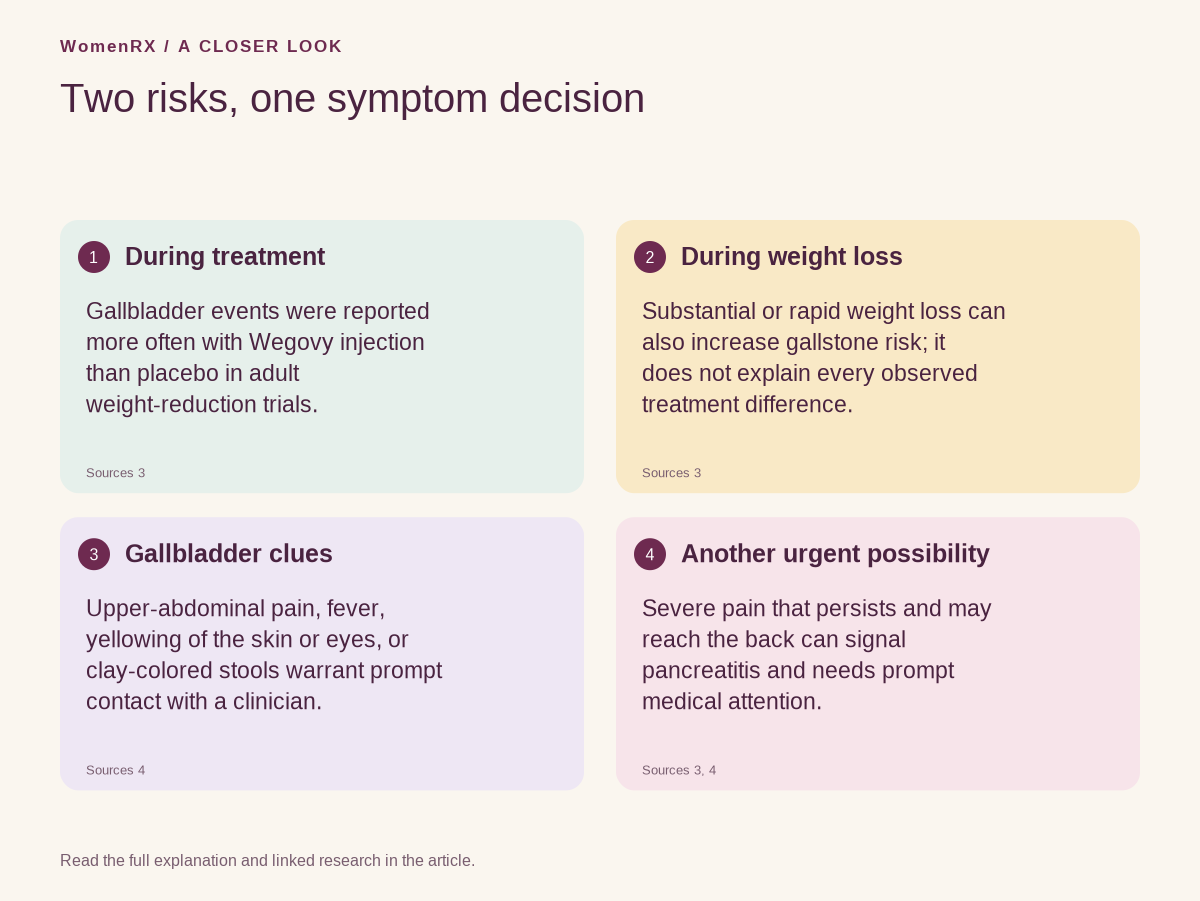
Two risks, one symptom decision
During treatment: Gallbladder events were reported more often with Wegovy injection than placebo in adult weight-reduction trials.3
During weight loss: Substantial or rapid weight loss can also increase gallstone risk; it does not explain every observed treatment difference.3
Gallbladder clues: Upper-abdominal pain, fever, yellowing of the skin or eyes, or clay-colored stools warrant prompt contact with a clinician.4
Another urgent possibility: Severe pain that persists and may reach the back can signal pancreatitis and needs prompt medical attention.34
Read the figure as text
The evidence separates what trials observed from the symptoms that call for assessment.- During treatment: Gallbladder events were reported more often with Wegovy injection than placebo in adult weight-reduction trials.3
- During weight loss: Substantial or rapid weight loss can also increase gallstone risk; it does not explain every observed treatment difference.3
- Gallbladder clues: Upper-abdominal pain, fever, yellowing of the skin or eyes, or clay-colored stools warrant prompt contact with a clinician.4
- Another urgent possibility: Severe pain that persists and may reach the back can signal pancreatitis and needs prompt medical attention.34
Sources you can check
- GLP-1 receptor agonists and gallbladder disease risk: insights into molecular mechanisms and clinical implications.Ramírez-Mejía MM, Ponciano-Rodriguez G, Eslam M, Méndez-Sánchez N. · Therapeutic advances in endocrinology and metabolism · 2025Return to first citation
- A retrospective cohort study on the comparative safety of glucagon-like peptide-1 receptor agonists versus dipeptidyl peptidase-4 inhibitors on the onset of gallbladder disease in type II diabetes.Carlson K, Kaur J, Gaber CE, Reutrakul S, Kim K. · Current medical research and opinion · 2026Return to first citation
- WEGOVY (SEMAGLUTIDE) INJECTION, SOLUTION WEGOVY (SEMAGLUTIDE) TABLET [NOVO NORDISK PHARMACEUTICAL INDUSTRIES, LP] | US prescribing information and patient instructionsAccessed 2026-09-25Return to first citation
- ZEPBOUND (TIRZEPATIDE) INJECTION, SOLUTION ZEPBOUND (TIRZEPATIDE) INJECTION, SOLUTION ZEPBOUND KWIKPEN (TIRZEPATIDE) INJECTION, SOLUTION [ELI LILLY AND COMPANY] | US prescribing information and patient instructionsAccessed 2026-09-25Return to first citation