Tirzepatide, Weight Loss, and Gallbladder Symptoms
Gallbladder problems have been reported during tirzepatide treatment, but the medicine and the weight lost during treatment are not the same possible explanation.
Tirzepatide treatment is associated with gallbladder problems, though that doesn’t mean the medicine directly caused every gallstone. In weight-loss trials, gallbladder inflammation was reported more often with Zepbound than with placebo, and acute gallbladder events were associated with weight reduction. New abdominal pain, especially with nausea or vomiting, deserves assessment rather than an assumption that it’s an ordinary medication side effect.12
What the trials show, and what they don’t
Gallstones can form without causing symptoms. Trouble can start when a stone blocks a bile duct, causing abdominal pain that may come with nausea or vomiting. A blockage can sometimes lead to gallbladder or pancreatic inflammation or jaundice.1
In two pooled Zepbound trials for weight reduction, gallstones were reported in 1.1% of people receiving tirzepatide and 1% receiving placebo. Gallbladder inflammation, called cholecystitis, was reported in 0.7% and 0.2%, respectively. These are the proportions of people in those trial groups who reported each event, not a prediction of what will happen to any one person.2
The distinction matters: the gallstone numbers were close, while gallbladder inflammation was reported more often in the tirzepatide groups. The prescribing information also says acute gallbladder events were associated with weight reduction. Those findings establish a reason to take symptoms seriously, but they don’t separate a possible effect of medication exposure from the effect of losing weight during treatment.2
Why weight change belongs in the conversation
Rapid weight loss is itself a recognized gallstone risk factor, including after weight-loss surgery. That surgical setting isn’t interchangeable with taking tirzepatide, but it helps explain why a new gallbladder finding shouldn’t automatically be attributed to one cause.13
For example, if abdominal pain begins after substantial weight loss on tirzepatide, two facts matter: you’ve been exposed to the medicine, and your weight has changed. The Zepbound trial findings connect acute gallbladder events with weight reduction, but the cited trial discussion doesn’t provide a pace-of-weight-loss threshold that could tell you whether your own weight change is the cause.2
Your starting point matters too. Diabetes and rapid weight loss are recognized gallstone risk factors. Hormones also influence gallstone formation: estrogen can promote cholesterol accumulation in bile, while progesterone can slow gallbladder emptying. That is context for a woman’s gallstone risk, not evidence that tirzepatide has a uniquely female gallbladder effect.14
If you’ve previously had gallstones, including stones discovered during pregnancy, say so when describing a new episode of pain. A past finding helps distinguish a known gallbladder problem from a new one; it doesn’t establish what caused either episode. Also describe roughly when the pain began relative to treatment and weight change. Those details help put the symptoms in context, but an examination and tests, rather than the timeline alone, are what can identify a gallbladder problem.12
Pain that needs more than a side-effect explanation
Tirzepatide can cause gastrointestinal symptoms, sometimes severe. That makes it tempting to label any new stomach pain as a medication effect. But gallstones can also cause abdominal pain with nausea or vomiting, so symptoms that are new, significant, or keep returning should be assessed rather than watched indefinitely. If gallbladder inflammation is suspected, Zepbound’s prescribing information calls for diagnostic studies and clinical follow-up.12
If abdominal pain comes with yellowing of the eyes or skin, dark urine, or unusually pale stools, seek medical assessment. These can be signs of jaundice from a bile-duct blockage. Gallstones can also cause inflammation of the gallbladder or pancreas.1
Evaluation may include an ultrasound and blood tests. If a scan finds gallstones but you have no symptoms, treatment may not be needed. Symptomatic stones, complications, or a stone in the common bile duct are different situations that may require treatment.1
The useful question isn’t simply, “Did tirzepatide cause this?” It’s, “Could this pain be coming from my gallbladder, and what do the symptoms and tests show?” Medication exposure, weight change, and any earlier gallstones all belong in that conversation. None is a reason to dismiss warning symptoms.12
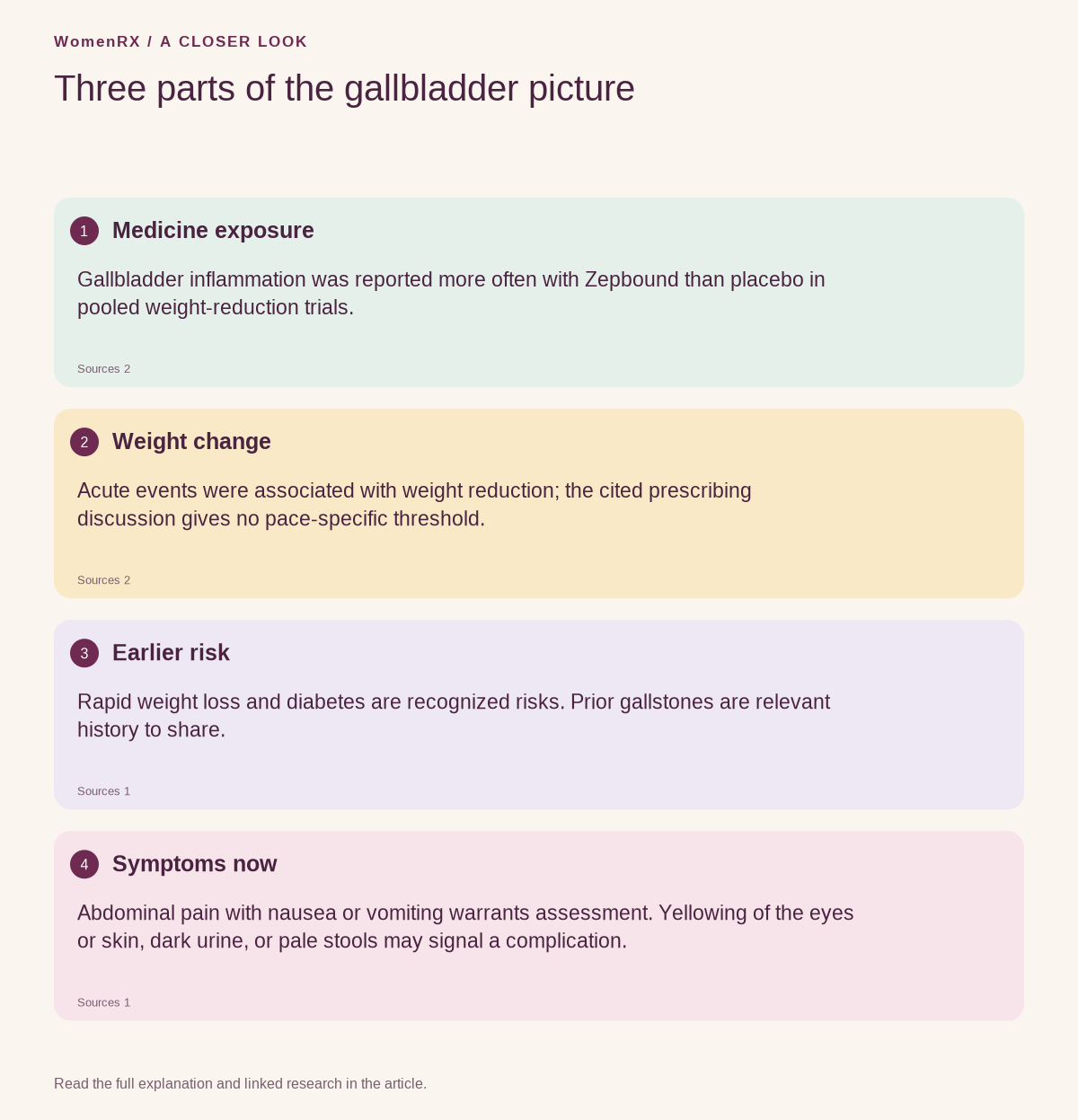
Three parts of the gallbladder picture
Medicine exposure: Gallbladder inflammation was reported more often with Zepbound than placebo in pooled weight-reduction trials.2
Weight change: Acute events were associated with weight reduction; the cited prescribing discussion gives no pace-specific threshold.2
Earlier risk: Rapid weight loss and diabetes are recognized risks. Prior gallstones are relevant history to share.1
Symptoms now: Abdominal pain with nausea or vomiting warrants assessment. Yellowing of the eyes or skin, dark urine, or pale stools may signal a complication.1
Read the figure as text
A gallbladder finding during tirzepatide treatment needs both a cause-and-symptom view; these factors are related but not interchangeable.- Medicine exposure: Gallbladder inflammation was reported more often with Zepbound than placebo in pooled weight-reduction trials.2
- Weight change: Acute events were associated with weight reduction; the cited prescribing discussion gives no pace-specific threshold.2
- Earlier risk: Rapid weight loss and diabetes are recognized risks. Prior gallstones are relevant history to share.1
- Symptoms now: Abdominal pain with nausea or vomiting warrants assessment. Yellowing of the eyes or skin, dark urine, or pale stools may signal a complication.1
More questions, answered
Does finding a gallstone mean I have to stop tirzepatide?
A gallstone finding alone doesn’t settle the medication decision. Stones found by chance may cause no symptoms, while pain or signs of a complication call for evaluation.1 If gallbladder disease is suspected, Zepbound’s prescribing information calls for diagnostic studies and follow-up.2 Discuss whether to continue tirzepatide with your prescriber in light of your symptoms and test results.
Sources you can check
- Gallstones - NHSAccessed 2026-09-25Return to first citation
- ZEPBOUND (TIRZEPATIDE) INJECTION, SOLUTION ZEPBOUND (TIRZEPATIDE) INJECTION, SOLUTION ZEPBOUND KWIKPEN (TIRZEPATIDE) INJECTION, SOLUTION [ELI LILLY AND COMPANY] | US prescribing information and patient instructionsAccessed 2026-09-25Return to first citation
- Efficacy of prophylactic ursodeoxycholic acid in preventing gallstone formation after metabolic bariatric surgery: an updated systematic review and meta-analysis of randomized controlled trials.Alrubaiaan A, Altunaib F, AlMutairi SA, AlFadhly N, AlKandari AF. · BMC surgery · 2026Return to first citation
- Advancements in Cholelithiasis Diagnosis: A Systematic Review of Machine Learning Applications in Imaging Analysis.Ahmed AS, Ahmed SS, Mohamed S, Salman NE, Humidan AAM, Ibrahim RF, Salim RS, Mohamed Elamir AA, Hakim EM. · Cureus · 2024Return to first citation