Tirzepatide Weight Loss: What the Timeline Really Shows
Early scale changes can’t predict your final result: trial evidence follows people through gradual dose increases and up to 72 weeks of treatment.
In trials, tirzepatide was started at a lower dose and increased gradually, so the first weeks aren’t a preview of the full treatment response. A post hoc analysis found clinically meaningful weight reduction by week 72 in the group that had lost less than 5% by week 8, though its average loss was smaller than the early-response group’s. These are group findings, not a women-specific forecast. 2
The first weeks are a starting point, not a verdict
Tirzepatide’s weight-loss effect is studied over months, not judged by a single weigh-in. In the SURMOUNT-1 and SURMOUNT-2 trials, participants began at 2.5 mg once weekly, with the dose increased every four weeks until they reached their assigned study dose. That gradual build-up means the first weeks include time at lower doses; they aren’t a fair stand-in for the whole treatment period. This describes the trial design, not a personal dosing plan. 2
Scale weight also includes water, muscle, and bone, not only body fat. Everyday factors can affect the number, so a short-term change doesn’t tell you by itself how much fat has changed. 1
Week 8 offers context, not a pass-or-fail test
A post hoc analysis grouped participants by whether they had lost at least 5% of their starting weight by week 8. At that point, participants had received 5 mg for four weeks; they would continue toward their assigned study dose when applicable. People who met that early-response threshold were more likely to be women, but that finding doesn’t mean the study established a separate expected timeline or outcome for women. 2
The useful reassurance is that slower early loss didn’t equal no later benefit at the group level. By week 72, both the early- and non-early-response groups showed clinically meaningful weight reduction. Early responders had greater average reductions, but the analysis didn’t say that everyone in either group followed the same curve. 2
So if your weight is changing slowly in the first several weeks, that alone can’t tell you where you’ll end up. The week-8 grouping is a way researchers compared trial participants after a defined period. It isn’t a promise, a deadline, or a reason to change your treatment on your own.
Months of treatment tell a different story
The 72-week results show why it helps to think in terms of a longer treatment course. At week 72, the analysis found greater weight reduction in the early-response group than in the non-early-response group. It does not support drawing a straight line from your first few weeks to a predicted final number. 2
The trial populations also matter: SURMOUNT-1 enrolled people with overweight or obesity without type 2 diabetes, while SURMOUNT-2 enrolled people with type 2 diabetes who had overweight or obesity. The post hoc analysis combined participants from both trials. Your health circumstances, treatment experience, and ability to continue treatment may differ from theirs. 2
What women-specific evidence can and can’t say
Women were represented in the trials, and women were more common among early responders in the post hoc analysis. But the reported finding is about who was more likely to meet the early-response threshold, not a comparison of women’s expected weight loss at each time point. The reported findings do not give a women-specific timeline or results by age or reproductive stage. 2
A weigh-in can reflect water as well as fat, but the trial analysis doesn’t provide a menstrual-cycle-specific adjustment. It’s reasonable to avoid treating one short-term scale change as a precise measure of treatment response; the available figures can’t tell you whether a particular fluctuation is due to your cycle or something else. 12
A more useful way to read your own trend
If you’re tracking your progress, put the number in context rather than asking one weigh-in to answer everything. You might note the date, the stage of treatment, and whether there was a pause or missed dose. Then look at the broader pattern over time. That won’t produce a guaranteed prediction, but it can make a conversation about whether your results match your goals more specific.
One more boundary: a 72-week result while participants are in a trial is not the same thing as a result after treatment stops. These findings describe weight change during the study period; they don’t establish how long an individual’s weight change will last after stopping treatment.
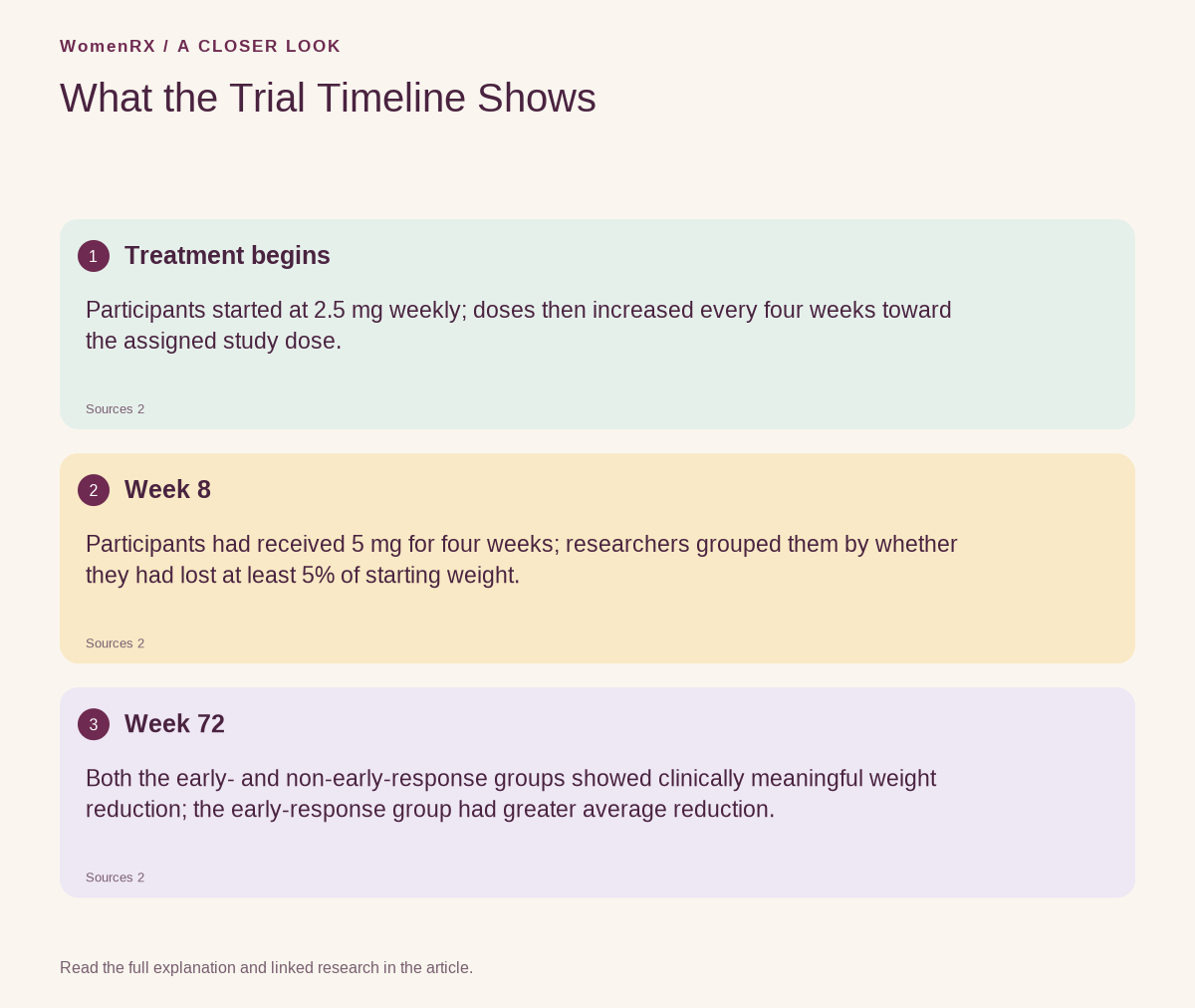
What the Trial Timeline Shows
Treatment begins: Participants started at 2.5 mg weekly; doses then increased every four weeks toward the assigned study dose.2
Week 8: Participants had received 5 mg for four weeks; researchers grouped them by whether they had lost at least 5% of starting weight.2
Week 72: Both the early- and non-early-response groups showed clinically meaningful weight reduction; the early-response group had greater average reduction.2
Read the figure as text
These points mark the trial’s treatment phases and reported assessment points. They describe study averages and group comparisons, not a guaranteed personal schedule.- Treatment begins: Participants started at 2.5 mg weekly; doses then increased every four weeks toward the assigned study dose.2
- Week 8: Participants had received 5 mg for four weeks; researchers grouped them by whether they had lost at least 5% of starting weight.2
- Week 72: Both the early- and non-early-response groups showed clinically meaningful weight reduction; the early-response group had greater average reduction.2
More questions, answered
Does losing less than 5% by week 8 mean tirzepatide won’t work for me?
Not necessarily. In a post hoc analysis of SURMOUNT-1 and SURMOUNT-2, the group that had lost less than 5% by week 8 showed clinically meaningful weight reduction by week 72, although its average loss was smaller than the early-response group’s. That group result can’t predict your individual outcome. 2
Can a menstrual-cycle change explain a short-term scale fluctuation?
A scale reading reflects water as well as fat, but the trial analysis doesn’t report results by menstrual-cycle phase. It can’t identify the cause of a particular fluctuation. 12
Sources you can check
- Body Weight: MedlinePlusAccessed 2026-09-25Return to first citation
- Tirzepatide Efficacy and Tolerability According to Early Weight Response: A Post Hoc Analysis of the SURMOUNT-1 and SURMOUNT-2 Trials.Kokkinos A, Thethi T, Lee CJ, Neff LM, Stefanski A, Cao D, Rodriguez A, Bartee A. · Diabetes, obesity & metabolism · 2026Return to first citation