Tirzepatide, Weight Loss, and Gallstones: What’s the Link?
Gallbladder problems have been reported with tirzepatide, and rapid weight loss is another reason to take new upper abdominal pain seriously.
Gallstones and other gallbladder problems can occur during tirzepatide treatment, but a pain episode doesn’t prove the medicine caused a stone. Rapid weight loss is itself a gallstone risk factor, and tirzepatide trials have reported gallbladder events. If you develop upper abdominal pain, especially with fever or yellowing of your skin or eyes, seek prompt medical assessment rather than assuming it’s a routine stomach side effect. 12
Two possible links, not one simple cause
If you’re losing weight on tirzepatide and feel pain high in your abdomen, there are two connections worth understanding. First, rapid weight loss is a recognized gallstone risk factor, but this evidence does not separate its contribution from a possible medication effect. Second, gallbladder events have been reported among people taking the medicine. An event happening during treatment does not, by itself, show whether the medicine, the weight loss, or another factor was responsible. 12
Gallstones are small stones that form in the gallbladder. Many cause no symptoms. Pain can occur when a stone blocks a bile duct, a passage that carries bile from the gallbladder. A blockage can sometimes lead to inflammation of the gallbladder or pancreas. That’s why new upper abdominal pain deserves attention rather than an automatic explanation of “just a side effect.” 1
What tirzepatide studies actually show
In pooled placebo-controlled Mounjaro trials in adults, acute gallbladder disease was reported in 0.6% of tirzepatide-treated participants and 0% of placebo-treated participants. The reported category included gallstones, biliary colic, and gallbladder removal; 0.6% is not a gallstones-only rate. These are observed event rates, not a test of whether tirzepatide directly formed stones in each person. 2
A 2023 review combined nine randomized trials involving 9,871 people with type 2 diabetes or obesity. It found an increased combined risk of gallbladder or biliary disease with tirzepatide compared with placebo or basal insulin, but did not find a statistically significant increase for gallstones considered separately. The combined outcome covered several kinds of gallbladder and bile-duct problems, so it shouldn’t be described as a finding about gallstones alone. 3
Not every analysis reaches the same result. A 2025 review of trials in people with obesity without diabetes found no statistically significant biliary risk for tirzepatide versus placebo. The reviews studied different populations and comparisons, and gallbladder events are uncommon. Taken together, they support taking symptoms seriously, not telling any one person that tirzepatide definitely caused a stone or that gallbladder problems cannot happen. 34
When pain needs assessment
Tirzepatide can also cause gastrointestinal symptoms that aren’t gallstones, including abdominal pain, nausea, diarrhea, and vomiting. Pain alone can’t reliably tell you which problem is occurring. 15
Contact a care team promptly about new pain in the upper abdomen while taking tirzepatide. Fever, yellowing of the skin or eyes, or pale stools alongside that pain make assessment particularly urgent. Mounjaro’s prescribing information calls for gallbladder diagnostic studies and follow-up when gallstones are suspected. If the pain is severe or won’t go away, seek care rather than waiting to see whether it passes. 12
For example, nausea after a meal and a new episode of upper abdominal pain may happen together, but calling both a routine medicine effect could miss a gallbladder problem. The useful next step is an assessment of the pain, not a guess based on whether you’ve recently started treatment or how much weight you’ve lost. 125
What this means for women
Being a woman is listed among gallstone risk factors, as are being over 40, living with obesity, and losing weight quickly. That’s about baseline risk, not evidence that tirzepatide affects women differently. 1 The tirzepatide findings do not establish a different gallbladder effect in women or show how pregnancy history might change an individual’s risk. If your reproductive history seems relevant to you, you can mention it when the pain is assessed, but don’t use it to explain away new symptoms. 234
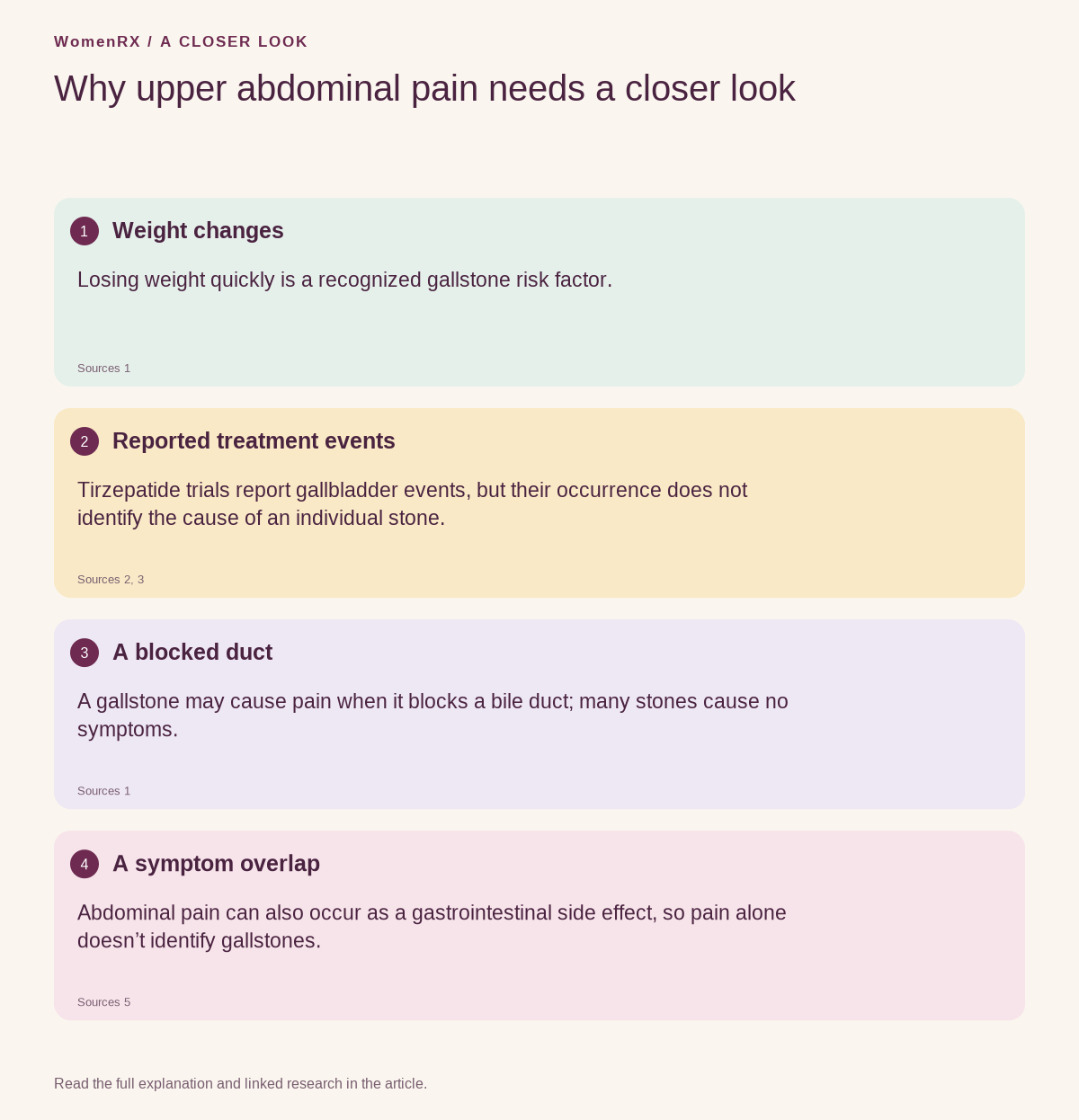
Why upper abdominal pain needs a closer look
Weight changes: Losing weight quickly is a recognized gallstone risk factor.1
Reported treatment events: Tirzepatide trials report gallbladder events, but their occurrence does not identify the cause of an individual stone.23
A blocked duct: A gallstone may cause pain when it blocks a bile duct; many stones cause no symptoms.1
A symptom overlap: Abdominal pain can also occur as a gastrointestinal side effect, so pain alone doesn’t identify gallstones.5
Read the figure as text
These connections explain why pain during tirzepatide treatment has more than one possible explanation.- Weight changes: Losing weight quickly is a recognized gallstone risk factor.1
- Reported treatment events: Tirzepatide trials report gallbladder events, but their occurrence does not identify the cause of an individual stone.23
- A blocked duct: A gallstone may cause pain when it blocks a bile duct; many stones cause no symptoms.1
- A symptom overlap: Abdominal pain can also occur as a gastrointestinal side effect, so pain alone doesn’t identify gallstones.5
More questions, answered
If a scan finds gallstones, will I need surgery?
Not necessarily. Gallstones that cause no symptoms may need no treatment. When they cause symptoms or complications, gallbladder removal is a common treatment; a stone in the common bile duct may require a procedure to clear the duct. The finding and your symptoms both matter. 1
Sources you can check
- Gallstones - NHSAccessed 2026-09-25Return to first citation
- MOUNJARO (TIRZEPATIDE) INJECTION, SOLUTION MOUNJARO KWIKPEN (TIRZEPATIDE) INJECTION, SOLUTION [ELI LILLY AND COMPANY] | US prescribing information and patient instructionsAccessed 2026-09-25Return to first citation
- Safety issues of tirzepatide (pancreatitis and gallbladder or biliary disease) in type 2 diabetes and obesity: a systematic review and meta-analysis.Zeng Q, Xu J, Mu X, Shi Y, Fan H, Li S. · Frontiers in endocrinology · 2023Return to first citation
- Gastrointestinal safety of semaglutide and tirzepatide vs. placebo in obese individuals without diabetes: a systematic review and meta analysis.Safwan M, Bourgleh MS, Alotaibi SA, Alotaibi E, Al-Ruqi A, El Raeya F. · Annals of Saudi medicine · 2025Return to first citation
- Tirzepatide: a medicine to manage type 2 diabetes and treat obesity - NHSAccessed 2026-09-25Return to first citation