Can Tirzepatide or Weight Loss Change Your Period?
A period change after starting tirzepatide is worth noticing, but its timing alone won’t tell you why it happened.
A late, missed, or newly regular period after starting tirzepatide doesn’t prove the medicine caused the change. Menstrual findings from studies of liraglutide and semaglutide can’t establish whether tirzepatide directly affects periods. 2 4 Weight and eating changes, an existing pattern of irregular cycles, and pregnancy are also worth considering. If pregnancy is possible, take a test rather than guessing from the timing.
First, compare the change with your usual pattern
Did you miss a period that’s usually predictable, or has an irregular cycle become more regular? Those are different changes. Write down what happened before deciding what it means: when you started tirzepatide, when your period was expected, and whether your eating or weight changed around the same time. A change that follows a new medicine is worth discussing, but the sequence alone can’t show what caused it.
The menstrual studies that offer some context investigated other medicines. In a 12-week randomized trial involving 60 women with overweight and polycystic ovary syndrome (PCOS), researchers compared liraglutide plus metformin with a hormonal medicine plus metformin. Menstrual-cycle measures improved in both groups. Because the trial did not study tirzepatide, it can’t tell us whether tirzepatide directly changes periods. 2
Weight change can be part of the picture, not the whole answer
PCOS can involve both irregular cycles and metabolic changes. In a separate six-month study of women with an ovarian syndrome involving irregular ovulation and excess body weight, 42 of the 80 participants who had anovulatory cycles before semaglutide treatment had normalized cycles and ovulation afterward. That finding doesn’t show whether the medicine, weight change, or other changes drove the result, and it doesn’t predict what will happen with tirzepatide. 4
Eating much less is another detail to mention if your periods become less predictable or stop. Energy deficiency can disrupt the hormonal signaling behind menstruation, although a review describing that link focused on adolescents, not adults taking tirzepatide. 3 A weight change on its own can’t explain your particular period change.
If you have PCOS, a more regular bleed may feel encouraging. It still doesn’t show that PCOS has resolved or confirm that you ovulated. In the semaglutide study, researchers assessed ovulation separately from menstrual-cycle characteristics. 4
Check pregnancy rather than ruling it out by timing
If pregnancy is possible and a period is late or missed, take a pregnancy test instead of assuming tirzepatide or weight loss explains it. Zepbound prescribing information says weight loss is not recommended during pregnancy and advises stopping Zepbound when pregnancy is recognized. If your test is positive, contact your prescriber promptly about next steps. 1
Bring the pattern, not a diagnosis
For a new or continuing change, a short note is more useful than trying to prove a cause. Record your usual cycle pattern and what’s different now; the dates you started tirzepatide and had any dose changes; substantial changes in eating or weight; any pregnancy-test result; and whether your cycles were irregular before treatment. If the change repeats, continues, or worries you, share that record with your prescriber. It gives you both a clearer starting point for considering pregnancy, PCOS, changes in intake, and other explanations.
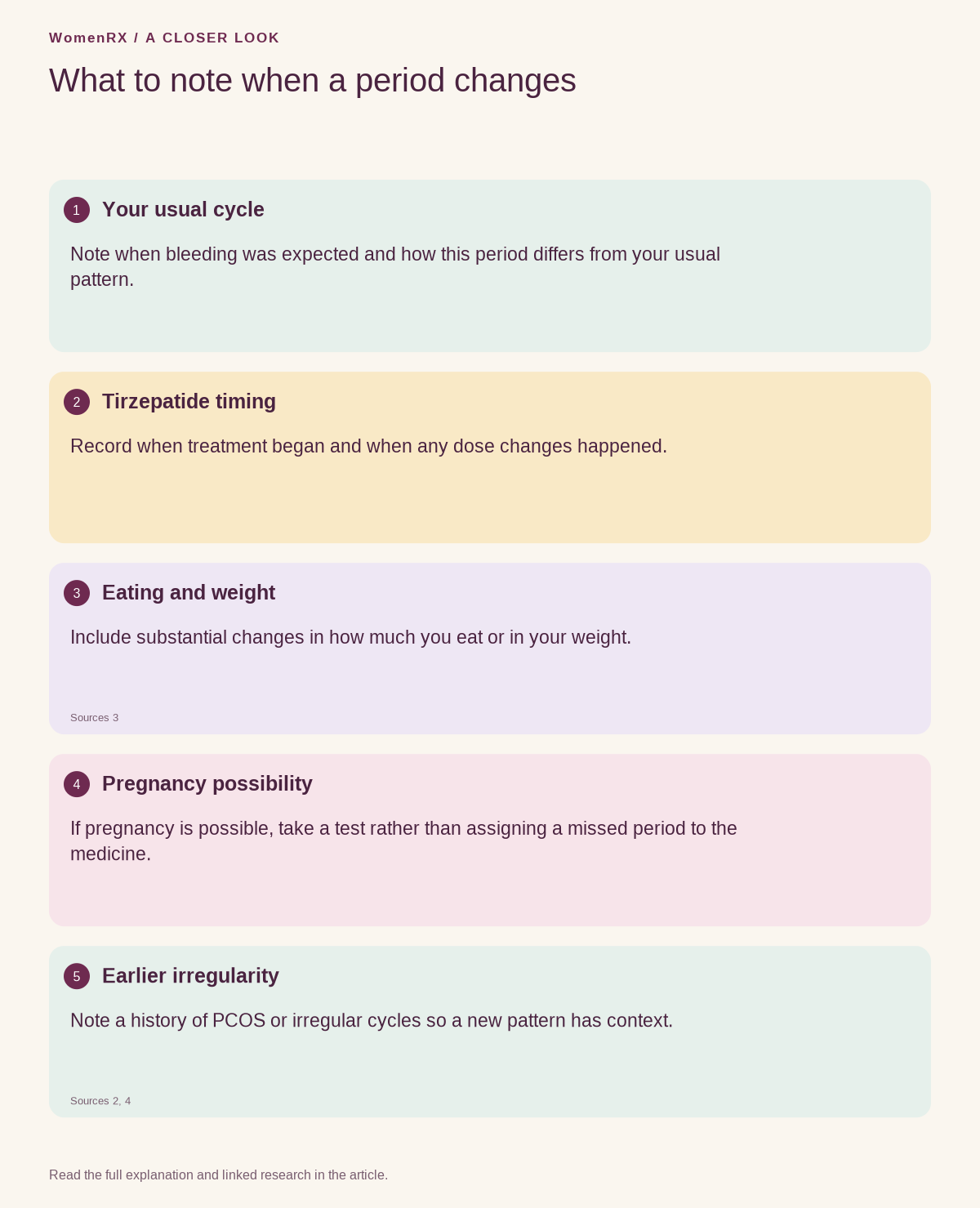
What to note when a period changes
Your usual cycle: Note when bleeding was expected and how this period differs from your usual pattern.
Tirzepatide timing: Record when treatment began and when any dose changes happened.
Eating and weight: Include substantial changes in how much you eat or in your weight.3
Pregnancy possibility: If pregnancy is possible, take a test rather than assigning a missed period to the medicine.
Earlier irregularity: Note a history of PCOS or irregular cycles so a new pattern has context.24
Read the figure as text
A short record helps separate what changed from what might have caused it. It is not a diagnostic checklist.- Your usual cycle: Note when bleeding was expected and how this period differs from your usual pattern.
- Tirzepatide timing: Record when treatment began and when any dose changes happened.
- Eating and weight: Include substantial changes in how much you eat or in your weight.3
- Pregnancy possibility: If pregnancy is possible, take a test rather than assigning a missed period to the medicine.
- Earlier irregularity: Note a history of PCOS or irregular cycles so a new pattern has context.24
Sources you can check
- ZEPBOUND (TIRZEPATIDE) INJECTION, SOLUTION ZEPBOUND (TIRZEPATIDE) INJECTION, SOLUTION ZEPBOUND KWIKPEN (TIRZEPATIDE) INJECTION, SOLUTION [ELI LILLY AND COMPANY] | US prescribing information and patient instructionsAccessed 2026-09-25Return to first citation
- Effects and plasma proteomic analysis of GLP-1RA versus CPA/EE, in combination with metformin, on overweight PCOS women: a randomized controlled trial.Liao M, Li X, Zhang H, Zhou L, Shi L, Li W, Shen R, Peng G, Zhao H, Shao J, Wang X, Sun Z, Zheng H, Long M. · Endocrine · 2024Return to first citation
- The impact of nutrition, exercise, and pharmacotherapy on menstrual health in adolescents with overweight and obesity.Wu J, Jacobson-Dickman E. · Nutrition (Burbank, Los Angeles County, Calif.) · 2026Return to first citation
- Evidence That Semaglutide Represents an Important Tool for Treatment of Irregular Menses and Chronic Anovulation in Women with Polyendocrine Metabolic Ovarian Syndrome.Carmina E, Longo RA. · Journal of clinical medicine · 2026Return to first citation