Can Tirzepatide Change Your Period?
Cycle changes can happen while you’re taking tirzepatide, but timing alone doesn’t show that the medication caused them.
It’s not established whether tirzepatide itself changes periods. A small trial found more cycle recovery with tirzepatide plus metformin than with metformin alone in women with PCOS, but it can’t predict what tirzepatide alone would do.3 If your period is late and pregnancy is possible, consider a pregnancy test.6 Seek care if bleeding is unusually heavy or pain disrupts your day.5
What the cycle research actually shows
A period that arrives late, comes early, or changes in flow may catch your attention soon after you start tirzepatide. The timing is useful information, but it doesn’t establish a cause. Your cycle, weight, eating patterns, and other health factors may all be changing at once.
The most directly relevant trial enrolled 60 Chinese women with overweight or obesity and polycyst ovary syndrome (PCOS). Everyone had irregular periods at the start. Researchers compared metformin alone with metformin plus tirzepatide for 16 weeks and found greater menstrual-cycle recovery in the combination group. This was an open-label study, cycle regularity was a secondary outcome, and there was no tirzepatide-only group. Its findings don’t establish that tirzepatide directly regulates periods or predict what will happen if you don’t have PCOS.3
The trial also found greater weight loss in the combination group. Because weight, metabolic measures, and cycle regularity changed during the same treatment period, it can’t separate a direct medication effect on the cycle from effects related to those other changes.3
Look at what changed alongside your period
Tirzepatide reduces food intake, likely through its effects on appetite, and lowers body weight.1 That gives you a useful question to ask if your cycle shifts: has eating or weight changed substantially, too? A review of research in adolescents describes energy deficiency as a cause of menstrual disruption, but adolescent findings don’t tell us whether a particular adult’s cycle change during tirzepatide treatment has the same explanation.4
Your starting pattern matters as well. If you have PCOS and your periods were irregular before treatment, a newly regular cycle is different from a previously predictable cycle becoming irregular. The PCOS trial speaks to the first situation, not the second.3
For a useful record, jot down the dates bleeding starts, whether the flow seems different from your usual, and when you started tirzepatide or had a dose change. Add any notable changes in appetite, eating, or weight. You’re not trying to prove a drug effect with a calendar. You’re making it easier to describe the change accurately and consider other explanations.
Don’t overlook contraception or pregnancy
If you use an oral hormonal contraceptive, there’s a specific tirzepatide interaction worth knowing about. Tirzepatide delays stomach emptying and may reduce how well oral hormonal contraceptives work. The US prescribing information for both Zepbound and Mounjaro advises switching to a non-oral method or adding a barrier method for four weeks after starting treatment and for four weeks after each dose increase. Both say hormonal contraceptives that aren’t taken by mouth should not be affected by this interaction.12
That warning is about contraceptive effectiveness, not evidence that tirzepatide itself changes menstrual bleeding. Pregnancy is one possible reason for a missed period. If pregnancy is possible and your period is late, consider a home pregnancy test rather than assuming it’s a medication effect. Tests are most reliable from the first day of a missed period; if you don’t know when your period is due, test at least 21 days after sex that could have led to pregnancy.56 If you learn you’re pregnant, let your prescriber know promptly. Zepbound’s prescribing information says to discontinue it when pregnancy is recognized; available human pregnancy data are insufficient to determine its risks.1 A missed period doesn’t, by itself, tell you whether pregnancy, a change in contraception, an underlying condition, or something else is responsible.5
When a change needs attention
You don’t need to prove tirzepatide caused a change before asking for help. If you’re changing a pad or tampon every one to two hours, bleeding is affecting your life, or period pain is severe enough to interfere with daily activities, seek care rather than simply watching the next cycle.5 These are reasons to address the bleeding or pain, not signs that tirzepatide is the cause.
If a less disruptive change continues or worries you, use your record to describe what changed to your prescriber and ask for advice.
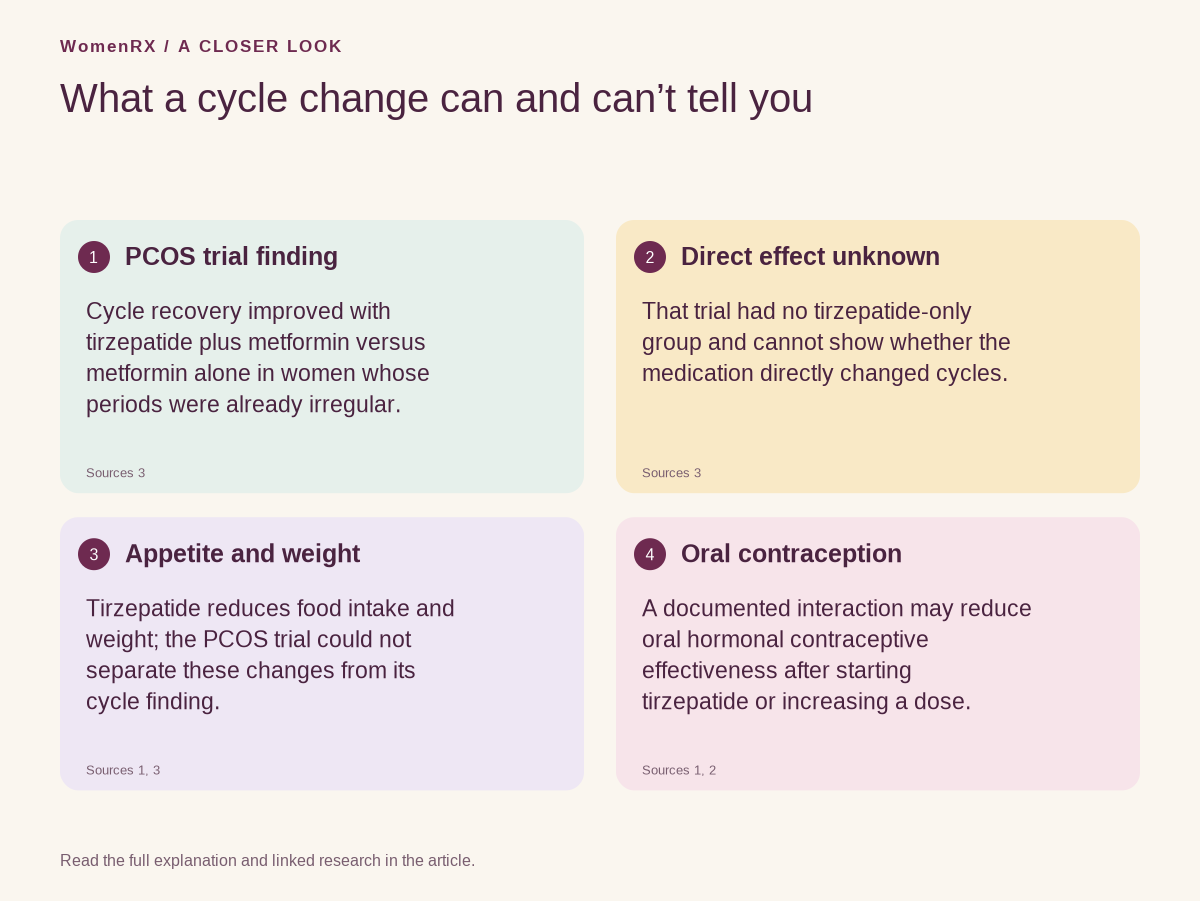
What a cycle change can and can’t tell you
PCOS trial finding: Cycle recovery improved with tirzepatide plus metformin versus metformin alone in women whose periods were already irregular.3
Direct effect unknown: That trial had no tirzepatide-only group and cannot show whether the medication directly changed cycles.3
Appetite and weight: Tirzepatide reduces food intake and weight; the PCOS trial could not separate these changes from its cycle finding.13
Oral contraception: A documented interaction may reduce oral hormonal contraceptive effectiveness after starting tirzepatide or increasing a dose.12
Read the figure as text
These distinctions help separate a research finding from other changes that may be happening at the same time.- PCOS trial finding: Cycle recovery improved with tirzepatide plus metformin versus metformin alone in women whose periods were already irregular.3
- Direct effect unknown: That trial had no tirzepatide-only group and cannot show whether the medication directly changed cycles.3
- Appetite and weight: Tirzepatide reduces food intake and weight; the PCOS trial could not separate these changes from its cycle finding.13
- Oral contraception: A documented interaction may reduce oral hormonal contraceptive effectiveness after starting tirzepatide or increasing a dose.12
Sources you can check
- ZEPBOUND (TIRZEPATIDE) INJECTION, SOLUTION ZEPBOUND (TIRZEPATIDE) INJECTION, SOLUTION ZEPBOUND KWIKPEN (TIRZEPATIDE) INJECTION, SOLUTION [ELI LILLY AND COMPANY] | US prescribing information and patient instructionsAccessed 2026-09-25Return to first citation
- MOUNJARO (TIRZEPATIDE) INJECTION, SOLUTION MOUNJARO KWIKPEN (TIRZEPATIDE) INJECTION, SOLUTION [ELI LILLY AND COMPANY] | US prescribing information and patient instructionsAccessed 2026-09-25Return to first citation
- Short-Term Combined Treatment With Tirzepatide and Metformin for Overweight/Obese Chinese Women With Polycystic Ovary Syndrome: A Prospective, Open-Label, Randomised Controlled Trial.Yang Z, Xu Y, Du H, Liu W, Chen H, Liu D, Zhang L, Wang C. · Diabetes, obesity & metabolism · 2026Return to first citation
- The impact of nutrition, exercise, and pharmacotherapy on menstrual health in adolescents with overweight and obesity.Wu J, Jacobson-Dickman E. · Nutrition (Burbank, Los Angeles County, Calif.) · 2026Return to first citation
- Period problems - NHSAccessed 2026-09-25Return to first citation
- Doing a pregnancy test - NHSAccessed 2026-09-25Return to first citation