Did Semaglutide Change Your Period?
A period change while taking semaglutide deserves a closer look at pregnancy possibility, your usual cycle pattern, and any new or heavy bleeding.
Semaglutide may be on your mind when your period changes, but timing alone doesn’t show it caused the change. Studies in women with PCOS found improved cycle regularity during treatment; they don’t establish a direct effect for women without PCOS. If pregnancy is possible, check for it rather than assuming a missed period is medication-related. Get heavy, persistent, or otherwise unusual bleeding assessed. 1 4 5
A missed period, unexpected spotting, or a suddenly regular cycle can all raise the same question: is it the semaglutide? Start with what changed, but don’t stop at the date you started treatment. Pregnancy, an existing pattern of irregular ovulation, and causes of abnormal bleeding may need different next steps. 1 4
What the cycle studies can tell you
The clearest menstrual findings come from women who already had polycystic ovary syndrome (PCOS) and irregular cycles. In a 16-week randomized trial, women received either metformin alone or metformin plus semaglutide. Among participants who completed the study, 42.3% of the metformin group and 72.5% of the combination group had a reported return to regular cycles. The groups also differed in weight loss, so the trial doesn’t separate a direct drug effect from changes associated with weight or metabolism. 4
In another study, 96 women with a related diagnosis and excess body weight completed six months of semaglutide treatment. Of the 80 who began with infrequent, anovulatory cycles, 42 had normalized cycles and ovulatory cycles afterward. There was no comparison group, which makes the result less able to establish what caused the improvement. Neither study tells us what semaglutide does to periods in women without these conditions. 5
There’s a practical point here if your periods used to be infrequent: a more regular cycle may also mean ovulation has returned. In the randomized PCOS trial, pregnancies occurred during follow-up after semaglutide had been stopped. The separate six-month study recommended contraception during treatment because pregnancy-safety data were lacking. If pregnancy is possible and a period is late, check for it rather than treating the missed period as a drug effect; contact your prescriber if you might be pregnant or are planning pregnancy. 4 5
Other explanations depend on the kind of change
A late or absent period: Think about whether pregnancy is possible and whether your cycles were irregular before treatment. Note any changes in eating patterns, weight, stress, contraception, or other medicines. These are useful parts of the history, not proof that any one factor caused the missed period. Irregular ovulation is one recognized category of abnormal uterine bleeding. 1
Heavier, longer, or bleeding between periods: Don’t assume this is part of weight loss. Abnormal bleeding can have structural causes, including fibroids or polyps, as well as causes related to ovulation or medicines. A guideline describes bleeding lasting more than eight days and heavy bleeding that affects quality of life as abnormal patterns worth evaluating. Fibroids, for example, can cause bleeding and pelvic pressure or pain. 1 3
A change around midlife: Perimenopause is useful context, but it shouldn’t become an automatic explanation for heavy bleeding or pelvic pain. These symptoms still warrant evaluation across the menopausal transition. If you’re postpartum, include when you gave birth and whether you’re breastfeeding when describing the change; the PCOS treatment studies don’t establish what semaglutide means for postpartum cycles. 2 4 5
When to make the call
Arrange an evaluation if bleeding is persistently different from your usual pattern, lasts more than eight days, or is heavy enough to disrupt daily life. Seek care promptly rather than waiting to collect more cycle dates if the bleeding is concerningly heavy or comes with pelvic pain. The cited guidance supports investigation of abnormal bleeding and a low threshold for investigating bleeding with pain, but it doesn’t provide a specific emergency blood-loss cutoff. 1 2 3
If you’ve gone through menopause and then bleed, get that assessed even if you recently started semaglutide. A year without periods for another reason, such as longstanding irregular cycles, does not by itself establish that you’re postmenopausal; new bleeding after a long gap still deserves evaluation. 1
A brief record can make that conversation more productive: mark your bleeding dates and whether the flow changed, then place semaglutide changes, weight and eating changes, contraception changes, and pregnancy possibility alongside them. The sequence helps describe what happened. It can’t diagnose the cause.
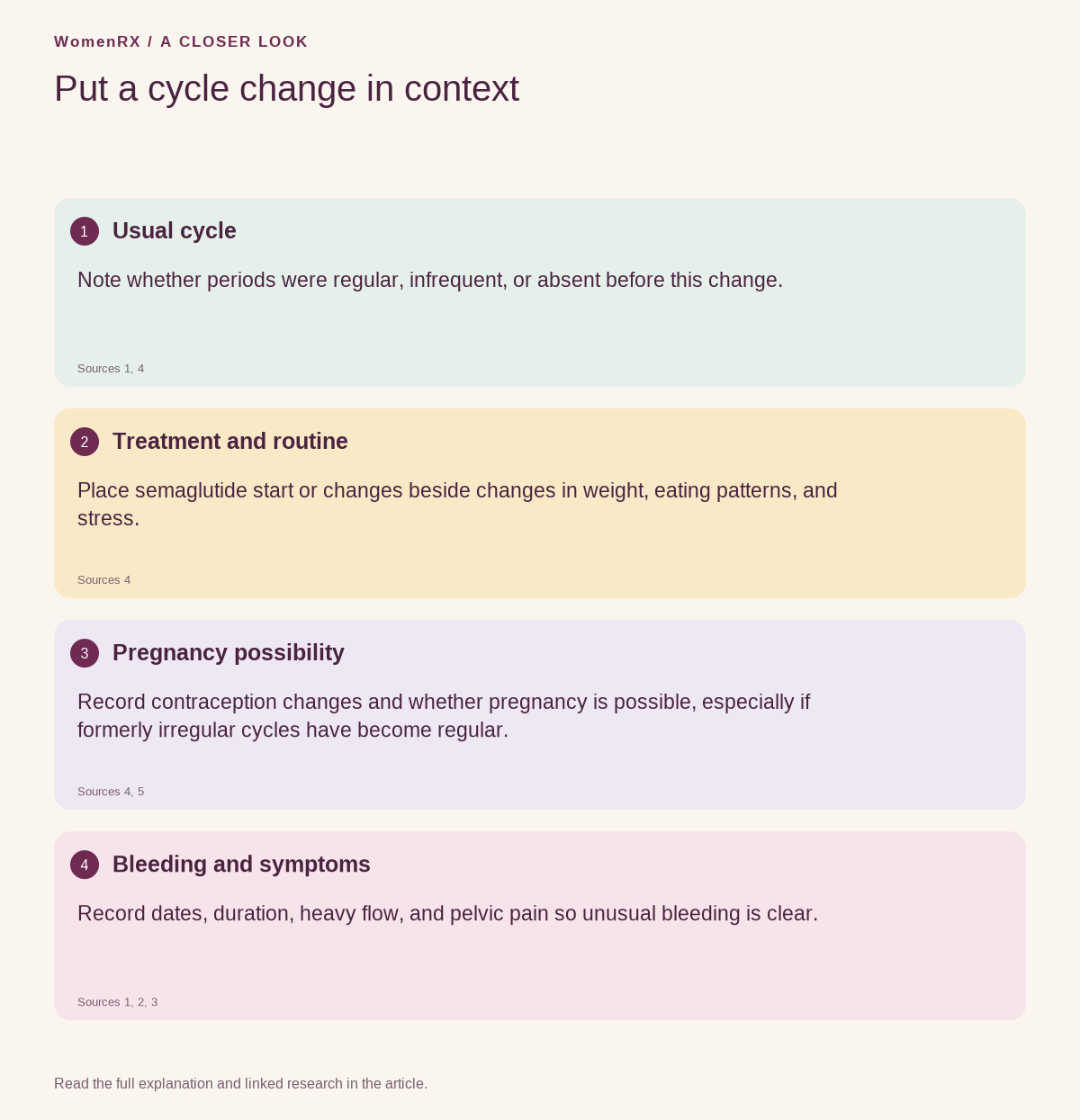
Put a cycle change in context
Usual cycle: Note whether periods were regular, infrequent, or absent before this change.14
Treatment and routine: Place semaglutide start or changes beside changes in weight, eating patterns, and stress.4
Pregnancy possibility: Record contraception changes and whether pregnancy is possible, especially if formerly irregular cycles have become regular.45
Bleeding and symptoms: Record dates, duration, heavy flow, and pelvic pain so unusual bleeding is clear.123
Read the figure as text
Mark what happened before and around the changed period. This timeline helps explain the sequence, not determine a cause.- Usual cycle: Note whether periods were regular, infrequent, or absent before this change.14
- Treatment and routine: Place semaglutide start or changes beside changes in weight, eating patterns, and stress.4
- Pregnancy possibility: Record contraception changes and whether pregnancy is possible, especially if formerly irregular cycles have become regular.45
- Bleeding and symptoms: Record dates, duration, heavy flow, and pelvic pain so unusual bleeding is clear.123
More questions, answered
Could a newly regular period mean I can get pregnant?
If you previously had irregular ovulation, it could. Ovulatory cycles were observed after treatment in a study of women with a PCOS-related condition. That finding doesn’t predict your individual fertility, but it’s a reason not to rely on previously infrequent periods as reassurance that pregnancy isn’t possible. 5
Is bleeding after a year without periods always postmenopausal bleeding?
No. The reason your periods stopped matters. Bleeding after menopause needs evaluation; a year without periods because of another condition doesn’t automatically mean menopause. New bleeding after a long gap is still worth discussing with a clinician rather than attributing it to semaglutide. 1
Sources you can check
- Visually directed hysteroscopic biopsy in the evaluation of abnormal uterine bleeding and postmenopausal bleeding: a Joint Society Practice Guideline. Joint Society Practice Guideline from AAGL-ESGE-GCH. · Facts, views & vision in ObGyn · 2026Return to first citation
- Uterine Leiomyomas Across the Menopausal Transition.Encalada-Soto D, Hochberg LS, Laughlin-Tommaso S. · Obstetrics and gynecology · 2026Return to first citation
- Guideline No. 461: The Management of Uterine Fibroids.Chen I, Kives S, Randle E, Rattray D, Sanders A, Vilos G. · Journal of obstetrics and gynaecology Canada : JOGC = Journal d'obstetrique et gynecologie du Canada : JOGC · 2025Return to first citation
- Effects of combined metformin and semaglutide therapy on body weight, metabolic parameters, and reproductive outcomes in overweight/obese women with polycystic ovary syndrome: a prospective, randomized, controlled, open-label clinical trial.Chen H, Lei X, Yang Z, Xu Y, Liu D, Wang C, Du H. · Reproductive biology and endocrinology : RB&E · 2025Return to first citation
- Evidence That Semaglutide Represents an Important Tool for Treatment of Irregular Menses and Chronic Anovulation in Women with Polyendocrine Metabolic Ovarian Syndrome.Carmina E, Longo RA. · Journal of clinical medicine · 2026Return to first citation