Semaglutide and Mood: How to Read the Evidence
Mood changes deserve attention, but current studies can’t tell whether semaglutide caused one person’s anxiety or low mood.
Studies don’t establish that semaglutide causes or prevents depression or anxiety. Safety reports have flagged mood-related events, while observational studies have found lower rates of some mental-health outcomes among semaglutide users. These findings answer different questions and don’t prove cause for an individual. Note when symptoms began and what else changed, then discuss the pattern and support options with your prescriber. 2 5
Start with the change you’re noticing
If anxiety or low mood began or worsened while you were taking semaglutide, it makes sense to wonder about a connection. The timing is useful information, but it can’t settle the cause on its own. You don’t need to prove a link before asking for support.
For a clearer discussion, note when you first noticed the change, whether it’s steady or comes and goes, and how it affects daily life. Include changes in treatment, health, sleep, stress, or routine that happened around the same time. These details can help frame the conversation; they don’t diagnose the cause.
If you’re pregnant, recently postpartum, or in perimenopause or menopause, mention that context too. The studies described below don’t establish how semaglutide relates to mood in those life stages, so don’t assume either hormones or the medication explains what you’re experiencing.
Why safety reports and studies can point in different directions
A multinational analysis of adverse-event reports found that reports involving semaglutide included signals for anxiety, depressed-mood disorders, and suicidality. A signal means those events were reported disproportionately in the database being studied. It isn’t an estimate of how likely you are to experience them, and it can’t show that the medicine caused them. The same study did not find a significant increase in overall psychiatric adverse-reaction reporting for GLP-1 medicines as a group. 5
Observational studies examine patterns in health records rather than assigning treatment at random. They can show associations, but differences between people, their health, or their care may also help explain what researchers find.
For example, a Swedish study followed people with diagnosed depression or anxiety who used antidiabetic medicines. Within the same individuals, periods of semaglutide use were associated with less worsening of mental illness than periods without GLP-1 receptor agonist use. A separate claims study of adults with type 2 diabetes found fewer office visits for depression and anxiety among people starting a GLP-1 medicine than among those starting a DPP-4 inhibitor. Visits are not a direct measure of how someone feels, and neither study establishes that semaglutide treats mood disorders. 2 3
Another matched health-record study found lower recorded rates of several psychiatric outcomes for semaglutide than for other GLP-1 medicines during its first year of follow-up. That comparison is also observational. Taken together, these findings don’t prove that semaglutide is protective, rule out an adverse effect, or identify what caused one person’s symptoms. 4
Make the conversation specific
You could start with: “I noticed a change in my mood around this time. Could we review the timing and what else might be contributing?” Bring your notes and mention any recent changes in treatment, health, or life circumstances. If you have a history of anxiety or depression, include that context.
You can also ask what support is appropriate now and whether your treatment plan should be reviewed. Anxiety can have different causes; an assessment may include questions about your symptoms and medical history. Psychotherapy and medicines are among the treatment options for anxiety disorders. 1
If you may not be safe
If you’re thinking about suicide or self-harm, or you’re unsure you can keep yourself safe, seek immediate emergency help now. If possible, tell someone you trust and ask them to stay with you while you get help. You deserve urgent support whether or not semaglutide is involved.
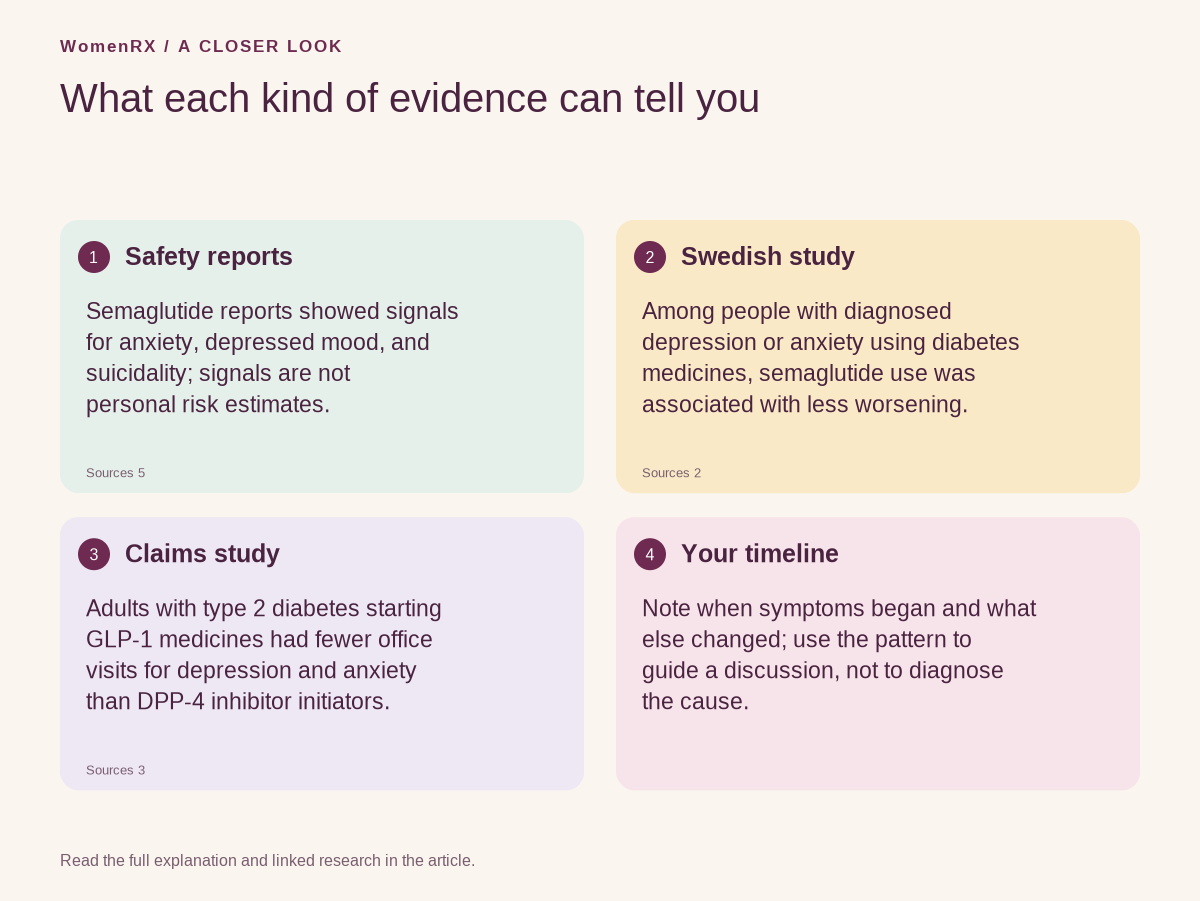
What each kind of evidence can tell you
Safety reports: Semaglutide reports showed signals for anxiety, depressed mood, and suicidality; signals are not personal risk estimates.5
Swedish study: Among people with diagnosed depression or anxiety using diabetes medicines, semaglutide use was associated with less worsening.2
Claims study: Adults with type 2 diabetes starting GLP-1 medicines had fewer office visits for depression and anxiety than DPP-4 inhibitor initiators.3
Your timeline: Note when symptoms began and what else changed; use the pattern to guide a discussion, not to diagnose the cause.
Read the figure as text
Safety reports can flag events, observational studies can find associations, and your symptom timeline can help focus a discussion. None alone proves what caused a mood change.- Safety reports: Semaglutide reports showed signals for anxiety, depressed mood, and suicidality; signals are not personal risk estimates.5
- Swedish study: Among people with diagnosed depression or anxiety using diabetes medicines, semaglutide use was associated with less worsening.2
- Claims study: Adults with type 2 diabetes starting GLP-1 medicines had fewer office visits for depression and anxiety than DPP-4 inhibitor initiators.3
- Your timeline: Note when symptoms began and what else changed; use the pattern to guide a discussion, not to diagnose the cause.
More questions, answered
Does a safety-report signal mean semaglutide caused depression?
No. It means the event appeared disproportionately in the reports analyzed. That finding raises a question for further investigation, but it doesn’t establish cause or tell you your personal chance of experiencing the event. 5
Do studies show that semaglutide improves anxiety or depression?
Some observational studies found lower rates of certain mental-health outcomes among semaglutide users. They don’t show that semaglutide treats anxiety or depression, because the studies were not randomized treatment tests. 2 4
Sources you can check
- Anxiety: MedlinePlusAccessed 2026-09-25Return to first citation
- Association between GLP-1 receptor agonist use and worsening mental illness in people with depression and anxiety in Sweden: a national cohort study.Taipale H, Taylor M, Lähteenvuo M, Mittendorfer-Rutz E, Tanskanen A, Tiihonen J. · The lancet. Psychiatry · 2026Return to first citation
- Glucagon-Like Peptide-1 Use and Healthcare Resource Utilization for Depression and Anxiety Among Adults with Type 2 Diabetes: 2019 to 2023.Do D, Lee T, Inneh A, Patel U. · The journal of behavioral health services & research · 2025Return to first citation
- Neuropsychiatric Outcomes With Tirzepatide, Semaglutide, and Other GLP-1 Receptor Agonists.Chen SC, Wang TJ, Chou CK, Lee C. · Diabetes, obesity & metabolism · 2026Return to first citation
- Psychiatric and psychological adverse effects associated with dulaglutide, semaglutide, and liraglutide: A vigibase study.Nishida K, Chrétien B, Dolladille C, Ebina T, Aleksic B, Cabé N, Savey V, Onoue T, Yatsuya H. · Clinical nutrition (Edinburgh, Scotland) · 2025Return to first citation