Semaglutide and Your Period: What a Change Might Mean
A changed period while taking semaglutide deserves attention, but its timing alone can’t tell you what caused it.
Research hasn’t established a direct effect of semaglutide on menstrual bleeding or cycle timing generally. Studies in women with polycystic ovary syndrome (PCOS) have found more regular cycles during treatment, but weight changes make the cause hard to separate.45 If pregnancy is possible and your period is late, take a test. If bleeding is disrupting your life or occurs between periods, contact a clinician.78
A cycle change is a clue, not a diagnosis
Maybe your period arrived later than usual after you started semaglutide. Maybe bleeding is different, or a previously unpredictable cycle seems steadier. The useful first distinction is what changed: the date bleeding began, how long it lasted, how much you bled, or whether a period didn’t arrive at all. Those aren’t interchangeable findings, and the research on semaglutide doesn’t answer them equally well.
Most of the direct menstrual research concerns women with PCOS who had irregular cycles before treatment. In one six-month study, women with an ovarian syndrome diagnosed using PCOS criteria and excess weight were assessed before and after semaglutide treatment. Some who had not been ovulating had ovulatory cycles afterward. But everyone received semaglutide, so the study couldn’t show whether the change came from the medicine itself, weight loss, or other changes that happened alongside treatment.4
A separate randomized trial compared metformin alone with metformin plus semaglutide in women with PCOS and overweight or obesity. The combination group had more menstrual-cycle recovery after 16 weeks. That’s a comparison, but it still doesn’t isolate a direct effect of semaglutide on the menstrual cycle: the groups differed in weight loss too, and the finding applies to the combination treatment in this PCOS population.5
A systematic review of GLP-1 medicines in women with PCOS found that the trial evidence available through its September 2024 search was insufficient to draw a conclusion about menstrual regularity. The two semaglutide studies described above add useful findings, but they don’t establish what semaglutide does to periods in people without PCOS or explain new heavy or unexpected bleeding.456
What else belongs in the picture?
Start with your pattern before semaglutide. If you have PCOS, irregular periods may already be part of that condition; a more regular cycle may be possible without proving exactly why it changed. If your periods were predictable before and are now late or different, that’s a different question from whether treatment helps restore cycles in women with PCOS.45
Next, note changes happening at the same time, particularly substantial weight change or a change in how much you’re eating. The PCOS studies observed menstrual and weight changes together; they didn’t determine which change, if either, caused an individual woman’s new cycle pattern.45 Pregnancy is another possibility to consider rather than explaining away a missed period. If you’re in perimenopause, include that context when describing a changing pattern, too; heavy bleeding can occur approaching menopause, but that doesn’t establish the cause of yours.8 None of these possibilities can be sorted out from the date you started semaglutide alone.
What to do with a late period or changed bleeding
If pregnancy is possible and your period is late, take a home pregnancy test. Most tests are most reliable from the first day of a missed period. If you don’t know when your period is due, test at least 21 days after the last time you had sex that could result in pregnancy. A negative result can be less reliable if you test too early; if you still think you could be pregnant, test again a few days later. If a second test is negative but your period hasn’t arrived, contact a clinician.7 A changed cycle isn’t reliable evidence that pregnancy can’t happen: researchers documented a return of ovulatory cycles in some women with PCOS during semaglutide treatment, and a separate trial recorded pregnancies during follow-up after semaglutide was stopped.45
If you learn you’re pregnant, contact the clinician who prescribes your medicine promptly so you can review your treatment together. For Wegovy used for weight reduction, U.S. prescribing information says to discontinue it when pregnancy is recognized; human pregnancy data are insufficient to establish the risks, and animal studies raise concern about fetal harm.1 U.S. prescribing information for oral Ozempic tablets likewise says human pregnancy data are insufficient to assess drug-associated risks and notes potential fetal risk based on animal studies.2 If you take semaglutide for diabetes, discuss how your blood sugar will be managed rather than making an abrupt medication change on your own.23 If you’re planning a pregnancy, prescribing information for both Wegovy and oral Ozempic advises stopping semaglutide at least two months beforehand because it takes a long time to leave the body.12
For a change that isn’t an immediate pregnancy question, make a short record you can actually use: the first day of each period, whether bleeding is lighter or heavier than your usual, any bleeding between periods, and when changes in treatment, weight, or eating occurred. This isn’t a diagnostic score. It helps you describe the change clearly, but you don’t need to wait for several cycles to ask about bleeding that’s affecting your life.
Contact a clinician if heavy bleeding is disrupting daily activities, if you bleed between periods or after sex, or if you have severe pain during a period. Bleeding that lasts more than seven days or requires changing a pad or tampon every one to two hours also fits descriptions of heavy periods worth discussing, especially if you’re often tired or short of breath.8 These are reasons to have the bleeding assessed, not evidence that semaglutide caused it. Other possible causes of heavy bleeding include fibroids and conditions affecting the ovaries or uterus; bleeding can also change as menopause approaches.8
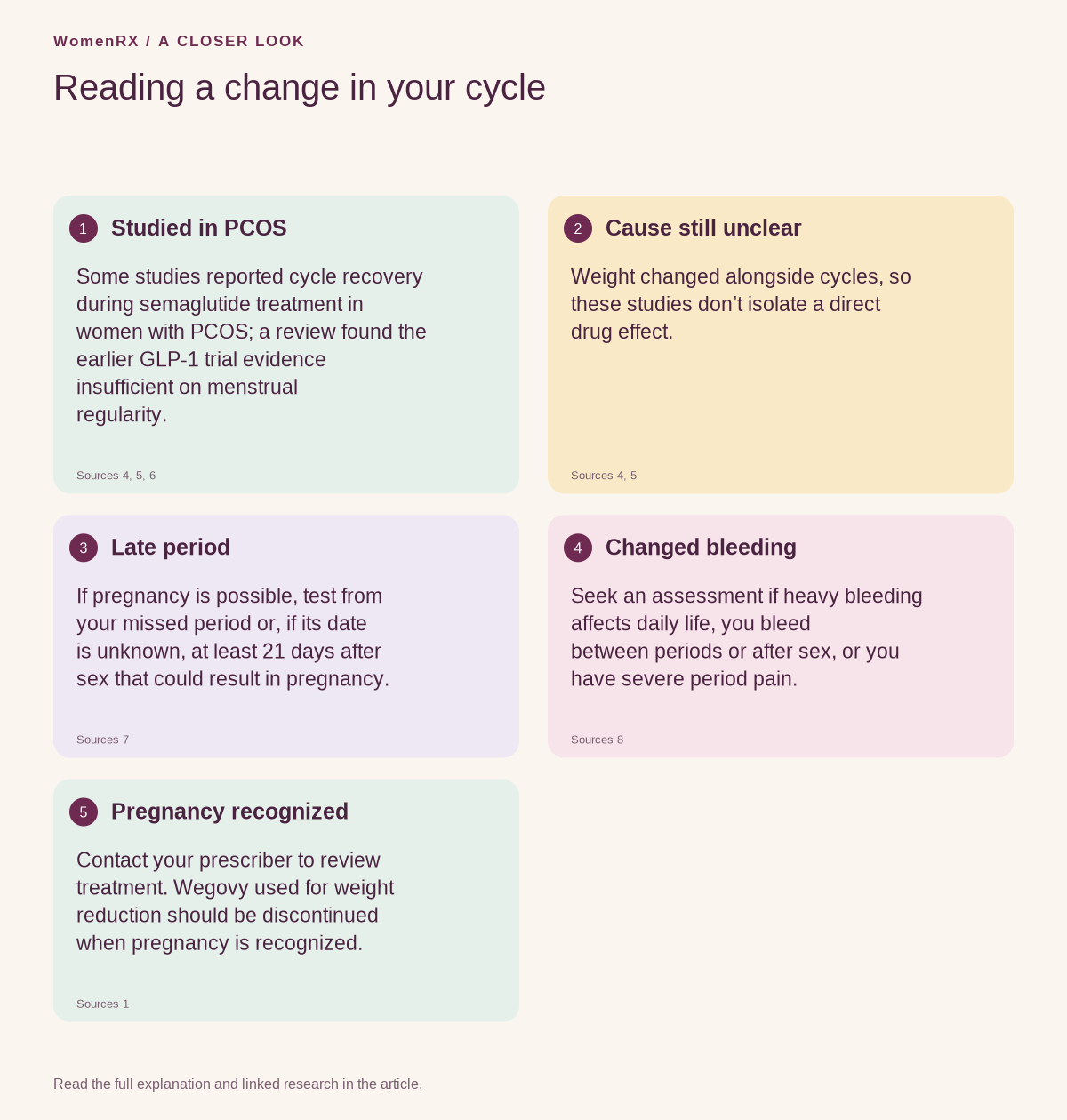
Reading a change in your cycle
Studied in PCOS: Some studies reported cycle recovery during semaglutide treatment in women with PCOS; a review found the earlier GLP-1 trial evidence insufficient on menstrual regularity.456
Cause still unclear: Weight changed alongside cycles, so these studies don’t isolate a direct drug effect.45
Late period: If pregnancy is possible, test from your missed period or, if its date is unknown, at least 21 days after sex that could result in pregnancy.7
Changed bleeding: Seek an assessment if heavy bleeding affects daily life, you bleed between periods or after sex, or you have severe period pain.8
Pregnancy recognized: Contact your prescriber to review treatment. Wegovy used for weight reduction should be discontinued when pregnancy is recognized.1
Read the figure as text
Separate what studies found in PCOS from practical steps for a late period or changed bleeding.- Studied in PCOS: Some studies reported cycle recovery during semaglutide treatment in women with PCOS; a review found the earlier GLP-1 trial evidence insufficient on menstrual regularity.456
- Cause still unclear: Weight changed alongside cycles, so these studies don’t isolate a direct drug effect.45
- Late period: If pregnancy is possible, test from your missed period or, if its date is unknown, at least 21 days after sex that could result in pregnancy.7
- Changed bleeding: Seek an assessment if heavy bleeding affects daily life, you bleed between periods or after sex, or you have severe period pain.8
- Pregnancy recognized: Contact your prescriber to review treatment. Wegovy used for weight reduction should be discontinued when pregnancy is recognized.1
More questions, answered
Does a more regular period mean I’m ovulating?
Not necessarily. One semaglutide study in women with an ovarian syndrome diagnosed using PCOS criteria assessed ovulation with hormone measurements as well as menstrual patterns. A calendar change alone can’t confirm that you ovulated or explain why your cycle changed.4
Sources you can check
- WEGOVY (SEMAGLUTIDE) INJECTION, SOLUTION WEGOVY (SEMAGLUTIDE) TABLET [NOVO NORDISK PHARMACEUTICAL INDUSTRIES, LP] | US prescribing information and patient instructionsAccessed 2026-09-25Return to first citation
- OZEMPIC (ORAL SEMAGLUTIDE) TABLET RYBELSUS (ORAL SEMAGLUTIDE) TABLET [NOVO NORDISK PHARMACEUTICAL INDUSTRIES, LP] | US prescribing information and patient instructionsAccessed 2026-09-25Return to first citation
- Pregnancy and Medicines | MedlinePlusAccessed 2026-09-25Return to first citation
- Evidence That Semaglutide Represents an Important Tool for Treatment of Irregular Menses and Chronic Anovulation in Women with Polyendocrine Metabolic Ovarian Syndrome.Carmina E, Longo RA. · Journal of clinical medicine · 2026Return to first citation
- Effects of combined metformin and semaglutide therapy on body weight, metabolic parameters, and reproductive outcomes in overweight/obese women with polycystic ovary syndrome: a prospective, randomized, controlled, open-label clinical trial.Chen H, Lei X, Yang Z, Xu Y, Liu D, Wang C, Du H. · Reproductive biology and endocrinology : RB&E · 2025Return to first citation
- GLP-1 receptor agonist treatment in women with polycystic ovary syndrome-a systematic review and meta-analysis.Forslund M, Wändell P, Forsberg L, Österberg M, Dagerhamn J, Wernersson E, Kärrman Fredriksson M, Ringborg A, Lindén Hirschberg A. · European journal of endocrinology · 2026Return to first citation
- Doing a pregnancy test - NHSAccessed 2026-09-25Return to first citation
- Heavy periods - NHSAccessed 2026-09-26Return to first citation