Can Rybelsus Change Your Menstrual Cycle?
A cycle change while taking Rybelsus is worth noticing, but it doesn’t tell you by itself what caused it.
It’s not clear whether Rybelsus itself changes menstrual cycles. A small trial found improved cycle regularity in women with PCOS who received weekly semaglutide plus metformin, but it cannot tell us what oral semaglutide does on its own.3 If your period is late and pregnancy is possible, consider a pregnancy test. Heavy or painful bleeding deserves a separate look.2
What the semaglutide research actually shows
The most useful distinction is between Rybelsus, an oral semaglutide tablet, and the weekly semaglutide-plus-metformin treatment studied for menstrual outcomes.13 In a randomized, open-label trial, 100 women with PCOS and overweight or obesity were assigned to metformin alone or metformin plus semaglutide once weekly. Eighty completed the study. After 16 weeks, cycle recovery was more common in the combination group, which also lost more weight.3
That finding doesn’t establish that semaglutide directly regulates periods. The trial tested weekly semaglutide with metformin, not Rybelsus alone. Participants had PCOS and infrequent periods before treatment, and the groups differed in weight loss. The researchers counted bleeding episodes to assess cycles; a more regular bleeding pattern by itself does not prove that ovulation occurred.3
A 2026 review of semaglutide studies in women with PCOS reached a similarly cautious conclusion: some studies reported improved menstrual regularity, but much of that evidence came from small studies or conference reports. Larger trials with consistent measures of ovulation and menstrual cycles are still needed.4 These findings can’t tell you whether Rybelsus caused a newly late, early, lighter, or heavier period if you don’t have PCOS.
First, separate a missed period from a bleeding change
If your period is late and pregnancy is possible, consider a pregnancy test rather than treating the change as proof that Rybelsus affected your cycle. In the PCOS trial, researchers used urine pregnancy tests during follow-up rather than relying on menstrual patterns to identify pregnancies.3 That research doesn’t establish when to take a home test. If you think you may be pregnant while taking Rybelsus, contact the clinician who prescribes it so you can discuss your blood-sugar care. The Rybelsus medication guide says its effects on an unborn baby are unknown and advises discussing blood-sugar treatment when pregnant or planning pregnancy.1
A heavier period calls for a different look. Heavy bleeding can have causes involving the uterus or ovaries, including fibroids and endometriosis; some other medicines, including anticoagulants, can contribute too. Needing to change a pad or tampon every one to two hours can be a sign of heavy bleeding. Arrange a medical assessment if heavy periods are affecting your daily life, you bleed between periods or after sex, or you have severe period pain, rather than attributing those changes to semaglutide.2
Where PCOS and weight change fit
PCOS involves ovulatory dysfunction, so a woman whose periods were already infrequent may notice a change in her pattern during treatment.4 The trial suggests that cycles can become more regular in women with PCOS receiving weekly semaglutide alongside metformin. It does not separate the possible contributions of semaglutide, weight change, and other effects of treatment, or predict what will happen to an individual taking Rybelsus.34
That distinction matters in both directions. A newly regular period isn’t proof that the medicine restored ovulation, and a missed period isn’t proof that it disrupted your hormones. The useful next question is what changed: the timing of bleeding, its amount, pain, the possibility of pregnancy, or another medicine. Those details help you and your care team investigate the change without settling too early on one explanation.32
If you’re planning to become pregnant, bring up Rybelsus before you start trying. Its medication guide advises stopping it two months before a planned pregnancy and talking with your prescriber about another way to manage blood sugar.1
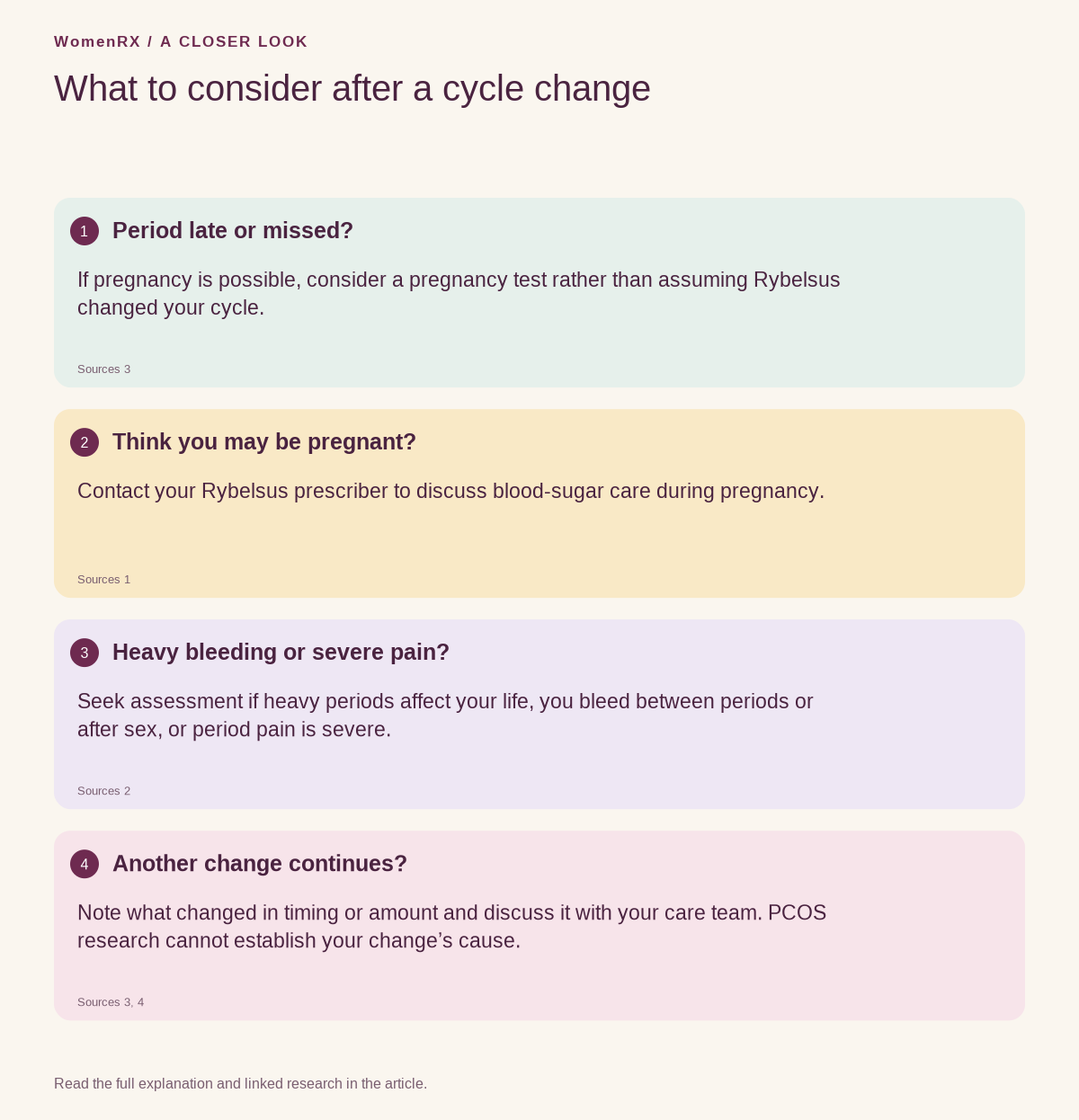
What to consider after a cycle change
Period late or missed?: If pregnancy is possible, consider a pregnancy test rather than assuming Rybelsus changed your cycle.3
Think you may be pregnant?: Contact your Rybelsus prescriber to discuss blood-sugar care during pregnancy.1
Heavy bleeding or severe pain?: Seek assessment if heavy periods affect your life, you bleed between periods or after sex, or period pain is severe.2
Another change continues?: Note what changed in timing or amount and discuss it with your care team. PCOS research cannot establish your change’s cause.34
Read the figure as text
Start with the change you noticed. This path separates possible pregnancy from bleeding concerns; it does not set pregnancy-test timing or provide emergency triage.- Period late or missed?: If pregnancy is possible, consider a pregnancy test rather than assuming Rybelsus changed your cycle.3
- Think you may be pregnant?: Contact your Rybelsus prescriber to discuss blood-sugar care during pregnancy.1
- Heavy bleeding or severe pain?: Seek assessment if heavy periods affect your life, you bleed between periods or after sex, or period pain is severe.2
- Another change continues?: Note what changed in timing or amount and discuss it with your care team. PCOS research cannot establish your change’s cause.34
Sources you can check
- OZEMPIC (ORAL SEMAGLUTIDE) TABLET RYBELSUS (ORAL SEMAGLUTIDE) TABLET [NOVO NORDISK PHARMACEUTICAL INDUSTRIES, LP] | US prescribing information and patient instructionsAccessed 2026-09-25Return to first citation
- Heavy periods - NHSAccessed 2026-09-25Return to first citation
- Effects of combined metformin and semaglutide therapy on body weight, metabolic parameters, and reproductive outcomes in overweight/obese women with polycystic ovary syndrome: a prospective, randomized, controlled, open-label clinical trial.Chen H, Lei X, Yang Z, Xu Y, Liu D, Wang C, Du H. · Reproductive biology and endocrinology : RB&E · 2025Return to first citation
- Efficacy and Safety of Semaglutide in Patients with Polycystic Ovary Syndrome: A Scoping Review.La Vignera S, Condorelli RA. · Biomedicines · 2026Return to first citation