Your Menstrual Cycle, Symptom Patterns, and PMDD
A cycle diary can show whether difficult symptoms repeatedly cluster before bleeding, even when your cycle doesn’t follow a textbook calendar.
Cycle day 1 is the first day of bleeding, and cycle length varies. 2 Severe symptoms that recur in the one to two weeks before periods, affect daily life, and have been present for at least two months may warrant PMDD assessment. Recording symptoms and bleeding for at least two cycles can help show the pattern, but a diary cannot diagnose PMDD on its own. 1
Start with the calendar, not a perfect cycle
Day 1 is the first day of your period. Your cycle runs from that day to the day before your next period starts. About 28 days is an average, not a requirement: cycles can be shorter or longer, and patterns may be less regular when periods first begin or as menopause approaches. 2
The cycle is commonly described using menstruation, the follicular phase, ovulation, and the luteal phase. The luteal phase comes before the next period, when premenstrual symptoms may appear. These phase names help explain the pattern, but if your cycles are inconsistent, dates alone may not accurately identify a phase. For tracking symptoms, start with the bleeding dates you actually observe. 2 3 4 5
PMDD symptoms are generally described as occurring in the one to two weeks before a period and improving a few days after bleeding begins. That timing is more useful to notice as a recurring pattern than to predict from a standard-length cycle. 1
Keep a two-cycle record you can actually use
For at least two cycles, make a brief daily note rather than trying to reconstruct how you felt weeks later. Record:
- Whether you’re bleeding, and the first day bleeding starts.
- Emotional and physical symptoms, including days when symptoms are absent.
- How symptoms affect work, relationships, sleep, or ordinary routines.
- Any contraception you use or changes to it, and any unusually early, late, or missed bleeding.
The point isn’t to score yourself or diagnose PMDD at home. It’s to see whether symptoms repeatedly appear before bleeding, ease after it starts, and disrupt your life. A clinician may ask what symptoms you have and how they affect you; a diary covering at least two menstrual cycles can help make that discussion more concrete. 1
Irregular cycles and contraception change the context
If your cycles vary, counting forward from one period to predict the next can be misleading. Keep recording actual bleeding dates and symptoms rather than assigning yourself a phase based on an assumed 28-day cycle. An app or paper calendar can help show the pattern. 2 4
Some hormonal contraceptives can be associated with irregular periods. If you use one, include it in your notes and mark changes in bleeding. That context can help you describe your pattern without treating a diary as proof of a particular hormonal phase. 2
When symptoms deserve a closer look
PMDD is not diagnosed from a symptom checklist alone. The pattern matters: symptoms are severe, recur before periods, and affect daily life. The NHS says a clinician may diagnose PMDD when symptoms occur each month around one to two weeks before a period and have been present for at least two months. A two-cycle diary can support that assessment; it isn’t a diagnosis by itself. If this pattern sounds familiar, bring your notes to a clinician. 1
PMDD is not generally understood as simply having abnormal ovarian hormone levels. One proposed explanation is that some people are more sensitive to the normal hormonal changes of the cycle; the exact causes are not fully known. 1 5
If your periods become irregular or your usual pattern changes, that is also worth discussing, particularly if the change persists. Irregular periods can have several causes, including hormonal contraception and conditions such as thyroid problems or PCOS. 2
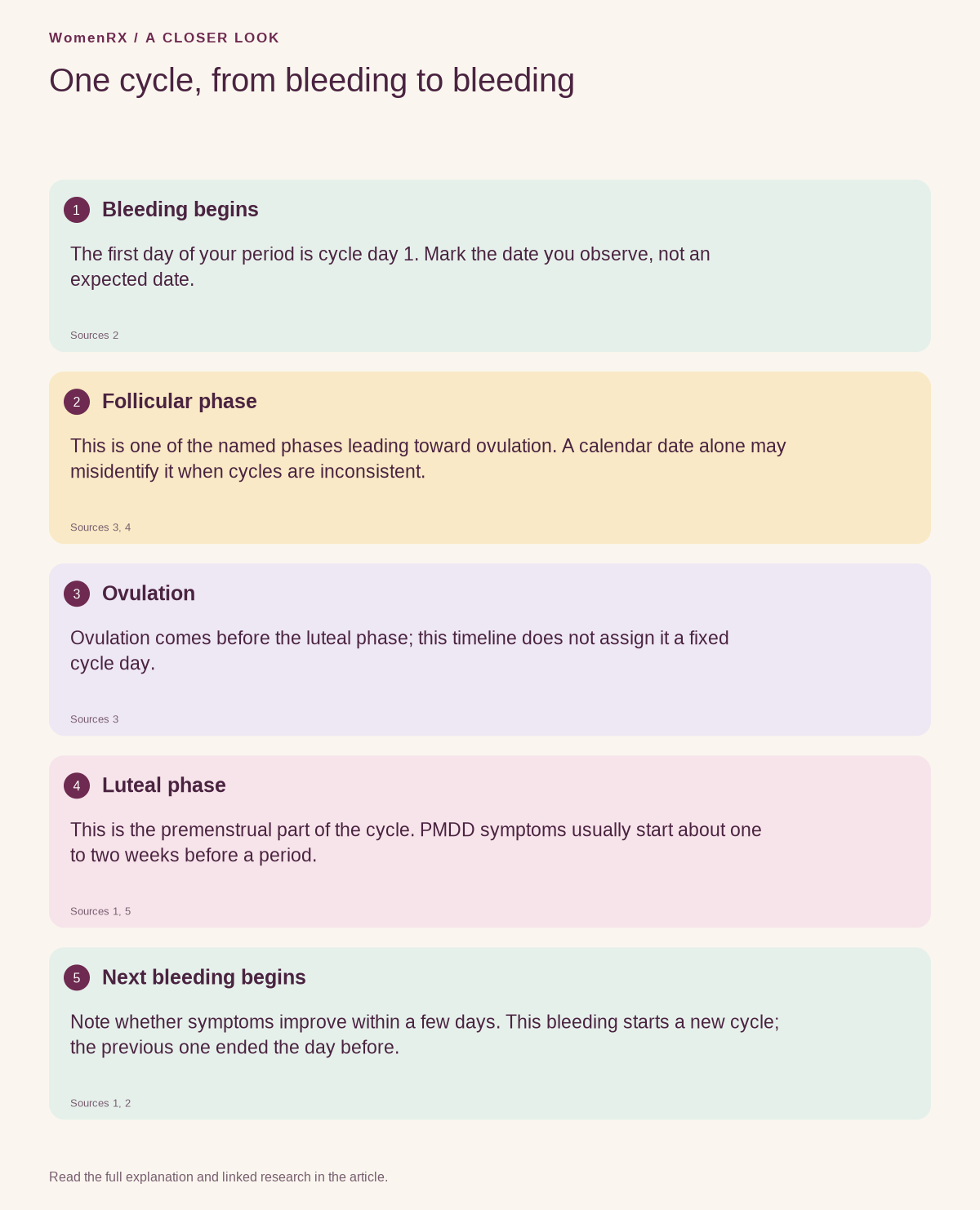
One cycle, from bleeding to bleeding
Bleeding begins: The first day of your period is cycle day 1. Mark the date you observe, not an expected date.2
Follicular phase: This is one of the named phases leading toward ovulation. A calendar date alone may misidentify it when cycles are inconsistent.34
Ovulation: Ovulation comes before the luteal phase; this timeline does not assign it a fixed cycle day.3
Luteal phase: This is the premenstrual part of the cycle. PMDD symptoms usually start about one to two weeks before a period.15
Next bleeding begins: Note whether symptoms improve within a few days. This bleeding starts a new cycle; the previous one ended the day before.12
Read the figure as text
Follow the usual phase sequence alongside the bleeding and symptom dates you can observe. The timeline assigns no fixed day to ovulation or other phases.- Bleeding begins: The first day of your period is cycle day 1. Mark the date you observe, not an expected date.2
- Follicular phase: This is one of the named phases leading toward ovulation. A calendar date alone may misidentify it when cycles are inconsistent.34
- Ovulation: Ovulation comes before the luteal phase; this timeline does not assign it a fixed cycle day.3
- Luteal phase: This is the premenstrual part of the cycle. PMDD symptoms usually start about one to two weeks before a period.15
- Next bleeding begins: Note whether symptoms improve within a few days. This bleeding starts a new cycle; the previous one ended the day before.12
More questions, answered
Can a hormone test confirm PMDD?
PMDD isn’t generally identified by assuming ovarian hormone levels are abnormal. A proposed explanation is heightened sensitivity to normal hormonal changes, and the exact cause is not fully understood. Assessment focuses on the recurring symptom pattern and how it affects you. 1 5
Does an irregular cycle rule out PMDD?
PMDD symptoms are described in relation to periods, and a diary covering at least two cycles may help with assessment. If your bleeding is irregular, record actual dates rather than relying on an assumed cycle length, and share that context during assessment. 1 2
Sources you can check
- PMDD (premenstrual dysphoric disorder) - NHSAccessed 2026-09-25Return to first citation
- Irregular periods - NHSAccessed 2026-09-25Return to first citation
- Autonomic Nervous System, Cognition, and Emotional Valence During Different Phases of the Menstrual Cycle-A Narrative Review.Roy S, Agordati E, Wilcockson TDW. · NeuroSci · 2025Return to first citation
- Exercise performance at different phases of the menstrual cycle: measurements, differences, and mechanisms - a narrative review.Wen Y, Gao B, Wang R, Zhao C. · Frontiers in endocrinology · 2025Return to first citation
- Psychobiological stress and premenstrual symptoms across the menstrual cycle: protocol for an ecological momentary assessment (ISSAC) study.Bencker C, Schmalenberger KM, Comasco E, Nater UM. · BMJ open · 2026Return to first citation