How to Track Mood Across Your Menstrual Cycle
A short daily record can help show whether mood symptoms repeat, when they change, and how much they affect your life.
Each day, note your mood and other symptoms, their effect on daily life, any bleeding, and useful context such as sleep or medication changes. Keep going on easier days, too. For assessing a possible premenstrual disorder, daily ratings across at least two cycles are recommended; your notes can help describe a pattern, but they aren’t a diagnostic test. 1 3
Make the record easy to keep
A tracker is most useful when you can fill it in on an ordinary day, including days when you feel fine. For assessment of possible premenstrual disorders, guidance recommends prospective daily symptom ratings across at least two cycles. Recording as you go can make timing easier to describe than relying on memory later; retrospective reports of premenstrual symptoms have high false-positive rates. 1 3
You don’t need to predict when your next period will start. Write down what you notice that day. If your cycles are irregular, record that and note bleeding when it actually occurs. If you use hormonal contraception, record that too, along with any changes. These details provide context, but they don’t establish a natural cycle phase. A study of elite athletes tracked mood and other daily measures in groups with regular cycles, irregular cycles, and hormonal contraception; it does not validate a personal tracker or show how to interpret an individual’s pattern. 2
A simple daily template
Use paper, a notes app, or a spreadsheet. Pick a format you can repeat without much effort. For example, you could rate each symptom from 0 (none) to 3 (severe). That’s a personal note-taking scale, not a validated diagnostic measure.
| Each day, note | What to write down |
|---|---|
| Mood and symptoms | Rate the changes you want to follow, such as irritability, low mood, anxiety, or physical symptoms. Add a brief note if a number needs context. |
| Impact | Note whether symptoms affected work, school, relationships, sleep, or usual activities. How much a symptom interferes with life is useful context alongside its intensity. 3 |
| Bleeding | Record whether bleeding occurred and any detail that matters to you. Write what happened rather than relying only on an app’s forecast. |
| Sleep | Note sleep in a consistent way, such as whether it felt restful or roughly how long you slept. Sleep and mood were tracked together in a prospective study that included athletes across different cycle-status groups. 2 |
| Medication and other context | Note medication changes, missed doses, contraception, or a major stressor when relevant. These are practical context notes, not a required or validated part of a diagnostic scale. |
If a longer entry feels like too much, start with mood or symptoms, impact, and bleeding. Add other details when they seem useful. In a small user-centered design study with people with lived experience of PMDD or severe premenstrual symptoms, participants emphasized ease of use and the ability to record both psychological and physical symptoms. 1
Summarize what repeats, not what you expected
After you have a record spanning a couple of cycles, look for what actually recurs. Which symptoms stand out? When do they seem to worsen or ease? Do they interfere with daily life? Do they settle after bleeding begins, or continue at other times? You don’t have to find a neat pattern, and not everyone experiences mood changes linked to their cycle. 4
That last distinction can matter in an assessment. Some premenstrual symptoms are concentrated in the luteal phase and remit after menstruation begins. In premenstrual exacerbation, symptoms of an underlying condition continue across the cycle but worsen before menstruation. Prospective daily records help show whether symptoms remit or persist. 3
A personal tracker can help you describe what you’ve noticed, but it can’t diagnose PMDD or another condition. A validated measure such as the Daily Record of Severity of Problems (DRSP) is used for prospective PMDD symptom ratings. If you want an assessment, bring your notes and explain how you tracked them; a clinician can help decide whether a standardized measure or another approach fits your situation. 1
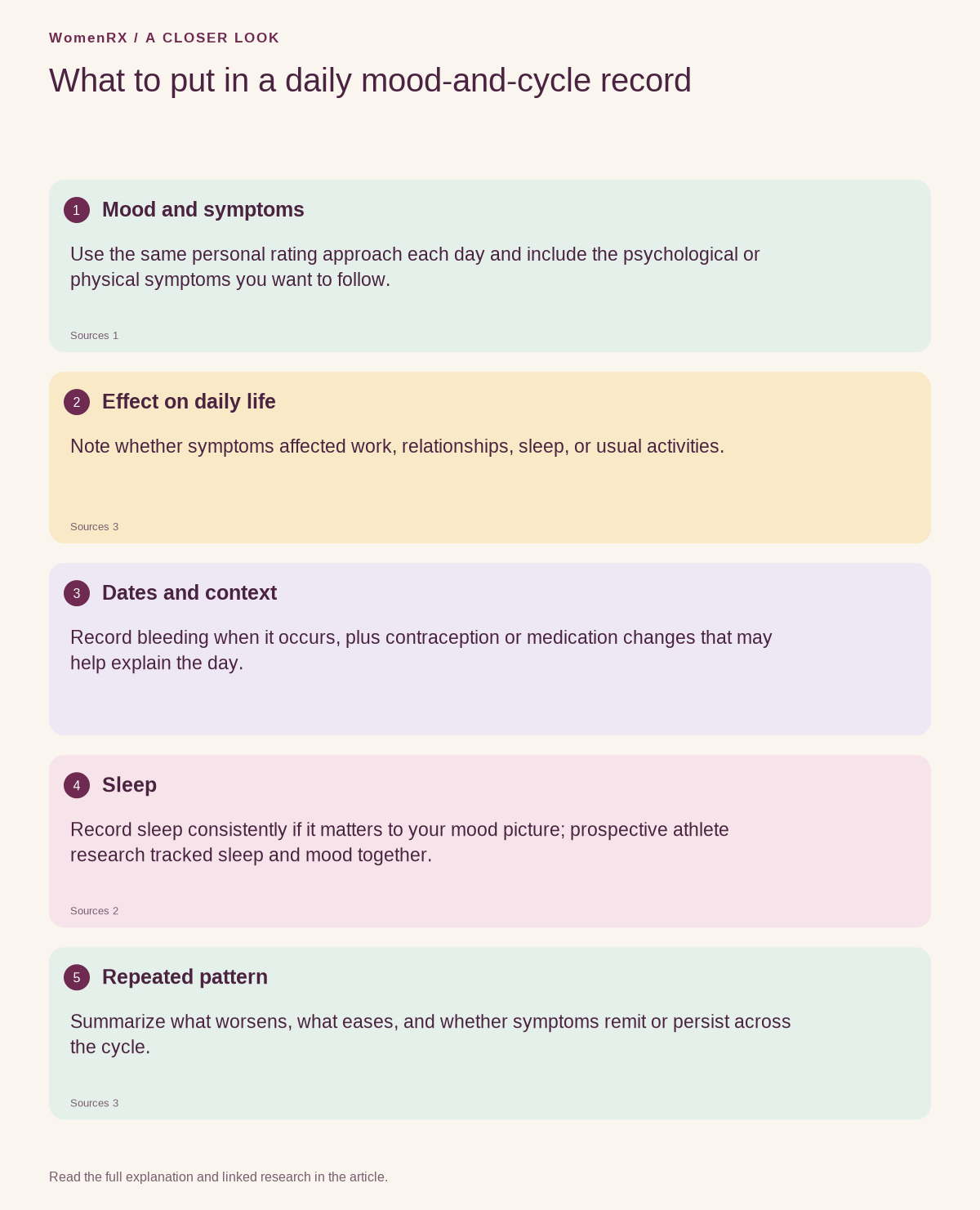
What to put in a daily mood-and-cycle record
Mood and symptoms: Use the same personal rating approach each day and include the psychological or physical symptoms you want to follow.1
Effect on daily life: Note whether symptoms affected work, relationships, sleep, or usual activities.3
Dates and context: Record bleeding when it occurs, plus contraception or medication changes that may help explain the day.
Sleep: Record sleep consistently if it matters to your mood picture; prospective athlete research tracked sleep and mood together.2
Repeated pattern: Summarize what worsens, what eases, and whether symptoms remit or persist across the cycle.3
Read the figure as text
Keep the daily entry brief, then use repeated observations to describe what changes and what continues.- Mood and symptoms: Use the same personal rating approach each day and include the psychological or physical symptoms you want to follow.1
- Effect on daily life: Note whether symptoms affected work, relationships, sleep, or usual activities.3
- Dates and context: Record bleeding when it occurs, plus contraception or medication changes that may help explain the day.
- Sleep: Record sleep consistently if it matters to your mood picture; prospective athlete research tracked sleep and mood together.2
- Repeated pattern: Summarize what worsens, what eases, and whether symptoms remit or persist across the cycle.3
More questions, answered
What if my cycles are irregular?
Keep recording symptoms and actual bleeding dates without trying to fit them to a predicted calendar. Note that your cycles are irregular. Your record can still show what happened over time, but it may not establish a cycle phase on its own. A study included people with irregular cycles, but it doesn’t validate an individual tracking method for clinical interpretation. 2
Can I track mood while using hormonal contraception?
Yes. You can record mood, symptoms, bleeding, and the contraception you use, including changes. Treat these as observations rather than assuming bleeding dates identify a natural cycle phase. A prospective athlete study included a hormonal-contraception group, but it does not provide a rule for interpreting an individual’s tracker. 2
Sources you can check
- Developing a Mood and Menstrual Tracking App for People With Premenstrual Dysphoric Disorder: User-Centered Design Study.Apsey C, Di Florio A, Stawarz K. · JMIR formative research · 2024Return to first citation
- Sleep duration impact on sleep quality, mood, and fitness in elite athletes with a natural menstrual cycle or hormonal contraceptive use.Baber F, Chassard T, Badier N, Lafitte A, Dupuit M, Saulière G, Debaud E, Toussaint JF, Antero J. · Chronobiology international · 2026Return to first citation
- Psychobiological stress and premenstrual symptoms across the menstrual cycle: protocol for an ecological momentary assessment (ISSAC) study.Bencker C, Schmalenberger KM, Comasco E, Nater UM. · BMJ open · 2026Return to first citation
- Affective Sensitivity to Ovarian Steroid Hormone Flux Across the Menstrual Cycle: Manifestations and Biopsychosocial Risk Factors.Stumper A, Schmalenberger KM, Eisenlohr-Moul TA, Peters JR. · Annual review of clinical psychology · 2026Return to first citation