Does Sleep Change Across the Menstrual Cycle?
Sleep can vary with cycle phase, but small studies have found different patterns, so repeated personal observations matter more than a prediction based on hormones alone.
Possibly. A small study of young women found more fragmented sleep in the late luteal phase, while a study of female athletes found no clear link between measured estradiol or progesterone and sleep. Neither result establishes a pattern for everyone. Tracking sleep, symptoms, bleeding, and contraception across cycles can show whether a pattern repeats, but it can't diagnose a hormone problem. 1 2
Sleep may feel different at different points in your cycle, but research hasn't established one pattern that applies to everyone. A small study found more sleep disruption in the late luteal phase, the days before menstruation. Another study of female athletes found that sleep measures weren't significantly associated with measured estradiol or progesterone. The useful takeaway is to look for a repeatable pattern in your own sleep, rather than assume a particular hormone level explains a rough night. 1 2
What the studies actually found
In a study of 17 healthy young women without obesity, researchers measured sleep and reproductive hormone markers daily during two cycles. Sleep was more disrupted in the late luteal phase. The study also found that short-term calorie restriction affected sleep independently of cycle phase, a reminder that cycle timing isn't the only possible influence. This small study can't tell us how often the same pattern occurs in other women. 1
A separate five-week study followed 24 young Indigenous women athletes, including 11 who were naturally cycling and 13 using hormonal contraception. It found no significant association between measured estradiol or progesterone and sleep measures. Among the naturally cycling athletes, more reported symptoms were associated with longer time to fall asleep. The participants were athletes in a particular training setting, so the result may not describe other groups. 2
These findings aren't necessarily contradictory. One study identified differences by cycle phase in a small group under specific diet conditions; the other didn't find a hormone-sleep relationship in a small athlete sample. Together, they suggest that sleep, symptoms, and hormones don't line up in a simple, predictable way for everyone. They don't establish that hormones cause an individual's sleep changes. 1 2
A simple way to track a pattern
For each day, jot down:
- When you went to bed and woke up, and whether you had trouble falling asleep or woke during the night.
- Whether you felt rested the next day, and any symptoms that stood out, such as pain or other premenstrual symptoms.
- The first day of bleeding, and whether you use hormonal contraception.
Keep the notes brief and look for a pattern across more than one cycle. One or two difficult nights don't show that your cycle is responsible. If you use a wearable, treat its sleep estimates as one observation, not a measurement of your hormones; in the athlete study, wearable sleep measures did not show a significant relationship with measured hormone concentrations. 2
If your cycles are irregular, record what actually happens rather than assigning yourself a cycle phase from a calendar prediction. Hormonal contraception also changes the hormonal profile, and the small athlete study does not establish how different contraceptive types affect sleep. Pregnancy and perimenopause are different life stages; these cycle studies don't answer what causes sleep changes in those settings. 2
When a recurring pattern is worth discussing
If sleep disruption keeps returning and affects how you feel or function during the day, it's reasonable to discuss it with a clinician, whether or not it appears tied to your cycle. Your notes may help describe the pattern, but they aren't a diagnostic test. These studies don't identify a particular cycle pattern that signals a hormone disorder, or establish a treatment for cycle-related sleep changes.
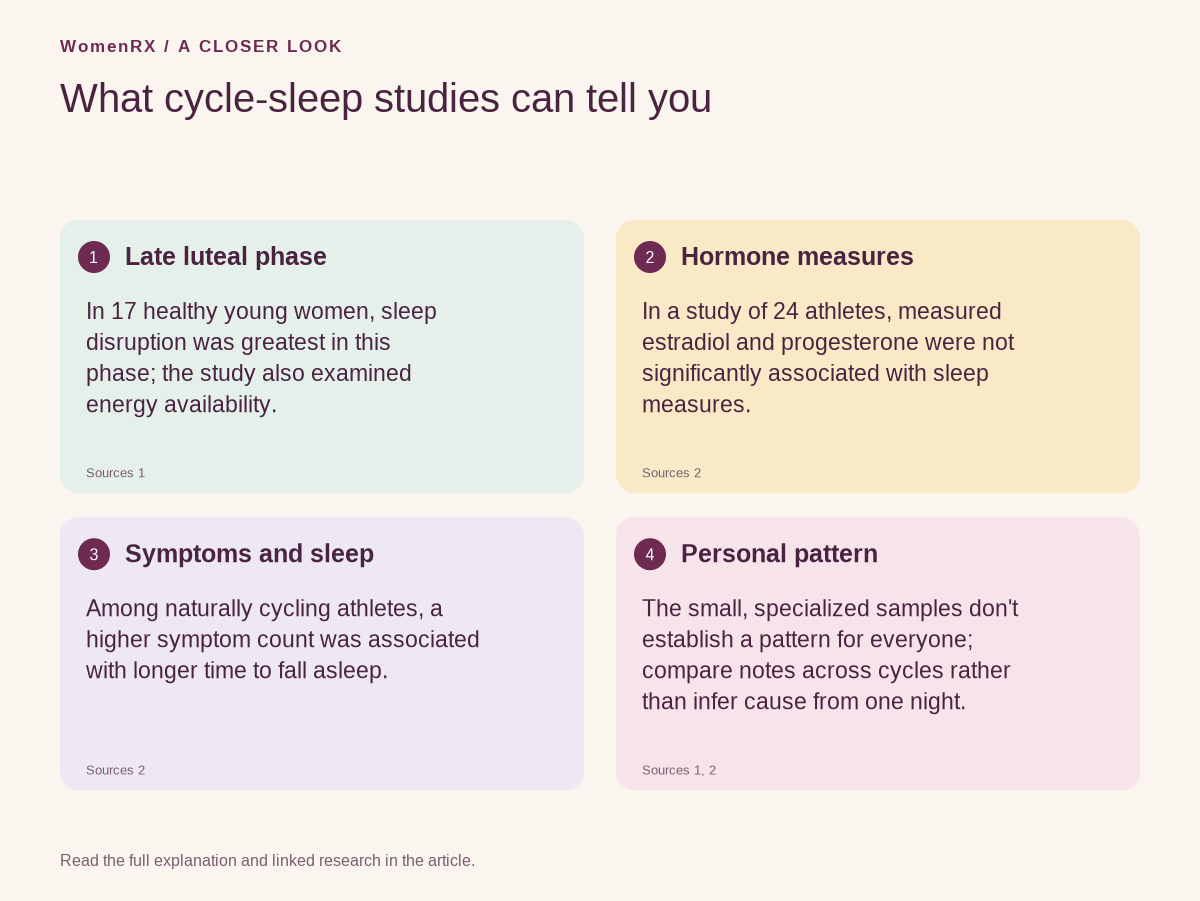
What cycle-sleep studies can tell you
Late luteal phase: In 17 healthy young women, sleep disruption was greatest in this phase; the study also examined energy availability.1
Hormone measures: In a study of 24 athletes, measured estradiol and progesterone were not significantly associated with sleep measures.2
Symptoms and sleep: Among naturally cycling athletes, a higher symptom count was associated with longer time to fall asleep.2
Personal pattern: The small, specialized samples don't establish a pattern for everyone; compare notes across cycles rather than infer cause from one night.12
Read the figure as text
A side-by-side view of two small studies helps separate a phase-related finding from a hormone-sleep association, and shows why neither predicts an individual's experience.- Late luteal phase: In 17 healthy young women, sleep disruption was greatest in this phase; the study also examined energy availability.1
- Hormone measures: In a study of 24 athletes, measured estradiol and progesterone were not significantly associated with sleep measures.2
- Symptoms and sleep: Among naturally cycling athletes, a higher symptom count was associated with longer time to fall asleep.2
- Personal pattern: The small, specialized samples don't establish a pattern for everyone; compare notes across cycles rather than infer cause from one night.12
More questions, answered
Does a sleep tracker show whether hormones are affecting my sleep?
No. A tracker may help you notice changes in estimated sleep over time, but it doesn't measure estradiol or progesterone. In a small study of female athletes, wearable sleep measures weren't significantly associated with measured concentrations of those hormones. 2
Sources you can check
- Caloric Restriction, the Menstrual Cycle, and Sleep in Women Without Obesity.Kim AE, Shekhar S, Hirsch KR, Purse BP, McGrath JA, Zava TT, Smith-Ryan AE, Hall JE. · The Journal of clinical endocrinology and metabolism · 2025Return to first citation
- Menstrual Cycle Symptoms, But Not Oestrogen or Progesterone Concentrations, Are Associated With Sleep in Female Athletes.Pearson MA, Weakley JJS, McKay AKA, Russell S, Leota J, Johnston RD, Minahan C, Harris R, Burke LM, Halson SL. · European journal of sport science · 2025Return to first citation