Can Symptoms Diagnose Low Progesterone? Cycle Timing Helps
Tracking symptoms can show when they occur in a cycle, not whether progesterone is low.
During the luteal phase after ovulation, the corpus luteum secretes progesterone. For a cycle-related assessment, a blood result needs to be interpreted in relation to ovulation. In a subfertility work-up, premenstrual spotting or irregular cycles may prompt further assessment, but neither confirms luteal phase deficiency; reliable tests of luteal function are lacking. Track other symptoms alongside bleeding and cycle dates to discuss their timing, not to infer a progesterone level. 2 3 4
What progesterone’s timing can tell you
Progesterone is mainly produced by the corpus luteum after ovulation and is the dominant hormone of the luteal phase, the part of the cycle between ovulation and the next period. It helps shape changes in the uterine lining during that phase. So a progesterone result is not a stand-alone reading: its meaning depends on whether ovulation has happened and when the sample was taken. 2
A result taken at the wrong point in the cycle could answer a different question from the one you meant to ask. A review of menstrual function in female athletes recommends mid-luteal progesterone measurement as one possible part of assessment, alongside cycle counting and ovulation testing. That is a monitoring suggestion in athletes, not a universal testing rule for every menstruating person. 3
Symptoms are clues, not a hormone test
In a subfertility work-up, spotting before a period or irregular cycles may prompt investigation, but neither confirms luteal phase deficiency; reliable diagnostic tools for assessing luteal function are lacking. Other premenstrual symptoms can be logged to describe their timing, rather than treated as progesterone results. 3 4
The limits matter because symptoms and ovulation do not always line up neatly. In a systematic review of female athletes who were not using hormonal contraception, most studies assessed symptoms retrospectively by self-report, and the review found substantial variation in cycle disorders and symptoms. Its authors called for more standardized assessment, including prospective symptom logs and, where feasible, ovulation testing and mid-luteal blood sampling. The athlete population limits how directly those suggestions can be applied to everyone, but the review supports recording patterns over time rather than drawing a hormone conclusion from one difficult week. 3
Make the record useful
For a few cycles, note:
- The first day of bleeding and how long bleeding lasts.
- When symptoms begin and ease, including whether they affect daily activities.
- Any spotting between periods and whether cycle lengths vary.
- If you use ovulation tests, when they are positive, while remembering that this is one piece of context rather than a diagnosis.
This kind of prospective record makes the relationship between symptoms and cycle phases easier to discuss. It can also help clarify whether a proposed progesterone blood test is intended to assess a point after ovulation. The athlete review describes cycle counting, urinary ovulation tests, symptom logging, and mid-luteal serum progesterone as assessment approaches, but it does not establish one schedule or a single interpretation for everyone. 3
When cycles are changing or have stopped
A cycle-day timeline is most useful when periods provide a reasonably clear reference point. If cycles are irregular, the calendar alone may not show when ovulation occurred, so a result should not be interpreted as though every cycle followed the same pattern. 3 4
After menopause, there is no menstrual cycle phase to use as a timing anchor. A progesterone question in that setting is different from asking whether a cycle-related symptom reflects low progesterone. Any vaginal bleeding after menopause should be checked, even if it happens once or is only spotting. 1
The useful takeaway is modest but practical: record the pattern, keep symptoms separate from conclusions about hormone levels, and make sure any test is interpreted with the cycle context in view.
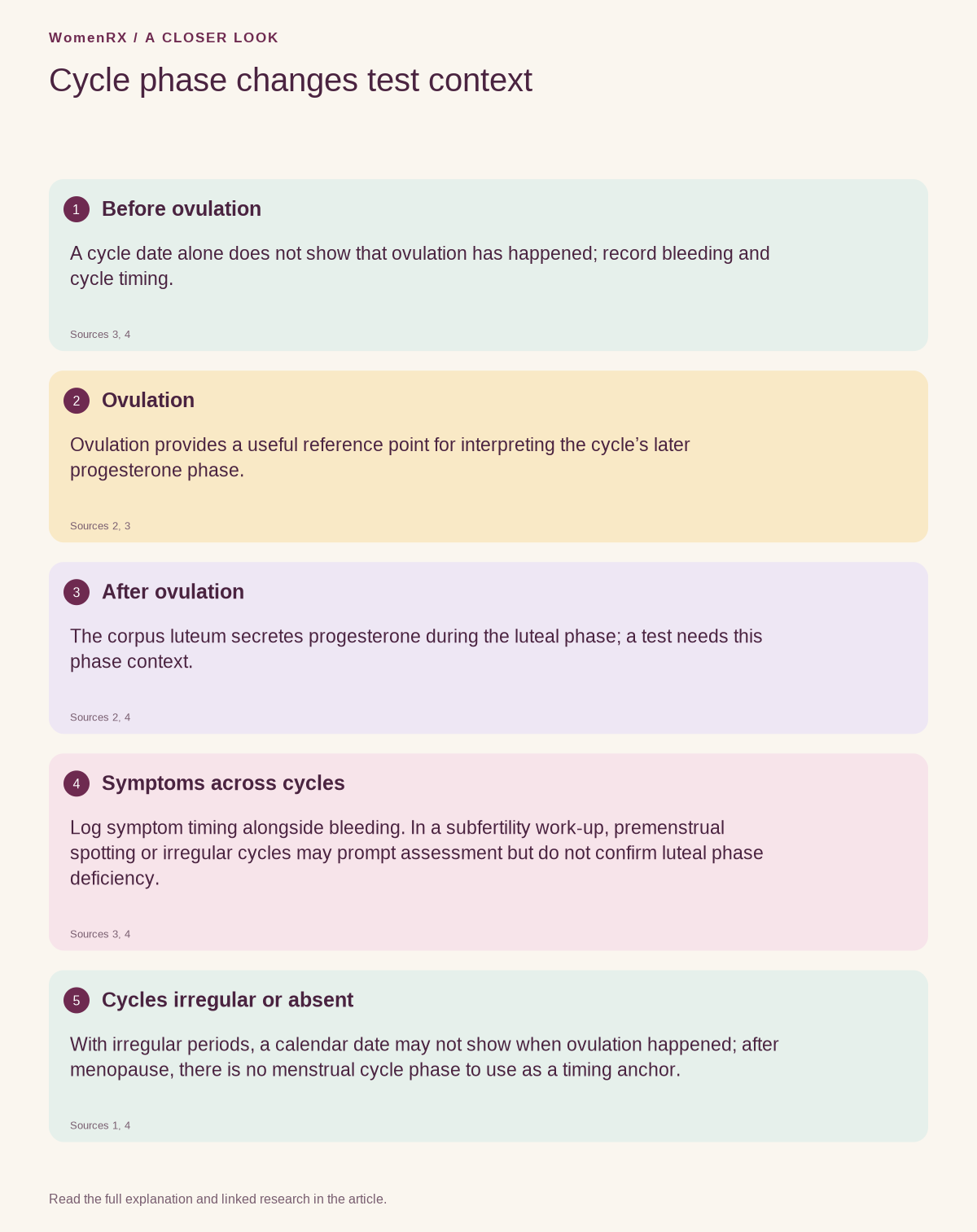
Cycle phase changes test context
Before ovulation: A cycle date alone does not show that ovulation has happened; record bleeding and cycle timing.34
Ovulation: Ovulation provides a useful reference point for interpreting the cycle’s later progesterone phase.23
After ovulation: The corpus luteum secretes progesterone during the luteal phase; a test needs this phase context.24
Symptoms across cycles: Log symptom timing alongside bleeding. In a subfertility work-up, premenstrual spotting or irregular cycles may prompt assessment but do not confirm luteal phase deficiency.34
Cycles irregular or absent: With irregular periods, a calendar date may not show when ovulation happened; after menopause, there is no menstrual cycle phase to use as a timing anchor.14
Read the figure as text
This phase map shows why symptom dates and possible progesterone testing need to be interpreted in relation to ovulation, not symptoms alone.- Before ovulation: A cycle date alone does not show that ovulation has happened; record bleeding and cycle timing.34
- Ovulation: Ovulation provides a useful reference point for interpreting the cycle’s later progesterone phase.23
- After ovulation: The corpus luteum secretes progesterone during the luteal phase; a test needs this phase context.24
- Symptoms across cycles: Log symptom timing alongside bleeding. In a subfertility work-up, premenstrual spotting or irregular cycles may prompt assessment but do not confirm luteal phase deficiency.34
- Cycles irregular or absent: With irregular periods, a calendar date may not show when ovulation happened; after menopause, there is no menstrual cycle phase to use as a timing anchor.14
More questions, answered
Is a progesterone test useful if I don’t know whether I ovulated?
The result is harder to interpret for a cycle-related question without knowing where you are in the cycle. Ovulation testing and cycle monitoring can add context; a calendar date alone may not establish when ovulation occurred. 3 4
Do premenstrual symptoms prove that progesterone is low?
No. In a subfertility work-up, premenstrual spotting or irregular cycles may prompt assessment, but neither confirms luteal phase deficiency. Logging other symptoms can help show when they occur without measuring progesterone. 3 4
Sources you can check
- Postmenopausal bleeding - NHSAccessed 2026-09-25Return to first citation
- Diagnostic and therapeutic use of oral micronized progesterone in endocrinology.Memi E, Pavli P, Papagianni M, Vrachnis N, Mastorakos G. · Reviews in endocrine & metabolic disorders · 2024Return to first citation
- The Prevalence of Menstrual Cycle Disorders and Menstrual Cycle-Related Symptoms in Female Athletes: A Systematic Literature Review.Taim BC, Ó Catháin C, Renard M, Elliott-Sale KJ, Madigan S, Ní Chéilleachair N. · Sports medicine (Auckland, N.Z.) · 2023Return to first citation
- An integrated view on the luteal phase: diagnosis and treatment in subfertility.Sonntag B, Ludwig M. · Clinical endocrinology · 2012Return to first citation