Could Symptoms Mean Low Progesterone? What Can and Cannot Be Inferred
Cycle changes and menopause symptoms can be worth discussing, but they don’t identify a progesterone deficiency on their own.
Symptoms alone can’t tell you that your progesterone is low. The meaning of a progesterone result depends partly on cycle timing, whether you’re ovulating, your life stage, and whether you use hormonal contraception or menopause hormone therapy. Cycle changes or troublesome symptoms can be reasons to seek an assessment, but they aren’t a diagnosis. 3 5 6
A symptom is a clue, not a hormone reading
There isn’t a reliable symptom checklist that can show you have “low progesterone.” Changes in bleeding, mood, sleep, or how you feel before a period can have several explanations. Even when symptoms follow a cycle pattern, that pattern doesn’t prove that a hormone level is deficient.
Mood symptoms are a useful example: some people are sensitive to normal ovarian hormone fluctuations, but a review reports that most menstruating people don’t experience a significant effect on mood or behavior. The review also describes hormone sensitivity as varied, rather than a simple response to having too little progesterone. 3
Hot flashes and vaginal or urinary discomfort can occur around menopause, but these symptoms don’t reveal which hormone is responsible or establish that progesterone is low. Menopause guidance discusses treatments for these symptoms as menopause-related concerns, not as a way to diagnose progesterone deficiency. 1 2
Why cycle timing changes what a result means
Progesterone changes across the menstrual cycle. That means a test result needs to be interpreted alongside where you are in your cycle and the reason the test was ordered. In a study of women in perimenopause, researchers specifically collected hormone measurements during the luteal phase, rather than treating a progesterone reading as independent of cycle stage. 6
Ovulation matters, too. During perimenopause, cycles and ovulation can become less predictable. In one small, two-year study of women aged 45 and older who were not using external hormones, the proportion of ovulatory cycles fell from 67% to 33%. That finding describes the study group, not a rule for every woman, and it doesn’t show that an individual’s symptoms are caused by low progesterone. 6
If a test is being considered, a useful question is: “What are we trying to find out, and when in my cycle would the result be meaningful?” The answer may depend on whether you have regular cycles, irregular cycles, or no periods, and on any hormone medicines you use.
The life-stage context matters
During cycling years, a change in bleeding or a recurring mood pattern may be worth discussing, especially if it affects your daily life. A pattern can help describe what is happening, but it cannot by itself distinguish hormone sensitivity from a low hormone level or another cause. 3
During perimenopause, cycle changes can reflect changing ovulatory activity. Don’t assume that irregular periods mean you have a progesterone deficiency; the small study above documents changing ovulation in a particular group, not a symptom-based diagnostic test. 6
After menopause, symptoms such as hot flashes or vaginal discomfort may still deserve attention, but they don’t demonstrate low progesterone. If you’re considering menopause hormone therapy, progesterone and related medicines may have a different purpose than symptom diagnosis: for a person with a uterus, a progestogen is used with systemic estrogen to help protect the uterine lining. 1 4
Hormone medicines can change the picture
Progesterone is not the only relevant factor when someone uses hormonal contraception or menopause hormone therapy. These treatments may involve progesterone or synthetic progestins, and their effects can depend on the medicine and how it is used. Research on progestagens and mood, cognition, and other brain effects remains limited in important ways; the effects of different treatments cannot be assumed to be interchangeable. 5
So, mention hormonal contraception or menopause therapy when discussing symptoms or a possible test. Don’t start progesterone or another hormone based only on a symptom list or an isolated result. The useful next move is an assessment of the change you’re noticing, with any test interpreted in its cycle and medication context.
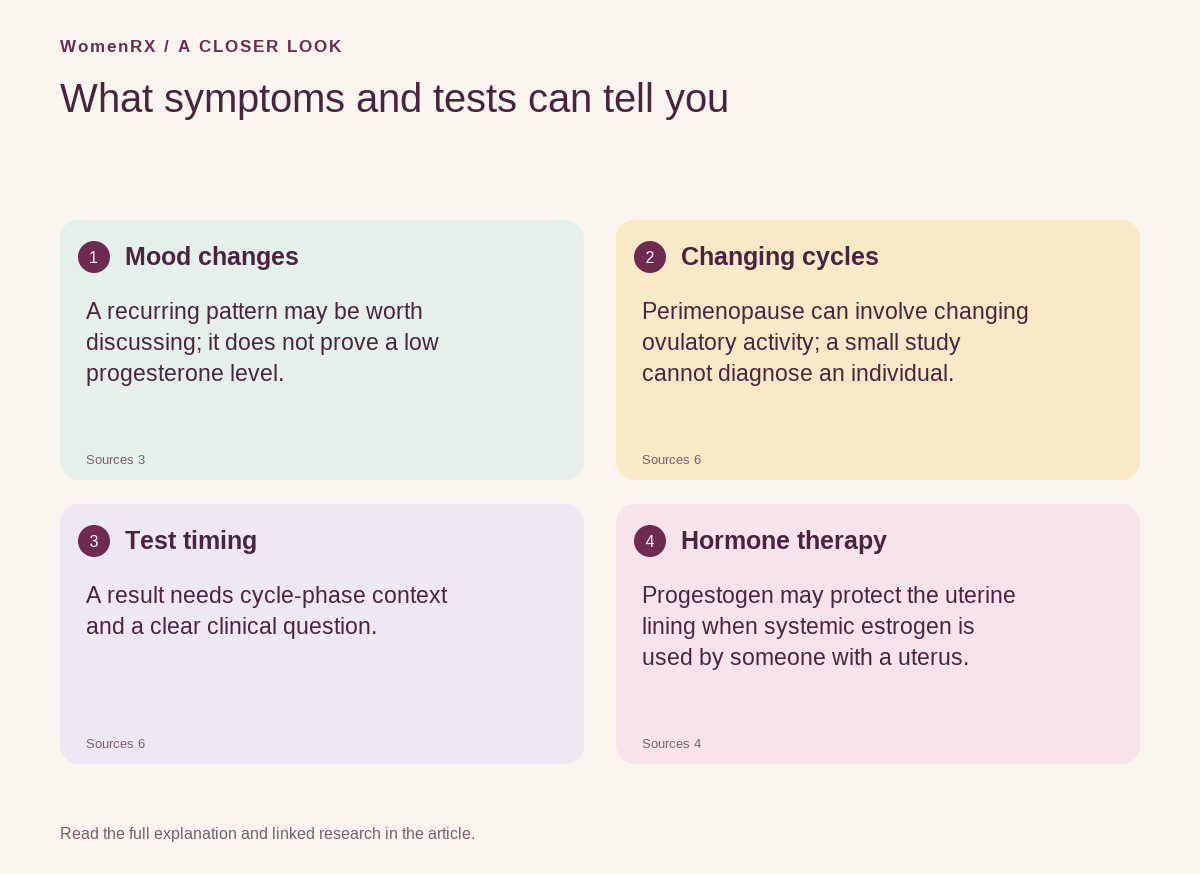
What symptoms and tests can tell you
Mood changes: A recurring pattern may be worth discussing; it does not prove a low progesterone level.3
Changing cycles: Perimenopause can involve changing ovulatory activity; a small study cannot diagnose an individual.6
Test timing: A result needs cycle-phase context and a clear clinical question.6
Hormone therapy: Progestogen may protect the uterine lining when systemic estrogen is used by someone with a uterus.4
Read the figure as text
Symptoms can prompt an assessment, but interpreting progesterone depends on cycle phase, life stage, and hormone use.- Mood changes: A recurring pattern may be worth discussing; it does not prove a low progesterone level.3
- Changing cycles: Perimenopause can involve changing ovulatory activity; a small study cannot diagnose an individual.6
- Test timing: A result needs cycle-phase context and a clear clinical question.6
- Hormone therapy: Progestogen may protect the uterine lining when systemic estrogen is used by someone with a uterus.4
More questions, answered
Does a mood change before my period mean my progesterone is low?
No. Mood symptoms can relate to sensitivity to normal hormone fluctuations, and that is not the same as proving a low progesterone level. The pattern may be useful to discuss, but it doesn’t diagnose the cause. 3
Does progesterone have a role in menopause hormone therapy?
Yes. For someone with a uterus who uses systemic estrogen, a progestogen is used to protect the uterine lining from estrogen’s proliferative effects. That treatment role is separate from using symptoms to diagnose a progesterone deficiency. 4
Sources you can check
- The 2022 hormone therapy position statement of The North American Menopause Society.“The 2022 Hormone Therapy Position Statement of The North American Menopause Society” Advisory Panel. · Menopause (New York, N.Y.) · 2022Return to first citation
- The 2023 nonhormone therapy position statement of The North American Menopause Society.Menopause (New York, N.Y.) · 2023Return to first citation
- Affective Sensitivity to Ovarian Steroid Hormone Flux Across the Menstrual Cycle: Manifestations and Biopsychosocial Risk Factors.Stumper A, Schmalenberger KM, Eisenlohr-Moul TA, Peters JR. · Annual review of clinical psychology · 2026Return to first citation
- Progesterone, progestins and the endometrium in perimenopause and in menopausal hormone therapy.Gompel A. · Climacteric : the journal of the International Menopause Society · 2018Return to first citation
- Progestagens and progesterone receptor modulation: Effects on the brain, mood, stress, and cognition in females.Bencker C, Gschwandtner L, Nayman S, Grikšienė R, Nguyen B, Nater UM, Guennoun R, Sundström-Poromaa I, Pletzer B, Bixo M, Comasco E. · Frontiers in neuroendocrinology · 2025Return to first citation
- Perimenopausal Bone Loss Is Associated with Ovulatory Activity-Results of the PeKnO Study (Perimenopausal Bone Density and Ovulation).Starrach T, Santl A, Seifert-Klauss VR. · Diagnostics (Basel, Switzerland) · 2022Return to first citation