Could Your Symptoms Mean Selenium Deficiency?
Symptoms such as fatigue have many possible causes, and selenium deficiency is uncommon in the United States, so symptoms alone can’t confirm it.
Fatigue or feeling unwell doesn’t by itself show that you’re low in selenium. Deficiency is rare in the United States and rarely causes obvious illness on its own. A useful assessment starts with your symptoms and nutrition and health history. A clinician may consider a selenium blood test when there’s a relevant risk, but a small study in a specialized hospital setting doesn’t establish routine testing for common symptoms. 1 3 4
Why a symptom list can mislead
Common symptoms such as fatigue can’t, by themselves, establish that you have low selenium. In the United States and Canada, selenium deficiency is rare, and deficiency by itself rarely causes overt illness. Some serious conditions have been associated with low selenium in particular settings, but that doesn’t make common symptoms a useful home test. 1
Fatigue is a good example. It can follow too little sleep or stress, but it can also be related to anemia, thyroid or kidney disease, pregnancy, sleep apnea, medicines, and other causes. If you’re persistently tired, the more useful question is what might be causing it, rather than whether selenium is the answer. 2 3
Risk matters more than a symptom match
Selenium inadequacy is more plausible when there’s a reason your intake or status could be low. The NIH Office of Dietary Supplements identifies people undergoing kidney dialysis, people living with HIV, and people whose diets rely heavily on food grown in selenium-poor regions as groups with greater risk. In the United States, even regions with lower-selenium soil generally have selenium intake above the recommended amount because foods come from many places. 1
A small study offers an example from a specialized hospital setting, not a general risk rule. It followed 39 patients in a neurosurgery study who had acute neurologic disorders and received enteral or parenteral nutrition for at least 14 days. Twenty-three were men, and the mean age was 74.6 years. Some had low selenium measurements; those identified as selenium-deficient had no clinical symptoms associated with deficiency. This study isn’t a reason for otherwise healthy women to seek routine testing; it illustrates a particular setting where nutrition and selenium status may warrant attention. 4
What assessment can and can’t tell you
Assessment has two parts that answer different questions. Your symptoms and health history help identify what needs investigating. If fatigue is the main concern, a clinician may ask about sleep, daily activities, appetite, and exercise, then use an exam and lab tests to look for possible causes. Anemia, for example, is assessed with blood tests; fatigue alone can’t distinguish it from a selenium concern. 2 3
The selenium-specific question is whether your nutrition or medical history gives a reason to suspect inadequate status. Diets dependent on crops from selenium-poor regions, kidney dialysis, and HIV are recognized risk contexts. Serum selenium can be measured: researchers used it in the small study of patients with acute neurologic disorders receiving nutritional support. But that study’s low-value definition and testing suggestions came from a specialized setting, not a general diagnostic cutoff or screening rule for women with nonspecific symptoms. A blood result therefore needs to be considered alongside the reason it was ordered, rather than treated as a stand-alone explanation for how you feel. 1 4
Pregnancy and breastfeeding change the intake target
The recommended selenium intake is 55 micrograms (mcg) a day for women ages 19 to 50, 60 mcg during pregnancy, and 70 mcg while breastfeeding. These are recommended dietary allowances for healthy people, not symptom-based diagnostic thresholds or instructions to start a supplement. The guidance gives different intake targets for these life stages; it does not identify ordinary pregnancy or breastfeeding symptoms as signs of selenium deficiency. 1
Food provides selenium through sources such as seafood, meat, poultry, eggs, grains, and dairy. The amount in plant foods can vary with the soil where they grew. Brazil nuts can contain particularly high amounts, with substantial variation between analyses, so they’re not a precise way to measure or correct an individual’s status. 1
A practical next step
If symptoms are ongoing, focus first on the symptom and its possible causes rather than starting selenium for a suspected deficiency. Mention a relevant risk factor, such as dialysis or long-term nutritional support, if it applies to you. If you’re pregnant or breastfeeding, use the life-stage intake target as nutrition guidance, not as evidence that a symptom is caused by low selenium. A supplement decision is more useful when it follows a clear reason to suspect inadequate status than when it’s based on a symptom list.
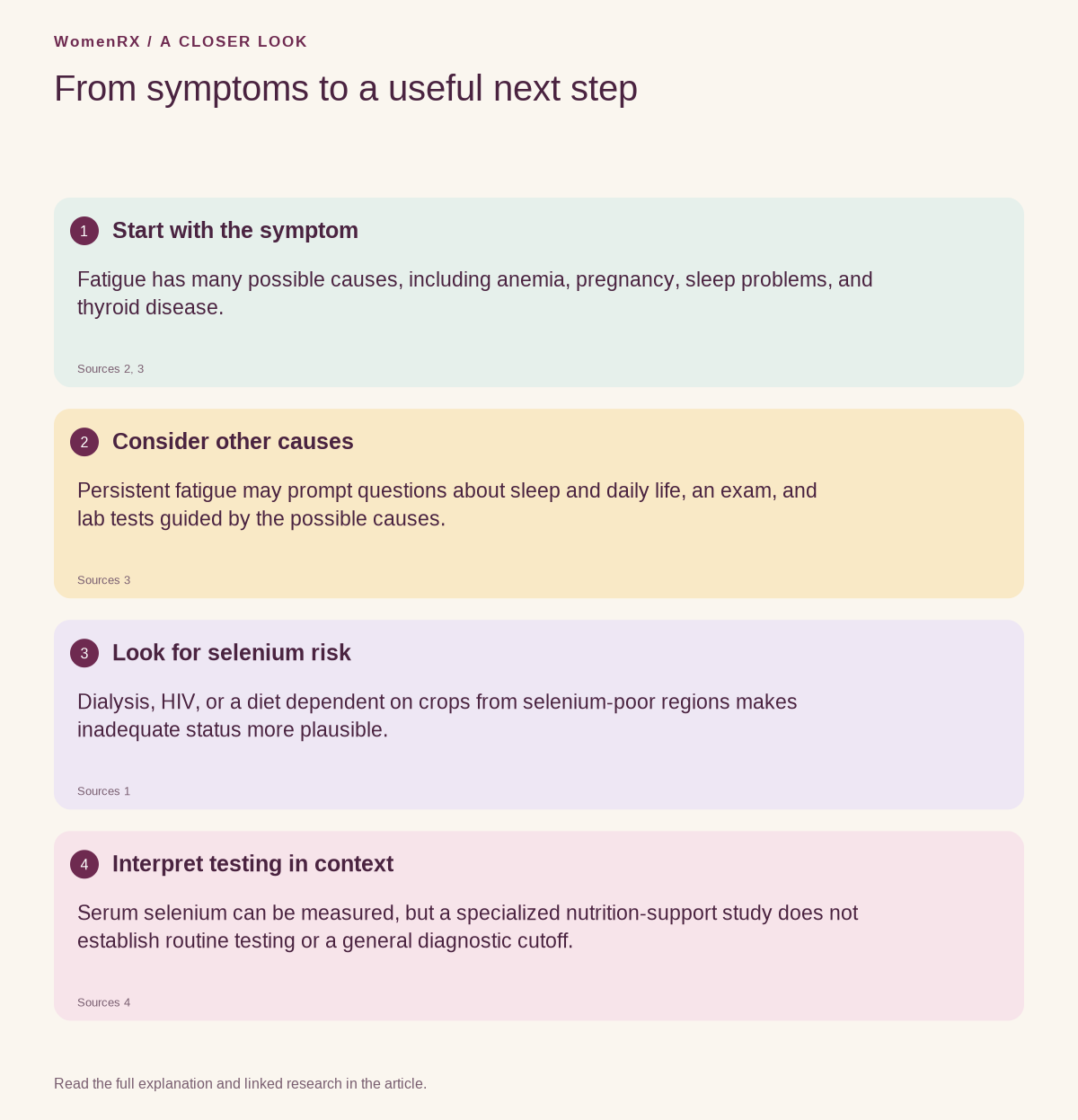
From symptoms to a useful next step
Start with the symptom: Fatigue has many possible causes, including anemia, pregnancy, sleep problems, and thyroid disease.23
Consider other causes: Persistent fatigue may prompt questions about sleep and daily life, an exam, and lab tests guided by the possible causes.3
Look for selenium risk: Dialysis, HIV, or a diet dependent on crops from selenium-poor regions makes inadequate status more plausible.1
Interpret testing in context: Serum selenium can be measured, but a specialized nutrition-support study does not establish routine testing or a general diagnostic cutoff.4
Read the figure as text
The path separates evaluating a symptom from deciding whether selenium status needs attention.- Start with the symptom: Fatigue has many possible causes, including anemia, pregnancy, sleep problems, and thyroid disease.23
- Consider other causes: Persistent fatigue may prompt questions about sleep and daily life, an exam, and lab tests guided by the possible causes.3
- Look for selenium risk: Dialysis, HIV, or a diet dependent on crops from selenium-poor regions makes inadequate status more plausible.1
- Interpret testing in context: Serum selenium can be measured, but a specialized nutrition-support study does not establish routine testing or a general diagnostic cutoff.4
More questions, answered
Should I ask for a selenium blood test because I’m tired?
Fatigue alone doesn’t point specifically to selenium deficiency. An evaluation can consider sleep, pregnancy, anemia, and thyroid or kidney disease, among other possibilities. Serum selenium can be measured, but the small study that used it involved patients with acute neurologic disorders receiving nutritional support; it doesn’t establish routine selenium testing for otherwise healthy women with fatigue. 2 3 4
Does breastfeeding mean I need a selenium supplement?
The recommended intake during breastfeeding is 70 mcg per day, compared with 55 mcg for women ages 19 to 50 who aren’t pregnant or breastfeeding. That target does not, by itself, mean you need a supplement; selenium comes from food too. 1
Sources you can check
- Selenium - Health Professional Fact SheetAccessed 2026-09-25Return to first citation
- Anemia | MedlinePlusAccessed 2026-09-25Return to first citation
- Fatigue: MedlinePlusAccessed 2026-09-25Return to first citation
- Serum Selenium Concentration in Neurosurgery Patients Receiving Parenteral Nutrition.Koketsu K, Kim K, Mihara R, Dan H, Ozeki T, Fujita H, Ideguchi M, Murai Y. · Journal of Nippon Medical School = Nippon Ika Daigaku zasshi · 2026Return to first citation