Low Progesterone: Possible Causes and How Clinicians Assess It
A progesterone result is easier to understand when you know where you were in your cycle and what the test was meant to investigate.
In cycling years, a low progesterone result may reflect a blood draw taken before ovulation, or a cycle in which ovulation did not happen as expected. Irregular or absent periods can have several underlying contexts, so a single result doesn’t identify the cause. Clinicians interpret it with cycle dates, menstrual history, and the reason for testing. Menopause treatment is a separate clinical question. 3 4 2 6
Start with the question behind the test
Progesterone changes over the course of a menstrual cycle. If the question is whether progesterone rose after ovulation, the blood draw needs to be interpreted in relation to that phase. A result taken before ovulation answers a different question from one taken after it, and irregular cycles can make the timing less clear. 3 4
It also matters why the test was ordered. A clinician may be investigating irregular or absent periods, fertility, or a result from a fertility-treatment cycle. Those situations call for different context; a progesterone measurement is not the same thing as a progesterone challenge test or a decision to use progesterone as treatment. 2 5
What can lie behind irregular or absent cycles?
A low result by itself can’t establish why a cycle was irregular or whether ovulation occurred. When ovulation doesn’t happen, there may be no typical post-ovulation phase to assess. The broader question is what may be disrupting menstrual function.
Exercise-related reproductive dysfunction is one possible context. A review describes a range of changes, including anovulation, infrequent or absent periods, and luteal-phase problems. It characterizes exercise-related dysfunction as multifactorial and a diagnosis of exclusion, so exercise is not a sufficient explanation for every low result or irregular cycle. 1
Other contexts for absent or infrequent periods include functional hypothalamic amenorrhea, premature ovarian insufficiency, and polycystic ovary syndrome (PCOS). A review discusses progesterone or progestins in the evaluation or treatment of amenorrhea and oligomenorrhea associated with these conditions, as well as disordered ovulation. That doesn’t mean a low progesterone test diagnoses any one of them. The menstrual pattern and the rest of the clinical picture matter. 2
For fertility concerns, irregular cycles or spotting before a period may prompt further evaluation, but they don’t confirm a luteal-phase deficiency. A review focused on subfertility notes that reliable tools for diagnosing adequate luteal function are lacking. 3
How cycle timing shapes testing
The first useful details are often the date of the last period, usual cycle length and regularity, and the date of the blood draw. If the aim is to assess the post-ovulation phase, the clinician needs a way to estimate when ovulation happened. A systematic review of studies in female athletes describes cycle calendars, urinary ovulation tests, and mid-luteal blood sampling as assessment methods, while also reporting that study definitions and methods varied. 4
If periods are irregular, a calendar date alone may not show whether a sample was taken at the intended phase. The clinician may consider menstrual history and, depending on the situation, ways of estimating ovulation. A single result should be read in that context, not treated as a stand-alone explanation for a cycle change. 3 4
When periods are absent, the evaluation may be broader than measuring blood progesterone. A progesterone or progestin challenge is a different kind of test: the review describes it as a way to gather information about estrogen exposure of the uterine lining and whether the outflow tract is open. Protocols described in the review vary, so this is a clinician-directed assessment, not a self-test. 2
Perimenopause and menopause are different contexts
A mid-luteal test depends on an identifiable post-ovulation phase. Once menstrual cycles have ceased, there is no cycle phase of that kind to target. If progesterone or another progestogen comes up in a menopause-treatment discussion, that treatment decision is not, by itself, evidence that a low blood progesterone level was diagnosed. Menopause hormone therapy decisions involve their own indications and individualized benefit-risk considerations. 4 2 6
If a result was measured during fertility treatment, interpretation can depend on the treatment cycle and on the type and route of progesterone used. Findings from one treatment setting don’t automatically apply to another. 5
The details that make a result more interpretable
For a discussion about a result, bring the date of your last period, your usual cycle pattern, the blood-draw date, and the reason the test was ordered. Mention whether periods have become infrequent or stopped, and whether the result was obtained during fertility treatment or while using prescribed hormones. Those details help distinguish a timing issue from a broader question about menstrual function or a treatment-specific result. 3 4 5
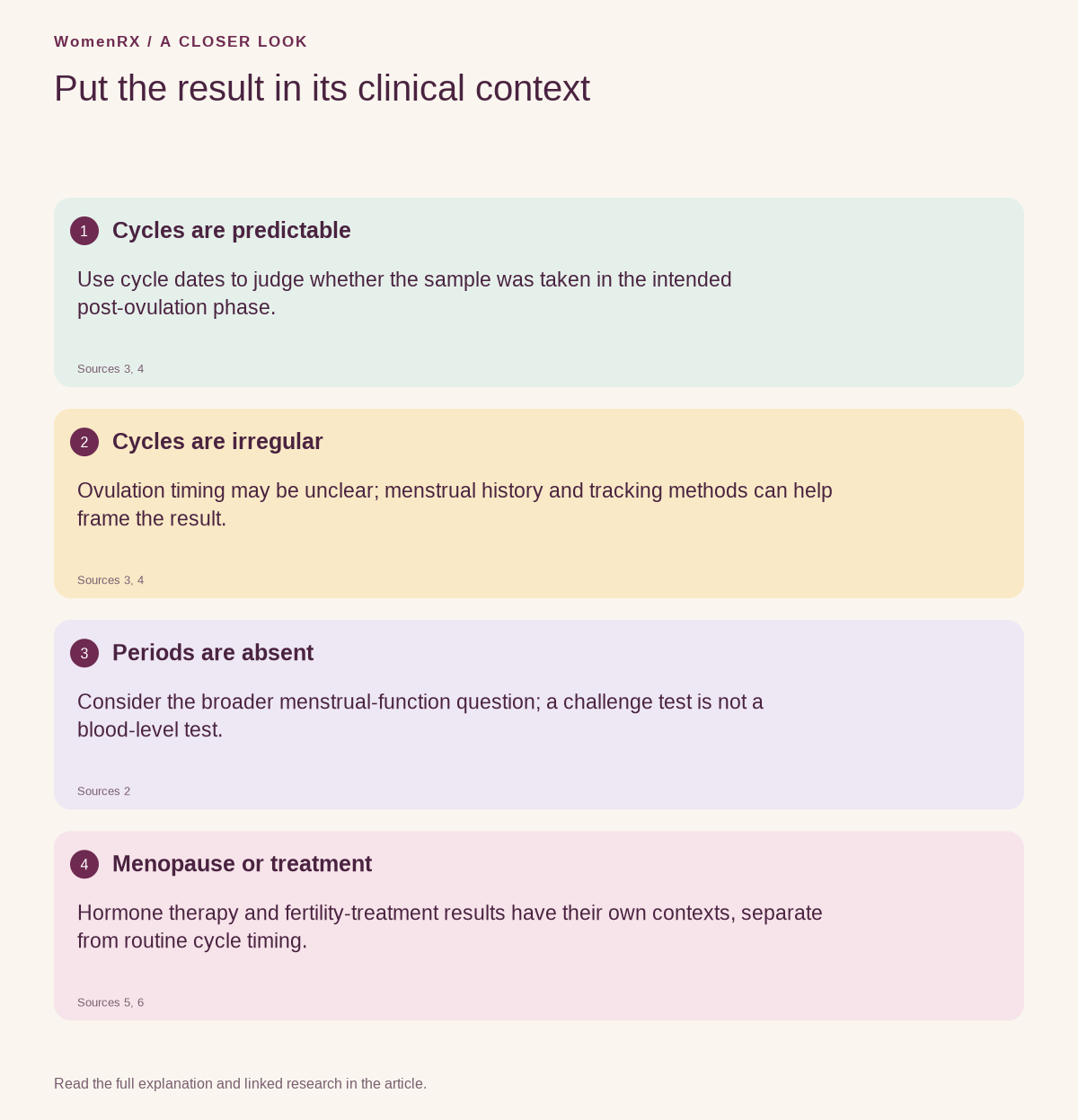
Put the result in its clinical context
Cycles are predictable: Use cycle dates to judge whether the sample was taken in the intended post-ovulation phase.34
Cycles are irregular: Ovulation timing may be unclear; menstrual history and tracking methods can help frame the result.34
Periods are absent: Consider the broader menstrual-function question; a challenge test is not a blood-level test.2
Menopause or treatment: Hormone therapy and fertility-treatment results have their own contexts, separate from routine cycle timing.56
Read the figure as text
The purpose of the test and the menstrual or treatment context help determine what a progesterone result can answer.- Cycles are predictable: Use cycle dates to judge whether the sample was taken in the intended post-ovulation phase.34
- Cycles are irregular: Ovulation timing may be unclear; menstrual history and tracking methods can help frame the result.34
- Periods are absent: Consider the broader menstrual-function question; a challenge test is not a blood-level test.2
- Menopause or treatment: Hormone therapy and fertility-treatment results have their own contexts, separate from routine cycle timing.56
More questions, answered
Is a progesterone challenge the same as a progesterone blood test?
No. A blood test measures progesterone in the sample. A challenge test involves taking progesterone or a progestin and observing whether bleeding follows; a review describes it as providing information about estrogen exposure of the uterine lining and outflow tract. It is a different assessment with variable protocols. 2
Sources you can check
- Menstrual function in sports.Roupas ND, Georgopoulos NA. · Hormones (Athens, Greece) · 2011Return to first citation
- Diagnostic and therapeutic use of oral micronized progesterone in endocrinology.Memi E, Pavli P, Papagianni M, Vrachnis N, Mastorakos G. · Reviews in endocrine & metabolic disorders · 2024Return to first citation
- An integrated view on the luteal phase: diagnosis and treatment in subfertility.Sonntag B, Ludwig M. · Clinical endocrinology · 2012Return to first citation
- The Prevalence of Menstrual Cycle Disorders and Menstrual Cycle-Related Symptoms in Female Athletes: A Systematic Literature Review.Taim BC, Ó Catháin C, Renard M, Elliott-Sale KJ, Madigan S, Ní Chéilleachair N. · Sports medicine (Auckland, N.Z.) · 2023Return to first citation
- New concepts and difficulties with progesterone supplementation in the luteal phase.Martínez MC, Rodríguez-Varela C, Demur EL. · Current opinion in obstetrics & gynecology · 2021Return to first citation
- The 2022 hormone therapy position statement of The North American Menopause Society.“The 2022 Hormone Therapy Position Statement of The North American Menopause Society” Advisory Panel. · Menopause (New York, N.Y.) · 2022Return to first citation