How to assess an online progesterone prescription service
Look beyond the speed of the prescription to see whether the service explains the treatment, reviews your health history, identifies the medicine, and plans follow-up.
Before seeking progesterone online, check whether a clinician will assess why you want it, whether you have a uterus, whether you use estrogen, and health history relevant to the proposed treatment. Ask for the exact product and a way to follow up. A questionnaire can gather information, but a quick approval alone doesn’t show how those details shaped the prescription. 1 2 3
An online visit may be convenient. The useful question is what happens between filling out a form and receiving a prescription. Can someone explain why progesterone fits your situation, what they checked before prescribing, and what happens if the plan needs to change?
First, find out what progesterone is meant to do
Ask the clinician to name the treatment goal. If you use systemic estrogen and have a uterus, a progestogen is generally recommended to reduce the chance of cancer of the uterine lining. In that situation, progesterone may be one part of a broader hormone therapy plan. 1
That’s a different decision from taking progesterone on its own for symptoms such as hot flashes or sleep problems. A narrative review discusses progestogen-only treatment as an option for some women, while noting limits in long-term safety evidence. If that’s what a service proposes, ask what benefit it expects for your particular symptom and why it favors this approach over other options. 4
Make sure the clinician knows whether you still have a uterus, have had a hysterectomy, or aren’t sure what an earlier surgery involved. Tell them about any estrogen you use, too. Those details affect the reason for adding progesterone; they shouldn’t be left for you to infer from a product page. 1
Look for an assessment, not an automatic approval
A questionnaire can be a starting point, but you should be able to tell whether a clinician reviews your answers, can ask follow-up questions, and considers your health history before prescribing. If estrogen is part of the proposed treatment, for example, a history of certain cancers or blood clots needs attention in the prescribing conversation. These examples appear in the patient information for Bijuva, a combined estradiol-and-progesterone product; they aren’t a complete checklist for every progesterone prescription. 1
There’s a reason to ask how this review works rather than assume a prescription means every issue was addressed. In a medical-record audit at four Veterans Health Administration facilities, 28% of new systemic hormone therapy prescriptions documented the absence of contraindications. That finding describes documentation in those facilities. It does not tell us whether an individual patient received a clinical review, and it does not measure the quality of online services. 3
A useful question is: “Who reviews my history, and how can I discuss anything that needs more than a yes-or-no answer?” If you mention a health condition and receive an unexplained approval anyway, ask how it factored into the decision.
Know exactly what you’re being prescribed
Before agreeing, ask for the medication’s name, formulation, route, and prescribed strength. “Progesterone” by itself may not give you enough information to recognize what the clinician intends. For example, Prometrium is an oral capsule containing micronized progesterone. That description belongs to that product; don’t assume it describes every item advertised under the word “progesterone.” 2
Ask which pharmacy will fill the prescription and how you can check that what you receive matches the clinician’s plan. If a service changes the proposed product or can’t explain its formulation, get clarification before moving ahead.
Check what happens after the prescription
Find out who you can contact with questions, what changes should prompt you to get back in touch, and when the treatment will be reviewed. This matters whether progesterone is part of an estrogen regimen or is being proposed on its own: you need a way to discuss whether it’s helping and whether the original plan still fits.
There isn’t one follow-up schedule established here for all progesterone prescriptions. As a product-specific example, Bijuva’s patient information advises regular conversations about whether that combined treatment is still needed. Use that as a prompt to ask about your follow-up plan, not as a schedule to apply to a different medicine. 1
A practical test of the service is whether you can leave the conversation able to say why progesterone was offered, how your uterus and any estrogen use affected the decision, what exact medicine was prescribed, and whom you’ll contact next. If any answer is missing, ask for it before accepting the prescription.
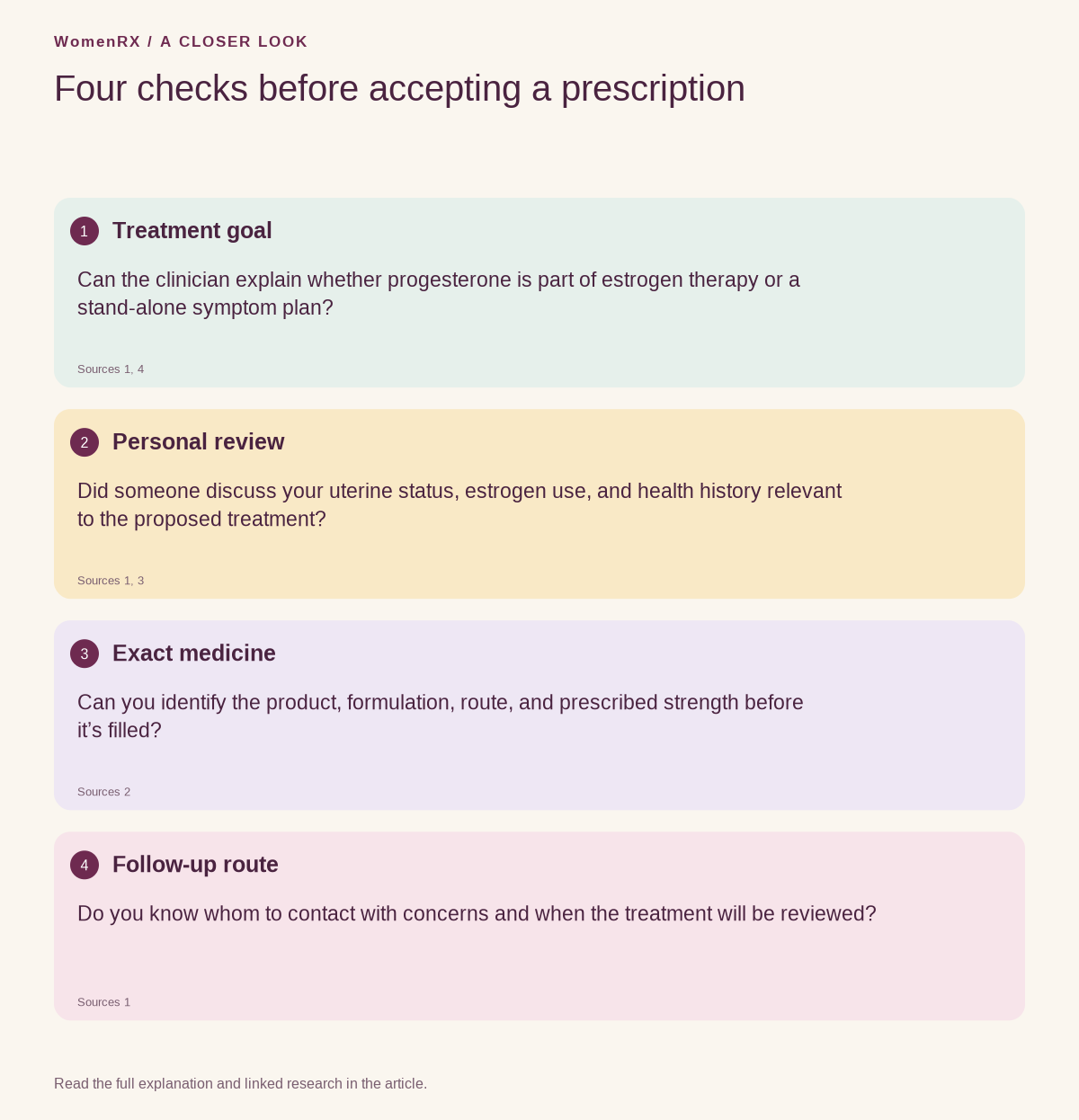
Four checks before accepting a prescription
Treatment goal: Can the clinician explain whether progesterone is part of estrogen therapy or a stand-alone symptom plan?14
Personal review: Did someone discuss your uterine status, estrogen use, and health history relevant to the proposed treatment?13
Exact medicine: Can you identify the product, formulation, route, and prescribed strength before it’s filled?2
Follow-up route: Do you know whom to contact with concerns and when the treatment will be reviewed?1
Read the figure as text
Use these questions to find out whether the service explains the clinical decision, not just the ordering process.- Treatment goal: Can the clinician explain whether progesterone is part of estrogen therapy or a stand-alone symptom plan?14
- Personal review: Did someone discuss your uterine status, estrogen use, and health history relevant to the proposed treatment?13
- Exact medicine: Can you identify the product, formulation, route, and prescribed strength before it’s filled?2
- Follow-up route: Do you know whom to contact with concerns and when the treatment will be reviewed?1
More questions, answered
Why does an online prescriber need to know whether I have a uterus?
If you use systemic estrogen and have a uterus, a progestogen is generally recommended to reduce the chance of cancer of the uterine lining. Uterine status helps the clinician explain whether that is the role progesterone would play in your plan. 1
Does a prescription for progesterone mean I’ll receive micronized progesterone?
Don’t rely on the general term alone. Ask for the precise product and formulation. Prometrium, for example, is an oral micronized progesterone capsule, but its product description shouldn’t be assumed to apply to every proposed prescription. 2
Sources you can check
- BIJUVA (ESTRADIOL AND PROGESTERONE) CAPSULE [MAYNE PHARMA] | US prescribing information and patient instructionsAccessed 2026-09-25Return to first citation
- PROMETRIUM (PROGESTERONE) CAPSULE [ACERTIS PHARMACEUTICALS, LLC] | US prescribing information and patient instructionsAccessed 2026-09-25Return to first citation
- Veterans Health Administration Primary Care Provider Adherence to Prescribing Guidelines for Systemic Hormone Therapy in Menopausal Women.Cordasco KM, Yuan AH, Danz MJ, Jackson L, Yee EF, Tcheung LS, Washington DL. · Journal for healthcare quality : official publication of the National Association for Healthcare Quality · 2019Return to first citation
- Expanding the Horizons of Menopausal Hormone Therapy: A Narrative Review of Progestogen-Only and Testosterone-Only Strategies for Tailored Management.Lee HJ, Yu EH, Joo JK. · Journal of menopausal medicine · 2026Return to first citation