What should you know before starting prescription progesterone?
Before you start, find out what the prescription is meant to do, exactly which hormones it contains, and how its route fits your treatment plan.
Confirm the treatment goal and the exact medicine and route before starting prescription progesterone. In menopause care, ask whether you’re also taking estrogen and, if you have a uterus, whether protecting its lining is part of the plan. A progesterone-only capsule and an estradiol-progesterone combination have different indications, and evidence for uterine protection differs by route. 1 2 4
First, find out what the prescription is for
A prescription for progesterone doesn't always have the same purpose. Oral micronized progesterone capsules have US-labeled uses that include preventing overgrowth of the uterine lining in certain postmenopausal women taking estrogen and treating secondary amenorrhea, which means periods have stopped after previously occurring. 2
A capsule containing both estradiol and progesterone has a different stated purpose: treating moderate to severe hot flashes and night sweats due to menopause. That indication belongs to the combination, not to progesterone alone. If symptom relief is your goal, ask which part of the plan is intended to relieve symptoms and which part serves another purpose. 1 2
If estrogen is part of the plan, ask about uterine protection
If you have a uterus and use systemic estrogen after menopause, a progestogen is generally included to protect the uterine lining. This matters even if estrogen is the part of the treatment you expect to help your hot flashes. A US study of hormone-therapy prescribing identified missing progesterone prescriptions for some women with a uterus who were prescribed systemic estrogen and noted the resulting concern about endometrial cancer risk. 3 4
Ask whether your prescription is meant to provide that protection. Then confirm that its form and route match the plan. A systematic review found evidence of endometrial protection with certain oral micronized-progesterone regimens and discussed some vaginal regimens used off-label. It concluded that transdermal micronized progesterone does not provide endometrial protection. A progesterone cream should not be treated as interchangeable with a prescribed capsule for this purpose. 4
Read the product name, not just the word “progesterone”
For example, Prometrium is an oral micronized-progesterone capsule. Bijuva is an oral capsule containing estradiol and micronized progesterone. Knowing which one you're being prescribed changes how you interpret its intended benefit, instructions, and reported side effects. 1 2
Before your first dose, check these points with the prescriber or pharmacist:
- What is this medicine intended to treat or prevent for me?
- Does this product contain progesterone alone, or estrogen too? Am I taking estrogen separately?
- How am I meant to use this specific product, and does its route fit the treatment goal?
- If I have a uterus and take estrogen, how does this plan protect the uterine lining?
- What side effects or bleeding changes should prompt a call, and when will we review whether the plan is working?
Bring a list of your prescription medicines, over-the-counter medicines, and supplements so the pharmacist can check interactions against the exact product. Don't rely on interaction advice for a different hormone formulation.
Put side-effect reports in context
Headache, breast tenderness, and dizziness were reported in a three-year placebo-controlled trial of postmenopausal women taking cyclic Prometrium with conjugated estrogen. For example, breast tenderness was reported by 27% of the combination-treatment group and 6% of the placebo group. Those figures describe that trial and combination, not the chance of breast tenderness from progesterone alone. 2
In a separate one-year study of estradiol-progesterone combination capsules in postmenopausal women, breast tenderness, headache, nausea, and vaginal bleeding were among the reported events. Because both hormones were in the capsule, the study cannot tell you which hormone caused an individual symptom. Ask what changes might occur with your plan and how to report bleeding you weren't expecting, rather than changing treatment on your own. 1
You may also see warnings based on the Women's Health Initiative trial of conjugated estrogen plus medroxyprogesterone acetate, a different progestin from micronized progesterone. That trial found increased cardiovascular risks with the regimen it tested. The prescribing information says those results do not establish the extent of risk for other doses, routes, or hormone combinations, but they cannot rule those risks out either. The useful question is how the risks and expected benefit of your actual prescription fit your health history. 1 2
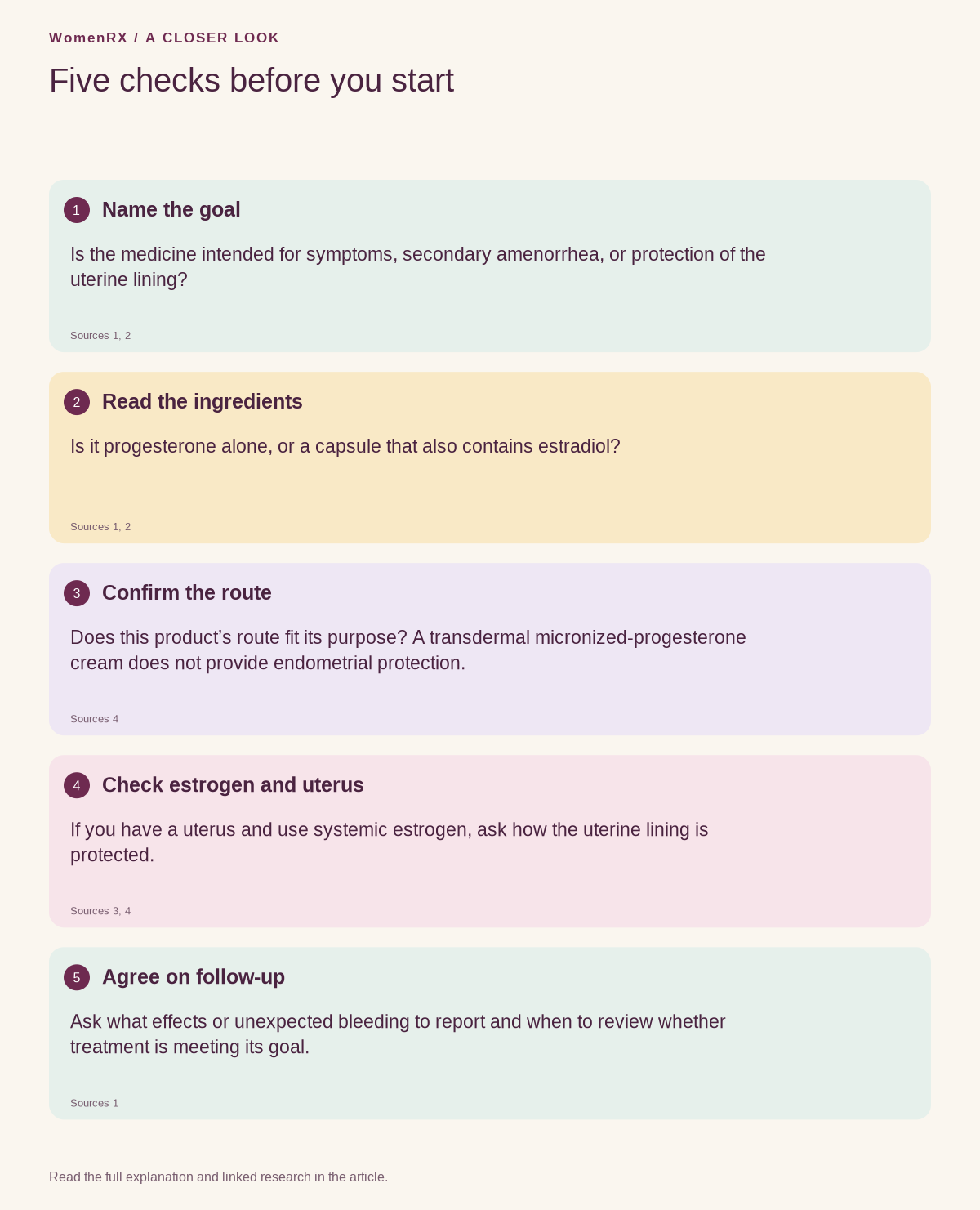
Five checks before you start
Name the goal: Is the medicine intended for symptoms, secondary amenorrhea, or protection of the uterine lining?12
Read the ingredients: Is it progesterone alone, or a capsule that also contains estradiol?12
Confirm the route: Does this product’s route fit its purpose? A transdermal micronized-progesterone cream does not provide endometrial protection.4
Check estrogen and uterus: If you have a uterus and use systemic estrogen, ask how the uterine lining is protected.34
Agree on follow-up: Ask what effects or unexpected bleeding to report and when to review whether treatment is meeting its goal.1
Read the figure as text
Use these questions to connect the prescription in your hand with its purpose and your menopause-treatment plan.- Name the goal: Is the medicine intended for symptoms, secondary amenorrhea, or protection of the uterine lining?12
- Read the ingredients: Is it progesterone alone, or a capsule that also contains estradiol?12
- Confirm the route: Does this product’s route fit its purpose? A transdermal micronized-progesterone cream does not provide endometrial protection.4
- Check estrogen and uterus: If you have a uterus and use systemic estrogen, ask how the uterine lining is protected.34
- Agree on follow-up: Ask what effects or unexpected bleeding to report and when to review whether treatment is meeting its goal.1
More questions, answered
Does being prescribed progesterone mean I’m also taking estrogen?
No. Oral micronized progesterone has a listed use for secondary amenorrhea as well as a use alongside estrogen for uterine-lining protection. A combination capsule, by contrast, contains both hormones. Check the product name and whether estrogen is prescribed separately. 1 2
Can progesterone cream replace a capsule for uterine protection?
Don’t assume so. A systematic review concluded that transdermal micronized progesterone does not provide endometrial protection. If uterine protection is part of your estrogen-treatment plan, clarify which prescribed product and route provide it. 4
Sources you can check
- BIJUVA (ESTRADIOL AND PROGESTERONE) CAPSULE [MAYNE PHARMA] | US prescribing information and patient instructionsAccessed 2026-09-25Return to first citation
- PROMETRIUM (PROGESTERONE) CAPSULE [ACERTIS PHARMACEUTICALS, LLC] | US prescribing information and patient instructionsAccessed 2026-09-25Return to first citation
- Veterans Health Administration Primary Care Provider Adherence to Prescribing Guidelines for Systemic Hormone Therapy in Menopausal Women.Cordasco KM, Yuan AH, Danz MJ, Jackson L, Yee EF, Tcheung LS, Washington DL. · Journal for healthcare quality : official publication of the National Association for Healthcare Quality · 2019Return to first citation
- The impact of micronized progesterone on the endometrium: a systematic review.Stute P, Neulen J, Wildt L. · Climacteric : the journal of the International Menopause Society · 2016Return to first citation