What Changes Might You Notice After Starting Micronized Progesterone?
Sleep may be one change to watch for, but results from estrogen-and-progesterone treatment can’t tell you what progesterone alone will do.
You might notice a change in sleep, though the evidence can’t predict whether you will. A 2026 review describes sleep benefits with micronized progesterone, but its finding on hot flashes concerns progestogens as a class. In a menopause trial, quality-of-life scores improved while women used estrogen and progesterone together, so the improvement can’t be credited to progesterone alone. 3 1
First, check what else changed
A before-and-after story can be useful for hearing what someone experienced. It’s less useful for predicting what will happen to you, especially if that person started estrogen and micronized progesterone together. A change in hot flashes or sleep could relate to the treatment as a whole rather than to progesterone specifically.
There’s also a difference between micronized progesterone and progestogens as a group. A 2026 narrative review reports relief of vasomotor symptoms, such as hot flashes, with progestogen-only treatments. Its summary doesn’t separate out a hot-flash result for micronized progesterone alone. It does describe sleep benefits with micronized progesterone, while noting that studies of progestogen-only treatment vary in methods and are often small. That leaves room for a benefit without giving you a reliable prediction of how much your sleep might change. 3
What a menopause trial measured
One randomized trial gives a concrete example of why the treatment combination matters. It enrolled 257 women ages 40 to 55 who were within three years of their final menstrual period. One group received transdermal estrogen and the other oral estrogen. Both groups also took micronized progesterone for 14 days each month. Researchers assessed menopause-specific quality of life at the start and during 24 weeks of treatment. 1
Scores improved from baseline in both groups. Overall changes differed little between estrogen routes, although the vasomotor-symptom domain favored oral estrogen at 24 weeks. These are results for two combined-treatment regimens. Because everyone received progesterone on the same schedule, the trial can’t tell us how much progesterone contributed to the improvement, whether progesterone alone would have produced it, or whether a different progesterone schedule would feel different. 1
The participants were near their final menstrual period. Their results don’t automatically describe what someone further into postmenopause, or still in an earlier part of perimenopause, will notice. 1
Match the outcome to the change you care about
“Feeling better” can mean fewer hot flashes, more restful sleep, a different mood, or an improvement on a quality-of-life questionnaire. Those aren’t interchangeable outcomes. The 2026 review describes mood effects of progestogen-only treatment as neutral overall; that doesn’t mean no individual could notice a mood change, but it isn’t evidence to expect one. 3
Sleep research needs the same care. A study protocol for women in late perimenopause proposes comparing estrogen-plus-progesterone treatment with other approaches using sleep questionnaires and a sleep-monitoring device. It describes how sleep will be measured, not a finding that progesterone improved it. 2
If sleep is the main change you’re hoping for, the review’s micronized-progesterone finding is more relevant than a combined-treatment quality-of-life score. If hot flashes are your main concern, don’t mistake the review’s finding for progestogens as a class for a measured effect of micronized progesterone alone. 3 1
Why a different regimen is a different comparison
In the estrogen-route trial, progesterone was taken for part of each month, not continuously. The trial didn’t compare those schedules. More broadly, the North American Menopause Society notes that the risks of menopausal hormone therapy differ with factors including hormone type, dose, duration, route, timing of initiation, and whether a progestogen is used. It does not follow that every reported benefit differs in the same way, but these treatment details matter when deciding whether someone else’s account resembles your situation. 1 4
When you hear a striking before-and-after account, ask what the person started, whether estrogen was included, and which change they’re describing. Then look for a study that actually compares treatments capable of answering that question. An experience can be real without being a forecast for yours.
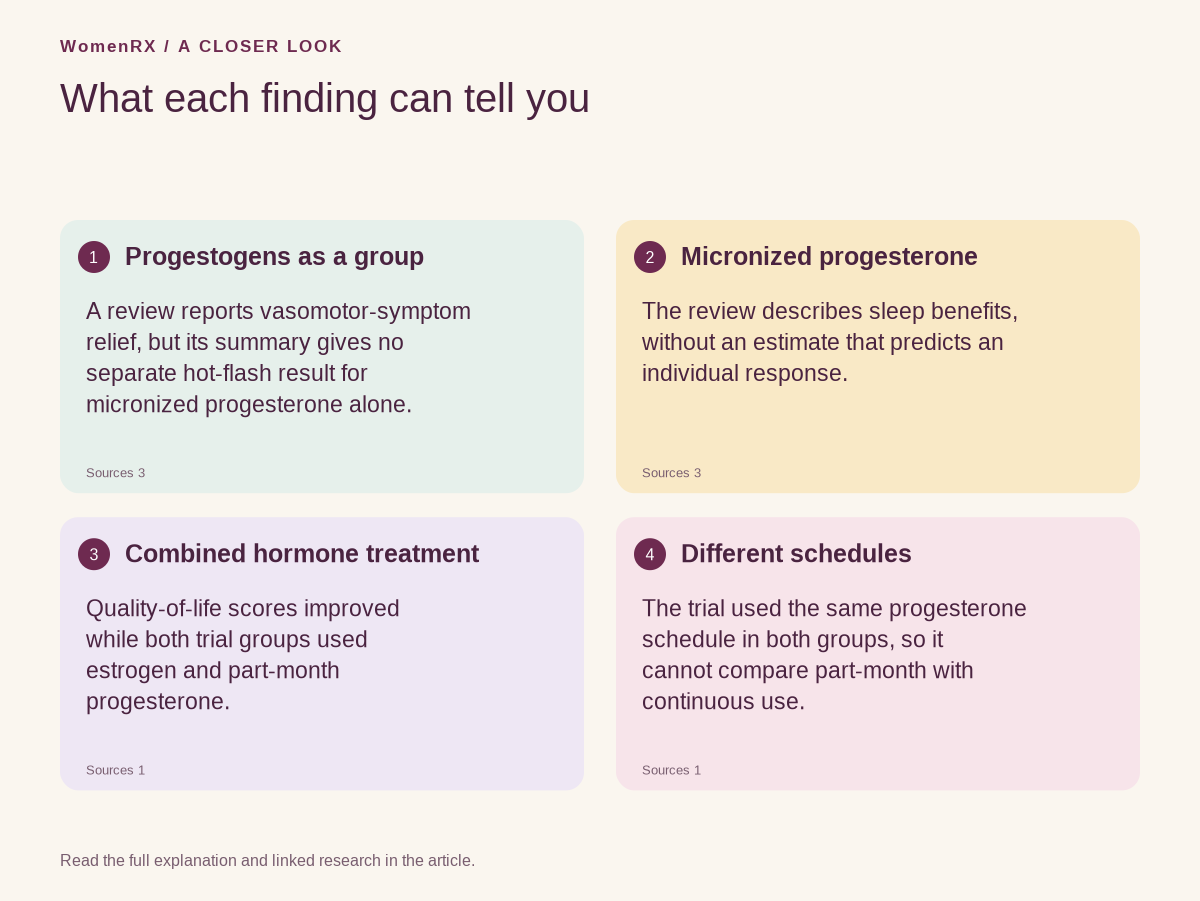
What each finding can tell you
Progestogens as a group: A review reports vasomotor-symptom relief, but its summary gives no separate hot-flash result for micronized progesterone alone.3
Micronized progesterone: The review describes sleep benefits, without an estimate that predicts an individual response.3
Combined hormone treatment: Quality-of-life scores improved while both trial groups used estrogen and part-month progesterone.1
Different schedules: The trial used the same progesterone schedule in both groups, so it cannot compare part-month with continuous use.1
Read the figure as text
The treatment and comparison determine whether a finding speaks to progesterone alone.- Progestogens as a group: A review reports vasomotor-symptom relief, but its summary gives no separate hot-flash result for micronized progesterone alone.3
- Micronized progesterone: The review describes sleep benefits, without an estimate that predicts an individual response.3
- Combined hormone treatment: Quality-of-life scores improved while both trial groups used estrogen and part-month progesterone.1
- Different schedules: The trial used the same progesterone schedule in both groups, so it cannot compare part-month with continuous use.1
More questions, answered
Does the evidence show that micronized progesterone alone relieves hot flashes?
The 2026 review reports vasomotor-symptom relief with progestogen-only treatments as a group. Its summary doesn’t give a separate hot-flash result for micronized progesterone alone. 3
Did the menopause trial compare taking progesterone part of the month with taking it every day?
No. Both groups took micronized progesterone for 14 days each month alongside estrogen. The trial compared estrogen routes, not progesterone schedules. 1
Sources you can check
- Changes in menopause-specific quality of life between women with transdermal estradiol versus oral estrogens: results of a randomized controlled trial.Tang R, Fan Y, Ruan X, Zhang Z, Ren M, Wu J, Shu K, Shi H, Xie M, Lv S, Yang X, Yu Q, Chen R. · Gynecological endocrinology : the official journal of the International Society of Gynecological Endocrinology · 2025Return to first citation
- No more sleepless nights in perimenopause-an open-label, randomized, parallel-group, active controlled intervention study in perimenopausal women with vasomotor symptoms and insomnia to investigate the efficacy of hormone replacement therapy and cognitive behavioral therapy for the treatment of insomnia: study protocol.Pavicic E, Stute P, Rudzik F, Urech A, Lozza-Fiacco S. · Trials · 2025Return to first citation
- Indications and Efficacy of Progestogen-Monotherapy as Menopause Hormone Therapy: A Narrative Review.Thomas C, Carere O, Clarfield L, Jacobson M. · BJOG : an international journal of obstetrics and gynaecology · 2026Return to first citation
- The 2022 hormone therapy position statement of The North American Menopause Society.“The 2022 Hormone Therapy Position Statement of The North American Menopause Society” Advisory Panel. · Menopause (New York, N.Y.) · 2022Return to first citation