Starting Menopausal Hormone Therapy After 60: What to Consider
Starting systemic hormone therapy after 60 isn’t automatically ruled out, but age and time since menopause make the benefit-risk balance less favorable on average.
There’s no automatic cutoff, but starting systemic menopausal hormone therapy after 60, or more than 10 years after menopause, generally has a less favorable benefit-risk balance because some risks increase with age and time. A decision should start with your symptoms and goals, then weigh your health history, time since menopause, and the specific therapy. Starting for the first time is different from reviewing treatment you already use. 1
First ask what you want treatment to help
Systemic menopausal hormone therapy can be highly effective for bothersome hot flashes and night sweats. It can also help prevent bone loss, but it isn’t recommended as a way to prevent cardiovascular disease. The most useful starting point is a specific goal: for example, fewer night sweats that interrupt sleep, or relief from another symptom that is affecting daily life. 13
The answer may depend on which symptoms you have. If your main concern is vaginal or urinary discomfort, systemic therapy may not be the only option. For bothersome genitourinary symptoms that haven’t improved with over-the-counter treatments, low-dose vaginal estrogen and other treatments may be considered without using systemic hormone therapy. 1
Age and time since menopause both matter
Guidance describes a more favorable average benefit-risk balance for women who start before age 60 or within 10 years of menopause, if they have no contraindications. Starting after 60 or more than 10 years after menopause is generally less favorable, largely because the absolute risks of coronary heart disease, stroke, blood clots in veins, and dementia are higher. These are factors to weigh, not an automatic prohibition. 1
Age and timing overlap, but they aren’t identical. If you’re over 60 but menopause began less than 10 years ago, for instance, both details are worth discussing rather than treating age alone as the whole answer. The evidence doesn’t make timing a guarantee of safety, either. A study using data from women with hot flashes found different cardiovascular estimates depending on whether therapy began within 10 years of menopause, but it studied perimenopausal and recently postmenopausal women, and the authors cautioned that residual confounding could affect the results. It doesn’t establish that starting after 60 prevents heart disease. 3
A discussion checklist
Bring these points to a conversation about starting therapy:
- Your main symptom and goal: What would you like to change, and how much is it affecting your life?
- Your menopause timeline: About when was your last menstrual period? How long has it been since menopause began?
- Your health history: Share any history of cardiovascular disease or estrogen-dependent cancer, which can affect whether hormone therapy is an appropriate option. Include other conditions and current medications so the risks can be considered in context. 2
- The treatment being considered: Ask how the route, formulation, duration, and use of a progestogen affect the balance of benefits and risks. These factors matter; “hormone therapy” isn’t a single uniform treatment. 1
- Your review plan: If you start, agree on what benefit you’re looking for and when to revisit whether it’s still worth continuing. Guidance recommends individualizing treatment and periodically reevaluating benefits and risks. 1
If systemic therapy isn’t the right fit
There are evidence-supported nonhormonal options for hot flashes and night sweats, including cognitive behavioral therapy, clinical hypnosis, some prescription medicines, and, in some cases, weight loss. Which options fit depends on your circumstances and preferences. Supplements and herbal remedies aren’t recommended for vasomotor symptoms in the North American Menopause Society’s 2023 position statement. 2
Choosing not to start systemic therapy doesn’t mean you have to leave symptoms unaddressed. Make the decision about the symptom you want help with, the approach being considered, and your own health history, rather than a yes-or-no rule based on age alone.
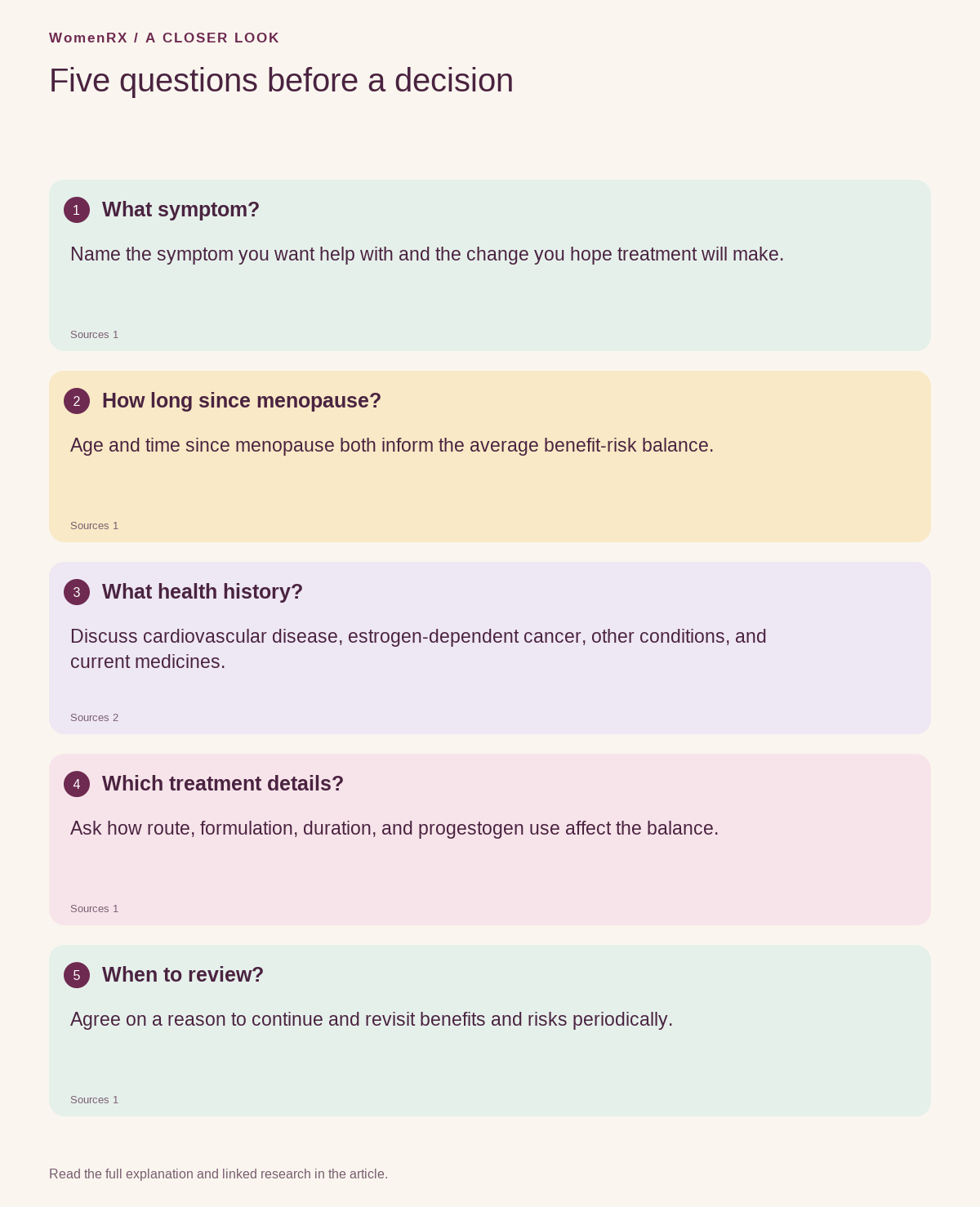
Five questions before a decision
What symptom?: Name the symptom you want help with and the change you hope treatment will make.1
How long since menopause?: Age and time since menopause both inform the average benefit-risk balance.1
What health history?: Discuss cardiovascular disease, estrogen-dependent cancer, other conditions, and current medicines.2
Which treatment details?: Ask how route, formulation, duration, and progestogen use affect the balance.1
When to review?: Agree on a reason to continue and revisit benefits and risks periodically.1
Read the figure as text
Use these questions to organize a discussion about first-time systemic therapy after 60. They help frame a personal risk-benefit conversation, not calculate or predict individual risk.- What symptom?: Name the symptom you want help with and the change you hope treatment will make.1
- How long since menopause?: Age and time since menopause both inform the average benefit-risk balance.1
- What health history?: Discuss cardiovascular disease, estrogen-dependent cancer, other conditions, and current medicines.2
- Which treatment details?: Ask how route, formulation, duration, and progestogen use affect the balance.1
- When to review?: Agree on a reason to continue and revisit benefits and risks periodically.1
More questions, answered
Is continuing hormone therapy after 60 the same decision as starting it after 60?
No. The guidance describes a less favorable balance for people who initiate therapy after 60 or more than 10 years after menopause. For people already taking it, the recommendation is to reevaluate benefits and risks periodically, with longer use tied to a documented reason such as persistent hot flashes or night sweats. 1
Can hormone therapy be started after 60 to prevent heart disease?
It shouldn’t be started for cardiovascular prevention. A study of women with symptoms during perimenopause or recent menopause does not establish a preventive benefit for people starting after 60, and its authors cautioned against using the findings to support hormone therapy for cardiovascular prevention. 3
Sources you can check
- The 2022 hormone therapy position statement of The North American Menopause Society.“The 2022 Hormone Therapy Position Statement of The North American Menopause Society” Advisory Panel. · Menopause (New York, N.Y.) · 2022Return to first citation
- The 2023 nonhormone therapy position statement of The North American Menopause Society.Menopause (New York, N.Y.) · 2023Return to first citation
- Menopausal Hormone Therapy and Cardiovascular Risk in Midlife Women With Vasomotor Symptoms.Wang Z, Swanson SA, Brooks MM, Barinas-Mitchell E, Bertolet M, Magnani JW, Thurston RC, El Khoudary SR. · JAMA internal medicine · 2026Return to first citation