Could Menopausal Hormone Therapy Help With Your Symptoms?
Hot flashes and other changes may fit the menopause transition, but the pattern, your health history, and any unusual bleeding matter before treatment is considered.
If hot flashes or night sweats are disrupting daily life, menopausal hormone therapy may be worth discussing. A review focused on estradiol transdermal spray also reports improvements in sleep, mood, sexual health, and genitourinary symptoms, but those findings do not predict your response to hormone therapy. Heavy or unusual bleeding calls for a separate assessment before treatment choices; your cycle stage and health history also matter. 4 6
Start with the pattern, not a symptom checklist
Hot flashes and night sweats are familiar menopause-related symptoms. Sleep problems, mood symptoms, and vaginal or sexual symptoms may also occur around this time. But symptoms don’t prove that menopause is the cause, and they don’t automatically mean hormone therapy is the right fit. 6
A useful first step is to notice what’s changing and how much it affects your life. For example, you might note when hot flashes happen, whether sleep is being interrupted, how your periods have changed, and which symptoms are hardest to manage. Bring that pattern into the conversation rather than trying to diagnose yourself from a list.
Your cycle stage changes the questions
During perimenopause, ovarian function can become less predictable, and bleeding may change. That can be part of the transition, but abnormal bleeding can also have other causes, including polyps, fibroids, or less common precancerous or cancerous changes. Pregnancy, sexually transmitted infections, and cervical or vaginal causes may also be considered, depending on the situation. 4
That’s why heavy, unusual, or between-period bleeding deserves its own assessment rather than being assumed to be “just menopause.” Depending on the details, evaluation may include an exam or ultrasound, with additional testing such as an endometrial biopsy or hysteroscopy considered based on findings. 4 If heavy bleeding is affecting daily life, or you have bleeding between periods or after sex, raise it directly. 1
After periods have stopped, bleeding still needs a separate conversation. Postmenopausal bleeding is a recognized reason for evaluation, and evidence-based guidance on bleeding during hormone therapy is less complete than guidance for some other bleeding situations. 5
What hormone therapy may offer
If hot flashes or night sweats are the main problem, ask whether hormone therapy could help relieve them. A review focused on estradiol transdermal spray reports improvements in those symptoms and also in sleep, mood, sexual health, and genitourinary symptoms. Those additional findings concern the spray studies, not a promise that every such concern will improve with hormone therapy. 6
The conversation is personal: which symptoms are you hoping to relieve, how much are they affecting you, and what does your health history mean for possible benefits and risks? Timing may also matter to the overall risk-benefit discussion. Hormone therapy should not be used to prevent heart disease, stroke, or dementia. 2 3
If you have a uterus, ask how a proposed systemic estrogen plan addresses the uterine lining. In a randomized trial of postmenopausal women with an intact uterus, progesterone given with estrogen was associated with less endometrial hyperplasia than estrogen alone; that finding supports asking about endometrial protection, not choosing a regimen on your own. 3
A focused conversation can help
You might bring three things to the visit: the symptoms that interfere most, a brief picture of how your periods have changed, and a list of relevant health conditions and medicines. Then ask:
- Do these symptoms fit a menopause-related pattern, or should something else be assessed?
- If hormone therapy is an option, which symptoms is it intended to treat, and what are the likely tradeoffs for me?
- If I still have my uterus, how will the plan protect its lining?
- If bleeding is part of my symptoms, what evaluation does it need before treatment is considered?
The goal isn’t to reach a yes-or-no answer from a checklist. It’s to connect your symptoms and cycle stage with the right assessment, then decide whether symptom treatment is worth discussing for you.
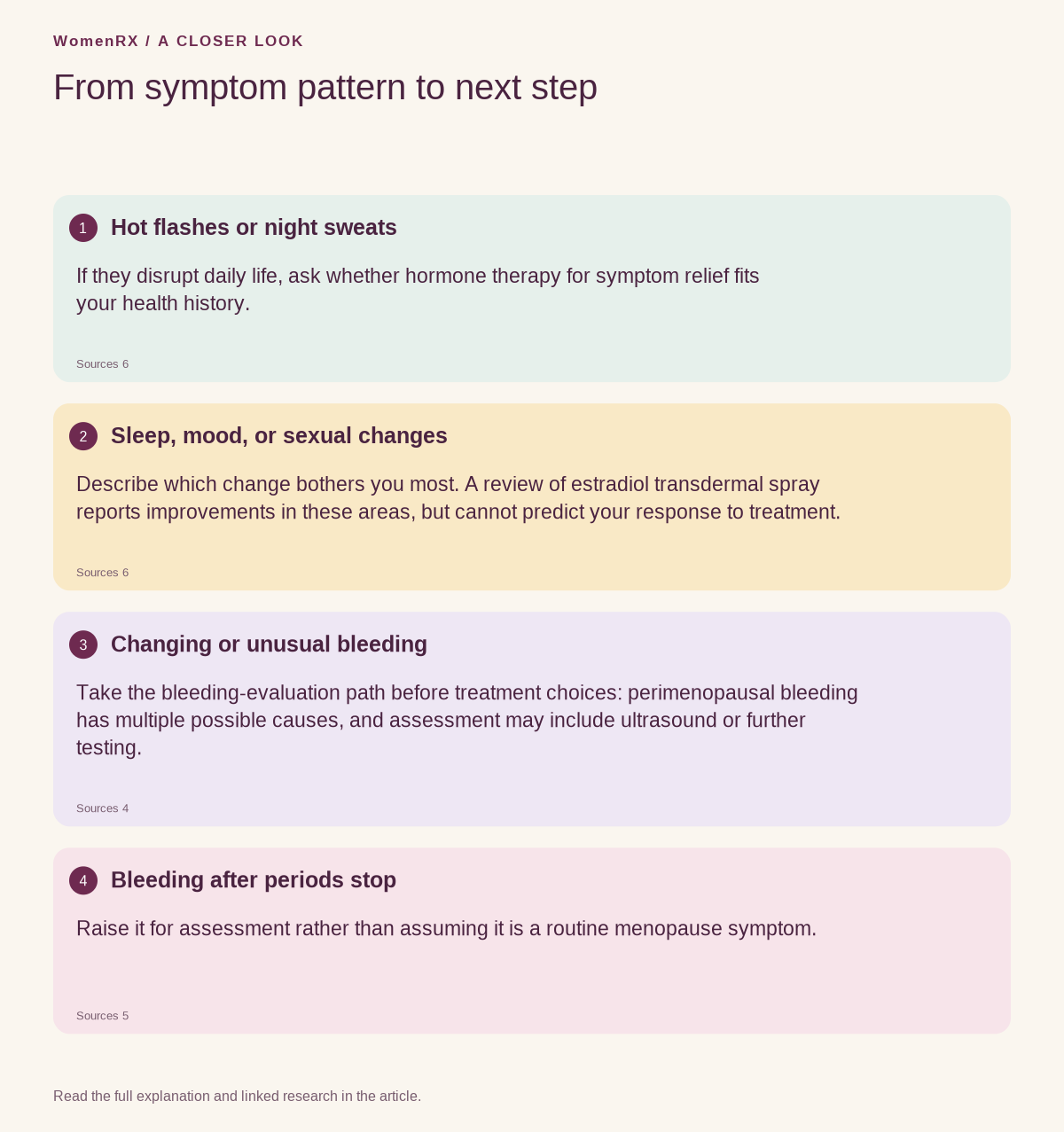
From symptom pattern to next step
Hot flashes or night sweats: If they disrupt daily life, ask whether hormone therapy for symptom relief fits your health history.6
Sleep, mood, or sexual changes: Describe which change bothers you most. A review of estradiol transdermal spray reports improvements in these areas, but cannot predict your response to treatment.6
Changing or unusual bleeding: Take the bleeding-evaluation path before treatment choices: perimenopausal bleeding has multiple possible causes, and assessment may include ultrasound or further testing.4
Bleeding after periods stop: Raise it for assessment rather than assuming it is a routine menopause symptom.5
Read the figure as text
Use this as a conversation guide, not a way to diagnose menopause. The cycle pattern and any bleeding that needs separate assessment help shape the next discussion.- Hot flashes or night sweats: If they disrupt daily life, ask whether hormone therapy for symptom relief fits your health history.6
- Sleep, mood, or sexual changes: Describe which change bothers you most. A review of estradiol transdermal spray reports improvements in these areas, but cannot predict your response to treatment.6
- Changing or unusual bleeding: Take the bleeding-evaluation path before treatment choices: perimenopausal bleeding has multiple possible causes, and assessment may include ultrasound or further testing.4
- Bleeding after periods stop: Raise it for assessment rather than assuming it is a routine menopause symptom.5
More questions, answered
Can hormone therapy prevent heart disease or dementia?
No. Hormone therapy should not be used to prevent heart disease, heart attacks, strokes, or dementia. Its role here is a discussion about menopause symptoms, not disease prevention. 2
Should heavy bleeding be treated as a menopause symptom?
Not without considering other causes. Bleeding changes can occur during perimenopause, but fibroids, polyps, pregnancy, infection, and other conditions may also be relevant. Heavy or unusual bleeding is worth raising separately. 4
Sources you can check
- Heavy periods - NHSAccessed 2026-09-25Return to first citation
- BIJUVA (ESTRADIOL AND PROGESTERONE) CAPSULE [MAYNE PHARMA] | US prescribing information and patient instructionsAccessed 2026-09-25Return to first citation
- PROMETRIUM (PROGESTERONE) CAPSULE [ACERTIS PHARMACEUTICALS, LLC] | US prescribing information and patient instructionsAccessed 2026-09-25Return to first citation
- Perimenopausal abnormal uterine bleeding.Dreisler E, Frandsen CS, Ulrich L. · Maturitas · 2024Return to first citation
- Diagnosis and medical management of abnormal premenopausal and postmenopausal bleeding.Black D. · Climacteric : the journal of the International Menopause Society · 2023Return to first citation
- Estradiol transdermal spray for menopausal symptom management: From RCT to real-world evidence.Hirschberg AL, Stute P, Águas F, Fait T, Polo-Kantola P, Amorim FG, Rézette I, Hadji P. · Maturitas · 2026Return to first citation