Could Menopausal Hormone Therapy Fit Your Symptoms and Health History?
The decision depends on what you want treated, when menopause began, your health history, and which form of therapy is being considered.
Menopausal hormone therapy may be worth discussing if bothersome hot flashes or night sweats, menopause-related vaginal or urinary symptoms, or bone loss are concerns. The balance tends to be more favorable for people under 60 or within 10 years of menopause who have no contraindications, but age alone doesn’t decide it. Your health history, uterus status, formulation, and whether you’re starting or continuing all matter. 3
Start with the symptom you want to change
Hormone therapy isn’t a general treatment for aging. It may be considered for bothersome hot flashes and night sweats, menopause-related genital or urinary symptoms, or to prevent bone loss and fractures. It should not be used to prevent heart disease or dementia. 3 1
Being specific about your goal makes the discussion more useful. For example, if hot flashes are disrupting sleep, the question may be whether systemic therapy’s likely symptom relief is worth its risks for you. If your main concern is vaginal dryness or discomfort with sex, a treatment that works locally may be a more fitting option than whole-body therapy.
Timing changes the balance, but isn’t an eligibility test
For people younger than 60 or within 10 years of menopause, hormone therapy’s benefit-risk balance is generally more favorable for bothersome vasomotor symptoms and prevention of bone loss, provided there are no contraindications. Starting after age 60 or more than 10 years after menopause is associated with a less favorable balance because the absolute risks of coronary heart disease, stroke, blood clots in veins, and dementia are higher. These are guideposts for a personal decision, not a rule that automatically qualifies or disqualifies you. 3
Starting and continuing are different decisions. If you’re already taking therapy, the question isn’t simply whether you’ve passed a particular age or number of years. Ongoing symptoms can be a reason to continue, but longer use should have a documented purpose and the benefits and risks should be revisited periodically. 3
Your health history and uterus status shape the plan
Tell the prescriber about relevant health conditions and personal history, including estrogen-dependent cancer or cardiovascular disease, which can make hormone therapy a poor fit or change which options are considered. There isn’t one simple checklist that can determine your individual risk from those labels alone. 4
Also say whether you still have your uterus. In a trial of postmenopausal women with an intact uterus, progesterone given with estrogen was associated with less endometrial hyperplasia than estrogen alone over three years. That finding helps explain why the uterus is a key part of choosing a regimen, but the trial studied particular medicines and doses; it doesn’t establish that every product or schedule has the same effects. 2
The choice isn’t just “hormones or no hormones.” Risks vary with the type, dose, duration, route, timing, and use of a progestogen. Ask how the specific option being discussed fits your circumstances rather than assuming that one route or product has the same risk profile as another. 3
Match the option to the symptom
For hot flashes and night sweats, hormone therapy is the most effective treatment. If you don’t want it or it isn’t a good fit, evidence-supported nonhormonal options include certain antidepressants (SSRIs or SNRIs), gabapentin, fezolinetant, cognitive behavioral therapy, and clinical hypnosis. Which option makes sense depends on your symptoms and health history. 4
For bothersome vaginal or urinary symptoms that haven’t improved with over-the-counter treatments, low-dose vaginal estrogen or other therapies may be options even when you don’t need systemic hormone therapy for another reason. 3
A short decision checklist
Before the conversation, jot down the symptom you most want to improve and what a meaningful improvement would look like. Bring a clear account of your health history, including relevant cancers or cardiovascular disease, and note whether you have a uterus. If you already use hormone therapy, include what you take and whether it is helping. 3 4
Then ask: What benefit are we aiming for? How does starting now, or continuing, affect the balance? Which options fit my symptom and history? If I have a uterus, how does the plan address it? What nonhormonal or local treatments could meet the same goal? These questions won’t produce a one-size-fits-all answer, but they focus the decision on what matters to you.
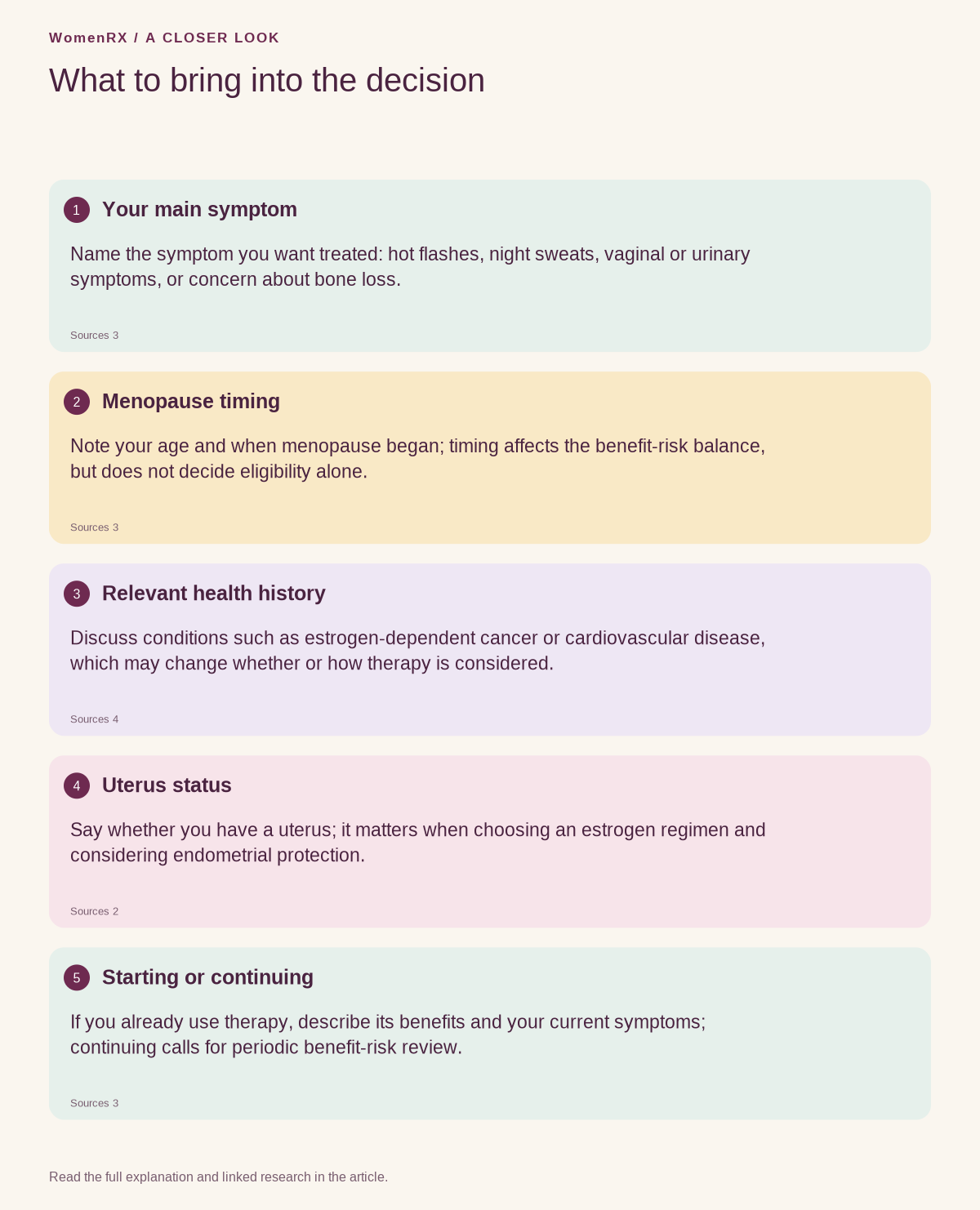
What to bring into the decision
Your main symptom: Name the symptom you want treated: hot flashes, night sweats, vaginal or urinary symptoms, or concern about bone loss.3
Menopause timing: Note your age and when menopause began; timing affects the benefit-risk balance, but does not decide eligibility alone.3
Relevant health history: Discuss conditions such as estrogen-dependent cancer or cardiovascular disease, which may change whether or how therapy is considered.4
Uterus status: Say whether you have a uterus; it matters when choosing an estrogen regimen and considering endometrial protection.2
Starting or continuing: If you already use therapy, describe its benefits and your current symptoms; continuing calls for periodic benefit-risk review.3
Read the figure as text
Use these prompts to organize the parts of the decision that can change the benefit-risk balance or point toward a different treatment.- Your main symptom: Name the symptom you want treated: hot flashes, night sweats, vaginal or urinary symptoms, or concern about bone loss.3
- Menopause timing: Note your age and when menopause began; timing affects the benefit-risk balance, but does not decide eligibility alone.3
- Relevant health history: Discuss conditions such as estrogen-dependent cancer or cardiovascular disease, which may change whether or how therapy is considered.4
- Uterus status: Say whether you have a uterus; it matters when choosing an estrogen regimen and considering endometrial protection.2
- Starting or continuing: If you already use therapy, describe its benefits and your current symptoms; continuing calls for periodic benefit-risk review.3
More questions, answered
Does being over 60 mean I can’t use hormone therapy?
Not by itself. Starting after 60, or more than 10 years after menopause, tends to have a less favorable benefit-risk balance, but the decision depends on your health history and treatment goal. Continuing an established plan is a separate decision that calls for periodic review. 3
What if my main symptoms are vaginal or urinary?
If symptoms are bothersome and over-the-counter treatments haven’t helped, low-dose vaginal estrogen or other local options may be considered without using systemic hormone therapy for a separate indication. 3
Sources you can check
- BIJUVA (ESTRADIOL AND PROGESTERONE) CAPSULE [MAYNE PHARMA] | US prescribing information and patient instructionsAccessed 2026-09-25Return to first citation
- PROMETRIUM (PROGESTERONE) CAPSULE [ACERTIS PHARMACEUTICALS, LLC] | US prescribing information and patient instructionsAccessed 2026-09-25Return to first citation
- The 2022 hormone therapy position statement of The North American Menopause Society.“The 2022 Hormone Therapy Position Statement of The North American Menopause Society” Advisory Panel. · Menopause (New York, N.Y.) · 2022Return to first citation
- The 2023 nonhormone therapy position statement of The North American Menopause Society.Menopause (New York, N.Y.) · 2023Return to first citation