Menopause and Perimenopause: Find Your Starting Point
The stage you’re in can help orient you, but the symptom or decision in front of you is the better place to start.
Perimenopause is the transition when periods often change; menopause is reached after 12 months without a period, and the years afterward are postmenopause. Symptoms can begin before that milestone and continue beyond it. The useful next step depends on what’s happening now: changing bleeding, hot flashes, sleep disruption, vaginal discomfort, or a question about treatment. Surgery and some medical treatments can change the usual pattern. 13

First, place the milestone in context
Menopause isn’t an illness or a switch that flips on a predictable birthday. During perimenopause, ovarian hormone production changes and periods may come closer together or farther apart, last longer or end sooner, and become heavier or lighter. Hot flashes, night sweats, sleep problems and mood changes may appear during this transition, though some women have few symptoms. 13
Menopause is identified after 12 consecutive months without a period. That makes the final period something you recognize in hindsight. The years that follow are postmenopause, not a promise that symptoms have stopped. Hot flashes may persist, and vaginal dryness or urinary concerns can still need attention. Hormonal contraception can change or stop bleeding, making periods less useful as a marker. 123
The timeline also works differently if you’ve had surgery. Removing the uterus stops periods, but it doesn’t itself cause menopause when the ovaries remain. Removing both ovaries can bring on menopause abruptly; some cancer treatments can also cause menopause earlier than expected. If ovarian function changes before age 40, primary ovarian insufficiency is another possibility, and it isn’t identical to menopause: periods and pregnancy may still be possible. 1
Follow the concern, not just the stage
Periods or bleeding: An irregular cycle can be part of perimenopause, but don’t assume every change has the same cause. Bleeding that is very heavy or lasts much longer than usual can have causes other than the transition. Once you’ve gone at least 12 months without a period, any new vaginal bleeding, even spotting, needs assessment. Most postmenopausal bleeding isn’t serious, but it can be a sign of cancer. 36
Heat and sleep: A hot flash is a sudden feeling of heat, often with sweating; at night, it can interrupt sleep. Poor sleep may then add to fatigue and make concentration or mood feel worse. That connection is useful, but it doesn’t mean every headache, anxious spell or bout of fatigue is caused by menopause. For mild heat symptoms, layers or a fan may help you get through the moment. If symptoms are disrupting daily life, there are both hormone and nonhormone treatment options. 13
Vaginal or urinary discomfort: Dryness can make sex painful, while urinary symptoms may include urgency, leakage or recurrent infections. This concern deserves its own route rather than being treated as a footnote to hot flashes. Lubricants or vaginal moisturizers may help dryness; local vaginal hormone treatment is another option to discuss when symptoms persist. 145
Health after periods end: The drop in estrogen is associated with loss of bone density. Weight-bearing and strength exercise, along with a diet that includes calcium-rich foods, are practical ways to support bone health. Postmenopause is also a good time to consider longer-term health alongside symptom relief, without assuming one treatment is right for everyone. 15
What treatment is meant to solve
Menopausal hormone therapy is an option for bothersome symptoms, particularly hot flashes and night sweats. Its benefit-and-risk discussion depends on the symptom being treated, your health history, the hormones and route proposed, and whether you have a uterus. If systemic estrogen is used while the uterus is present, a progestogen is generally included to protect the uterine lining; that distinction changes after hysterectomy. 148
Not every concern calls for systemic hormones. Vaginal symptoms may be addressed with lubricants, moisturizers or local treatment. Nonhormone medicines are available for hot flashes, while cognitive behavioral therapy can be used for sleep problems. Hormone therapy also isn’t contraception: pregnancy is still possible during perimenopause. 135
If menopause arrives unusually early, or follows ovary removal or cancer treatment, the decision deserves a more specific discussion than a standard midlife treatment comparison. So does starting or reconsidering systemic hormone therapy later in postmenopause, when other health conditions and medicines may affect the balance of benefits and risks. 17
Start with the reading path that matches the question you have today. You can come back to the broader timeline once you’ve found the concern that needs an answer.
More questions, answered
Can I be in perimenopause if I still have periods?
Yes. Changing periods are a common feature of perimenopause, and pregnancy can still be possible while you’re in the transition. 13
Does a hysterectomy mean I’ve reached menopause?
Not necessarily. A hysterectomy stops periods, but if your ovaries remain, it doesn’t itself cause menopause. The operation matters: removing both ovaries changes ovarian hormone production much more abruptly. 1
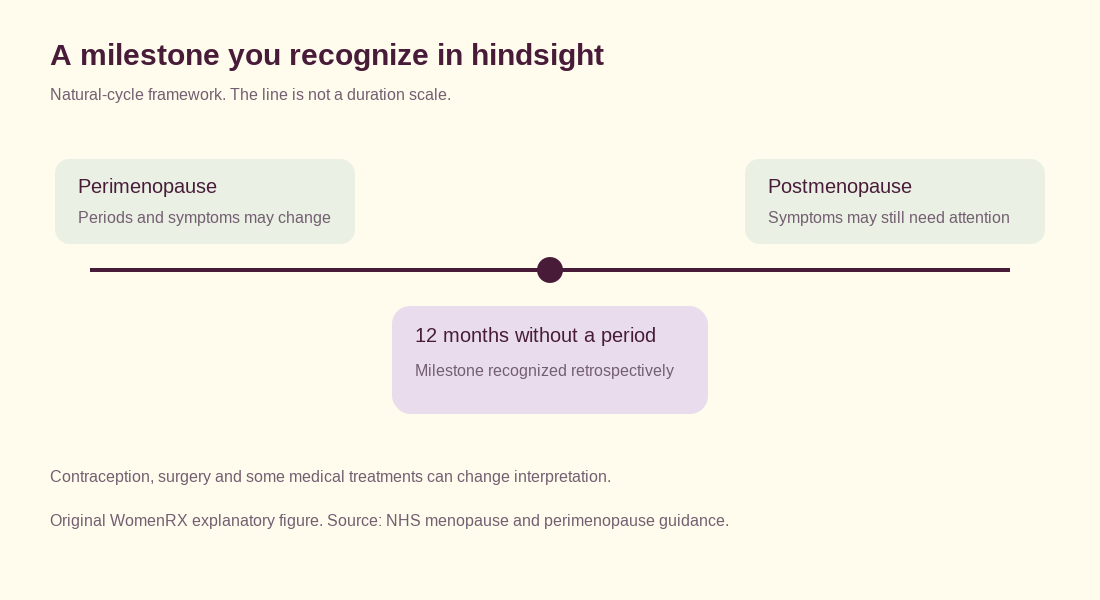
The natural-cycle milestone
Changing periods belong to perimenopause. Menopause is recognized retrospectively after 12 months without a period when hormonal contraception is not affecting the pattern. Symptoms may continue afterward; medical and surgical history can change interpretation.
Sources you can check
- Menopause | Menopause Symptoms | MedlinePlusAccessed 2026-09-25Return to first citation
- What are menopause and perimenopause? - NHSAccessed 2026-09-25Return to first citation
- Symptoms of menopause and perimenopause - NHSAccessed 2026-09-25Return to first citation
- Treatment for menopause and perimenopause - NHSAccessed 2026-09-25Return to first citation
- Things you can do to help menopause and perimenopause symptoms - NHSAccessed 2026-09-25Return to first citation
- Vaginal Bleeding | Uterine Fibroids | MedlinePlusAccessed 2026-09-25Return to first citation
- Menopausal Hormone Therapy in Clinically Vulnerable Women: A Narrative Review of Guidelines and Real-World Evidence.Yanachkova V, Lebanova H, Stoev S. · Medicina (Kaunas, Lithuania) · 2026Return to first citation
- Summary of the 2023 Thai Menopause Society Clinical Practice Guideline on Menopausal Hormone Therapy.Chaikittisilpa S, Orprayoon N, Vallibhakara O, Vallibhakara SA, Tanmahasamut P, Somboonporn W, Rattanachaiyanont M, Techatraisak K, Jaisamrarn U. · Journal of menopausal medicine · 2024Return to first citation