What to Check Before Starting Hormone Therapy Through Telehealth
A useful remote consultation should explain how your symptoms, health history, options, and follow-up shape the decision.
Before starting menopausal hormone therapy through telehealth, expect more than a symptom questionnaire or a prescription. The clinician should discuss what you want treated, your menopause timing and relevant health history, potential benefits and risks, and whether hormone or nonhormone options fit your situation. Ask how the plan will be reviewed over time and what would prompt an in-person visit or referral. 1 2
A remote visit can make it easier to start a conversation about menopause care. The useful question isn’t simply whether a clinic offers hormone therapy. It’s whether the clinician explains how your own symptoms and health history shape the options, and what happens after the visit.
Hormone therapy can be a reasonable option for some people, but it isn’t a standard package. Its benefits and risks vary with factors such as treatment type, dose, route, duration, timing, and whether a progestogen is used. Treatment decisions should be individualized and revisited over time. 1
Start with what you want help with
A consultation should make space to describe what’s bothering you and how it affects everyday life. For example, you might be seeking help for hot flashes that interrupt sleep, or vaginal and urinary symptoms that make sex or daily comfort difficult. The reason for treatment matters because different symptoms may call for different options.
Hormone therapy is the most effective treatment for bothersome vasomotor symptoms such as hot flashes. For certain genitourinary symptoms, low-dose vaginal estrogen or other treatments may be options when over-the-counter approaches haven’t helped and systemic hormone therapy isn’t indicated. 1 A clinician should explain which problem a proposed treatment is meant to address, rather than implying that one prescription treats every menopause concern.
Make sure your history is part of the decision
The clinician should ask enough to understand your menopause timing and health history before discussing whether treatment might suit you. Age and time since menopause matter: the 2022 North American Menopause Society statement describes a more favorable benefit-risk balance for many women younger than 60 or within 10 years of menopause onset who have no contraindications. It describes a less favorable balance for women starting later, in part because certain risks rise. These are factors for an individualized discussion, not a yes-or-no rule that applies to everyone. 1
Ask how the clinician has considered conditions that could change the decision. Estrogen-dependent cancers and cardiovascular disease are examples of contraindications mentioned in the menopause society’s nonhormone therapy statement. 2 That statement also identifies personal preference as a reason someone may choose a nonhormone option. This isn’t a complete list of medical considerations, so ask the clinician to explain which parts of your own history matter and why.
A questionnaire can help collect details, but it shouldn’t stand in for a conversation about what those details mean. You should be able to ask follow-up questions and hear how the recommendation connects to your symptoms, history, and preferences.
Compare the actual options
If hormone therapy is being considered, ask what type and route are proposed, what symptoms the plan is intended to help, and how the clinician weighed benefits against risks. The risks vary by treatment characteristics, including route and whether a progestogen is used, so “hormone therapy” alone doesn’t tell you what plan is being recommended. 1
It’s also fair to ask about alternatives. Evidence-supported nonhormone treatments for vasomotor symptoms include certain prescription medicines, cognitive behavioral therapy, and clinical hypnosis. 2 A clinician should be able to explain whether an alternative is relevant to your symptoms and preferences, not just present hormone therapy as the only path.
If your main concern is vaginal or urinary discomfort, ask whether a local treatment or another option makes more sense than systemic therapy. The menopause society statement distinguishes these situations and describes low-dose vaginal estrogen and other therapies for bothersome genitourinary symptoms when systemic therapy isn’t indicated. 1
Leave with a follow-up plan
Before the visit ends, make sure you understand what happens next: how you’ll check whether the plan is helping, when the benefits and risks will be reviewed, and whom to contact if questions arise. Periodic reevaluation is part of individualized hormone therapy care. 1
It’s also reasonable to ask what would make the clinician recommend an in-person assessment or a referral. A remote visit may not settle every question. A responsible process should make clear how uncertainty or a more complex history will be handled, rather than treating an online form or prescription as proof that treatment is suitable.
You can keep the conversation focused with four questions:
- Which of my symptoms is this option meant to treat?
- How did my health history and menopause timing affect your recommendation?
- What other hormone or nonhormone options should I consider?
- How will we review whether the plan is helping, and when would I need an in-person visit or referral?
You don’t have to decide during the first appointment. The goal is to understand the reasoning, choices, and follow-up well enough to decide whether the plan makes sense for you.
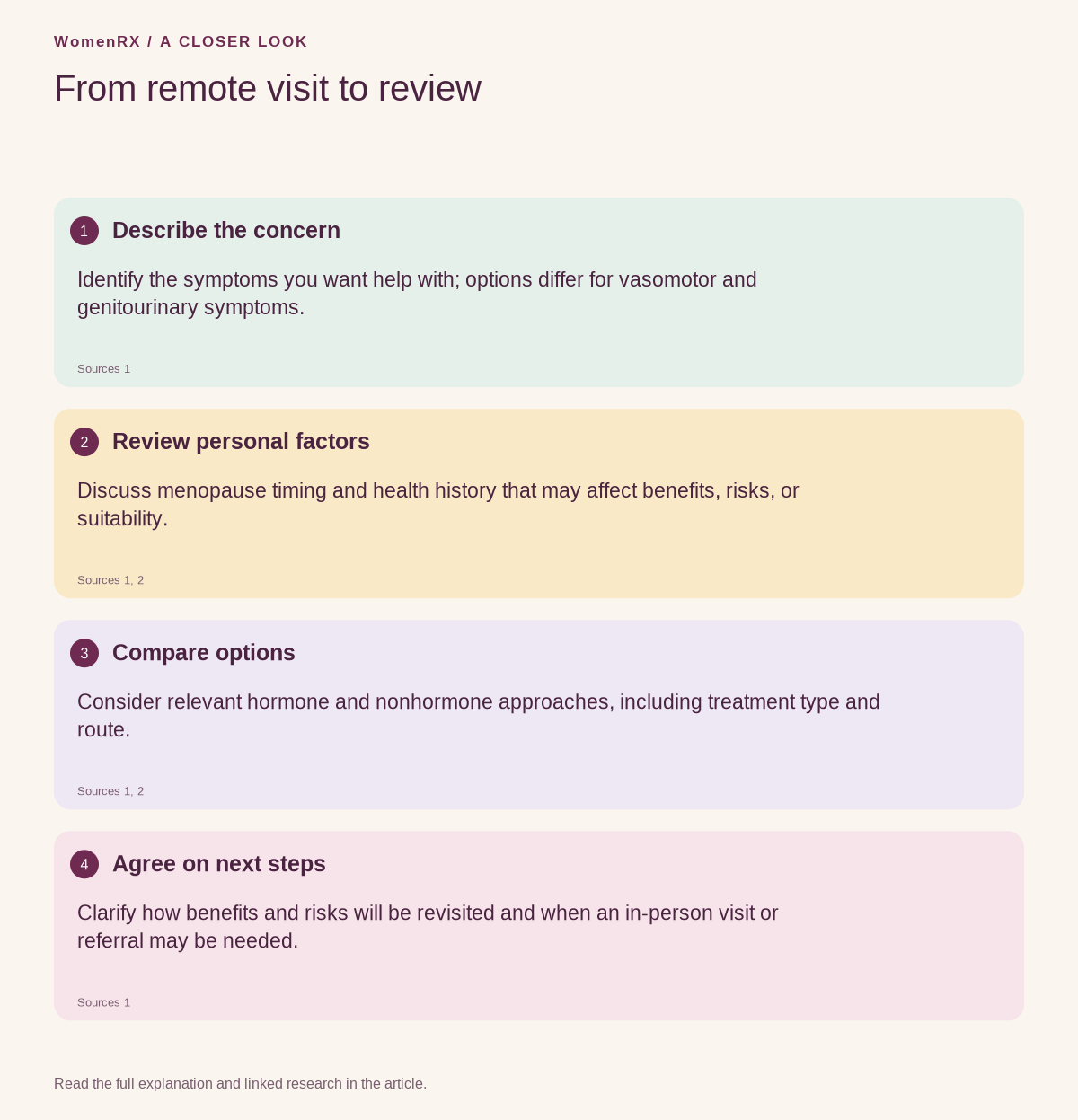
From remote visit to review
Describe the concern: Identify the symptoms you want help with; options differ for vasomotor and genitourinary symptoms.1
Review personal factors: Discuss menopause timing and health history that may affect benefits, risks, or suitability.12
Compare options: Consider relevant hormone and nonhormone approaches, including treatment type and route.12
Agree on next steps: Clarify how benefits and risks will be revisited and when an in-person visit or referral may be needed.1
Read the figure as text
A responsible discussion connects your reason for seeking care to an individualized decision and a plan to revisit it.- Describe the concern: Identify the symptoms you want help with; options differ for vasomotor and genitourinary symptoms.1
- Review personal factors: Discuss menopause timing and health history that may affect benefits, risks, or suitability.12
- Compare options: Consider relevant hormone and nonhormone approaches, including treatment type and route.12
- Agree on next steps: Clarify how benefits and risks will be revisited and when an in-person visit or referral may be needed.1
More questions, answered
Is an online questionnaire enough to decide whether hormone therapy is right for me?
A questionnaire can gather information, but it shouldn’t replace a discussion of how your symptoms, menopause timing, health history, and preferences affect the decision. Ask the clinician to explain how those details shaped the recommendation. 1 2
Should I expect the same type of hormone therapy for hot flashes and vaginal symptoms?
Not necessarily. Systemic hormone therapy is the most effective treatment for bothersome hot flashes, while low-dose vaginal estrogen or other treatments may be considered for certain genitourinary symptoms when systemic therapy isn’t indicated. Ask which symptoms a proposed treatment is meant to address. 1
Sources you can check
- The 2022 hormone therapy position statement of The North American Menopause Society.“The 2022 Hormone Therapy Position Statement of The North American Menopause Society” Advisory Panel. · Menopause (New York, N.Y.) · 2022Return to first citation
- The 2023 nonhormone therapy position statement of The North American Menopause Society.Menopause (New York, N.Y.) · 2023Return to first citation