How to Compare Telehealth for Menopause and Hormone Therapy
The strongest choice is a service that explains its clinical process, offers care matched to your goals, and has a clear plan for follow-up or in-person evaluation.
Compare menopause telehealth providers by asking who will assess you, how they consider your medical history and treatment goals, which hormone and nonhormone options they discuss, and how follow-up works. Check whether they care for both perimenopause and postmenopause and can arrange labs or an in-person evaluation when needed. Convenience matters, but satisfaction with virtual visits alone doesn’t show which provider delivers better clinical outcomes. 1 2 3 4
A virtual menopause visit can save travel and connect you with a clinician who isn’t nearby. The useful comparison isn’t simply which service offers the quickest appointment. It’s whether the care helps you make a well-informed decision and stays connected to your broader health needs. Telehealth can also leave gaps: a clinician may not have your full medical history, and some questions require lab testing or an in-person exam. 1
A practical scorecard for comparing services
For each provider, mark a row clear, unclear, or not offered. These labels are a personal comparison tool, not a validated rating system. Look for answers you can understand, not promises that one treatment is right for everyone.
| What to compare | A clear answer should explain | Ask if it’s unclear |
|---|---|---|
| Menopause experience | Who conducts the visit and how they assess menopause-related concerns | “Who will I speak with, and what experience do they have caring for perimenopause and postmenopause?” |
| Assessment | How your symptoms, medical history, and treatment goals shape the discussion | “What information do you need before discussing treatment?” |
| Treatment choices | Whether the clinician discusses hormone and nonhormone approaches when relevant | “If I don’t want hormone therapy, or it isn’t a good fit for me, what options can we discuss?” |
| Follow-up | How you can raise concerns and revisit the plan | “Who handles follow-up, and how do I contact them between visits?” |
| In-person care | What happens if a virtual visit isn’t enough | “Can you arrange testing or an in-person evaluation if needed?” |
| Cost and coverage | What you’ll pay and whether insurance may cover the visit | “What costs should I check before booking?” |
The point of asking about history and goals is practical: hormone therapy’s potential benefits and risks vary with factors such as treatment type, route, duration, timing, and use of a progestogen. A menopause care plan should be individualized and periodically reevaluated, rather than based on a one-size-fits-all package. 2
Look for discussion, not a default prescription
Hormone therapy is an option for some people, not an automatic next step. The North American Menopause Society’s 2022 position statement describes it as the most effective treatment for vasomotor symptoms, such as hot flashes, and says the benefit-risk balance depends on the individual. It also notes that the balance differs with age and time since menopause began. 2
A thoughtful provider should be able to explain why a treatment is being considered and what alternatives might fit your priorities. If hormone therapy isn’t a good fit or you prefer not to use it, evidence-based nonhormone options are available for vasomotor symptoms. The 2023 position statement includes options such as cognitive behavioral therapy and certain prescription medicines; the right discussion depends on your situation and preferences. 3
Ask how the provider’s approach accounts for where you are in the transition. Perimenopause and postmenopause aren’t interchangeable experiences, and the care discussion should make room for your stage, symptoms, history, and goals. The evidence-based hormone therapy recommendations specifically call for individualizing treatment and reviewing it over time. 2
Virtual care should have a next step
A virtual visit may work well for discussing symptoms and treatment choices, but it shouldn’t be a dead end if your situation needs more. MedlinePlus notes that a virtual clinician may not have your full medical history, may be unable to make a diagnosis without an in-person exam, or may need you to have lab testing. Ask in advance who coordinates those next steps and how information gets back to your usual care team. 1
Patient experience studies can help set expectations, but they don’t identify a best provider. In one cross-sectional study at a single menopause clinic in Toronto during the first wave of COVID-19, patients reported high satisfaction with telephone visits. The study measured satisfaction and visit preference, not whether one telehealth service produced better health outcomes than another. 4
So weigh access and convenience alongside clinical continuity. A good fit is a service that can explain its assessment, answer your questions without rushing you toward a preset treatment, and tell you what happens if virtual care isn’t enough.
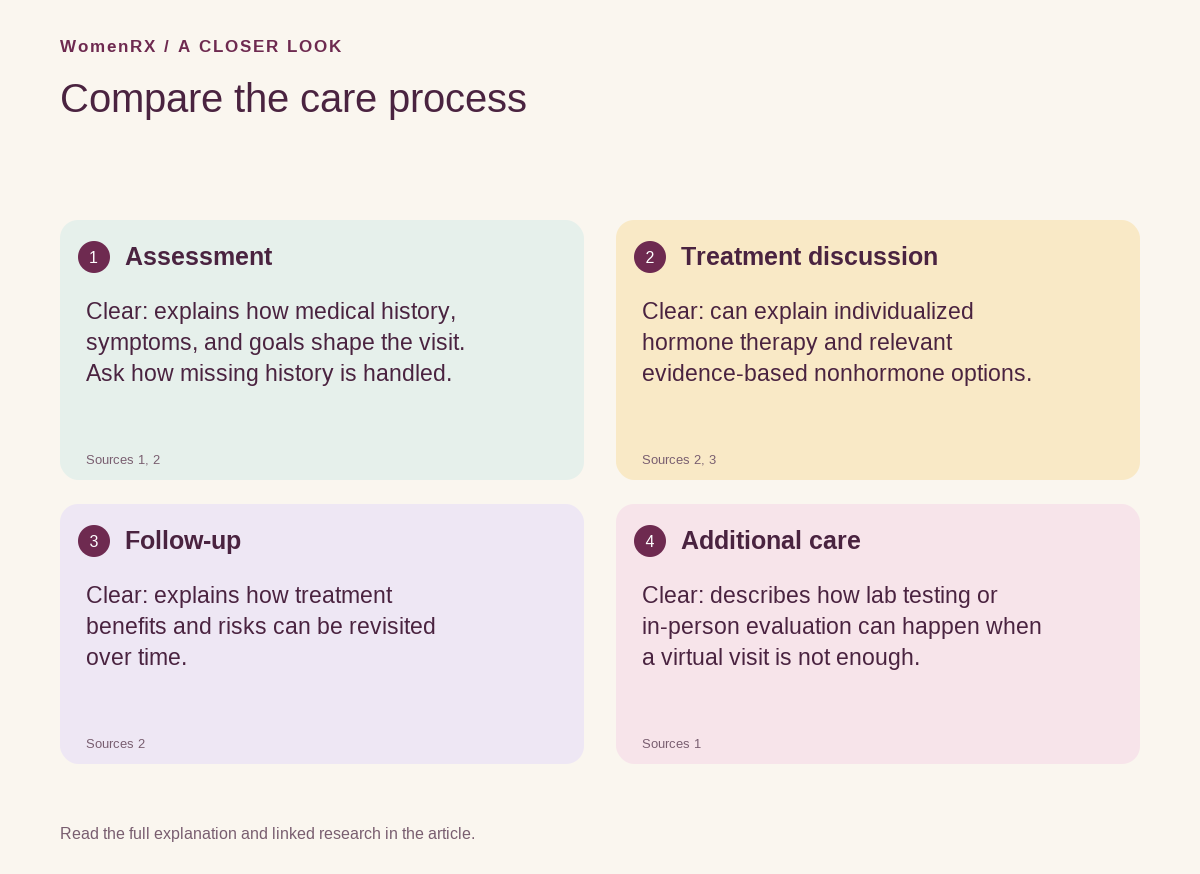
Compare the care process
Assessment: Clear: explains how medical history, symptoms, and goals shape the visit. Ask how missing history is handled.12
Treatment discussion: Clear: can explain individualized hormone therapy and relevant evidence-based nonhormone options.23
Follow-up: Clear: explains how treatment benefits and risks can be revisited over time.2
Additional care: Clear: describes how lab testing or in-person evaluation can happen when a virtual visit is not enough.1
Read the figure as text
Use these distinctions to compare how menopause telehealth services approach assessment, treatment discussions, continuity, and access to additional care.- Assessment: Clear: explains how medical history, symptoms, and goals shape the visit. Ask how missing history is handled.12
- Treatment discussion: Clear: can explain individualized hormone therapy and relevant evidence-based nonhormone options.23
- Follow-up: Clear: explains how treatment benefits and risks can be revisited over time.2
- Additional care: Clear: describes how lab testing or in-person evaluation can happen when a virtual visit is not enough.1
More questions, answered
Should a telehealth menopause provider offer hormone therapy?
Not necessarily. Hormone therapy is one option, and whether it fits depends on individual factors and treatment goals. A useful service should be able to discuss relevant alternatives too, including evidence-based nonhormone options for vasomotor symptoms. 2 3
Can telehealth handle every menopause concern?
No. A virtual visit may not provide enough information for every diagnosis, and lab testing or an in-person exam may sometimes be needed. Ask how the service handles those situations before you book. 1
Sources you can check
- Telehealth: MedlinePlusAccessed 2026-09-25Return to first citation
- The 2022 hormone therapy position statement of The North American Menopause Society.“The 2022 Hormone Therapy Position Statement of The North American Menopause Society” Advisory Panel. · Menopause (New York, N.Y.) · 2022Return to first citation
- The 2023 nonhormone therapy position statement of The North American Menopause Society.Menopause (New York, N.Y.) · 2023Return to first citation
- Delivery of menopause care during a pandemic: an evaluation of patient satisfaction with telephone visits.Wright E, Shaltout O, Zokvic MA, Shirreff L. · Menopause (New York, N.Y.) · 2021Return to first citation