Tirzepatide and Menopause Hormone Therapy: What We Know
Tirzepatide has shown weight loss across menopause stages, but that doesn’t show hormone therapy adds to the effect.
There’s no direct evidence here that menopause hormone therapy makes tirzepatide produce more weight loss. A post hoc analysis found substantial weight loss with tirzepatide across pre-, peri-, and postmenopausal groups, but it did not compare outcomes by hormone therapy use. A separate expert review describes a possible hormone-therapy association with semaglutide as unproven, not a reason to start hormone therapy for weight loss. 3 4
What the tirzepatide results show
A post hoc analysis of women in the SURMOUNT-1, -3, and -4 trials grouped participants by reproductive stage. In SURMOUNT-1, women in the premenopausal, perimenopausal, and postmenopausal groups lost substantially more weight with tirzepatide than with placebo over 72 weeks. The paper reports reductions of about 23% to 26% with tirzepatide versus about 2% to 3% with placebo, depending on the group and reported analysis. Similar patterns were reported in the other trials. 3
That’s useful evidence that tirzepatide can work across menopause stages. It doesn’t tell us whether taking menopause hormone therapy changes the result. The analysis compared reproductive stages, not hormone therapy users with nonusers, and it did not report weight-loss outcomes by hormone therapy use. 3
Why a menopause subgroup isn’t a hormone-therapy comparison
The distinction matters. A study can include women using hormones without testing whether those hormones affect treatment results. In SURMOUNT-1, the analysis reported baseline use of “hormone-replacement therapies and contraceptives” across reproductive-stage groups. It did not separate those categories in its weight-loss results or show a comparison adjusted for hormone use. 3
Nor does a post hoc comparison by menopause stage isolate the effects of hormones. The groups differed in baseline characteristics, including age, duration of obesity, and weight. The researchers also reported a very small pre- versus postmenopausal difference in an adjusted analysis, which was not reproduced in the other two trials. That finding isn’t evidence that menopause hormone therapy boosts weight loss. 3
A separate 2026 position statement says that an association between menopause hormone therapy and greater semaglutide-related weight loss is hypothesis-generating. It cautions against using that association as a reason to start hormone therapy solely to increase weight loss. Semaglutide is not tirzepatide, and an association does not establish that hormone therapy caused the difference. 4
What to make of claims that women “lose more”
Ask what was actually compared. A claim about added benefit needs a study that compares tirzepatide outcomes among hormone therapy users and nonusers, accounts for important baseline differences, and reports the results clearly. A menopause-stage subgroup analysis alone can’t answer that question. Neither can an observation involving a different medication.
The practical conclusion is narrower: the reported tirzepatide analysis supports weight loss across reproductive stages, but it doesn’t establish an extra effect from hormone therapy. A mouse experiment has examined tirzepatide in a model involving menopause, obesity, and diabetes, but it cannot show what happens when women take tirzepatide with menopause hormone therapy. 2 3
Keep the two treatment decisions separate
Menopause hormone therapy is used for specific menopause-related indications, including bothersome hot flashes and night sweats, genitourinary symptoms, and prevention of bone loss in appropriate circumstances. Its benefits and risks depend on factors such as the type and route of therapy, timing, and whether a progestogen is used. The North American Menopause Society recommends individualizing and periodically reassessing treatment. 1
So if you’re considering tirzepatide while already using hormone therapy, the evidence doesn’t support expecting extra weight loss from the combination. It also doesn’t show that you should stop hormone therapy. Keep the decisions tied to their purposes: whether hormone therapy still fits your menopause-related needs, and whether tirzepatide is an appropriate option for your weight and health goals. Bring a specific claim you’ve seen to the conversation and ask whether it comes from a direct comparison or a subgroup observation.
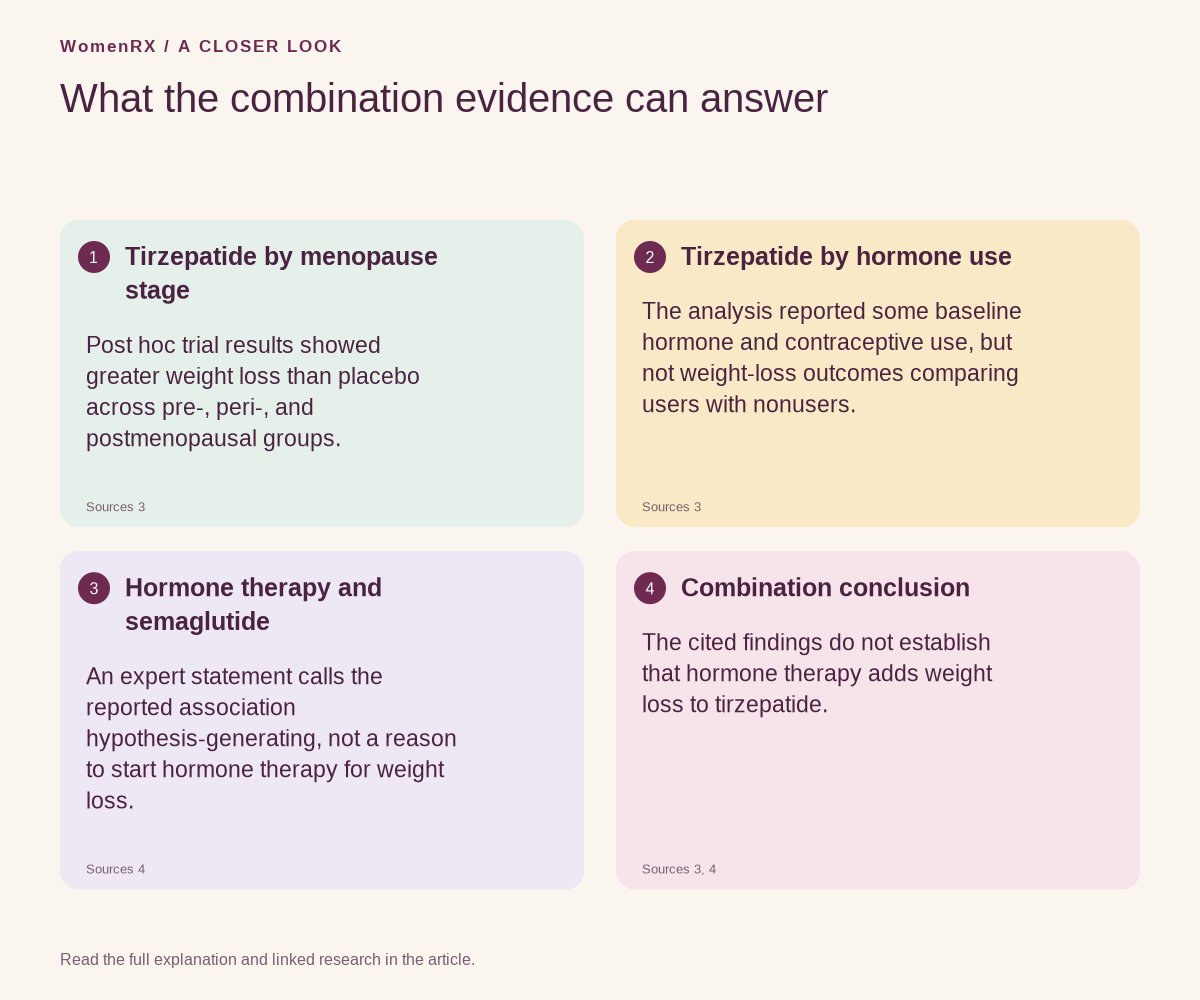
What the combination evidence can answer
Tirzepatide by menopause stage: Post hoc trial results showed greater weight loss than placebo across pre-, peri-, and postmenopausal groups.3
Tirzepatide by hormone use: The analysis reported some baseline hormone and contraceptive use, but not weight-loss outcomes comparing users with nonusers.3
Hormone therapy and semaglutide: An expert statement calls the reported association hypothesis-generating, not a reason to start hormone therapy for weight loss.4
Combination conclusion: The cited findings do not establish that hormone therapy adds weight loss to tirzepatide.34
Read the figure as text
Separate findings about menopause stage, hormone use, and different medications to see what supports a combination claim.- Tirzepatide by menopause stage: Post hoc trial results showed greater weight loss than placebo across pre-, peri-, and postmenopausal groups.3
- Tirzepatide by hormone use: The analysis reported some baseline hormone and contraceptive use, but not weight-loss outcomes comparing users with nonusers.3
- Hormone therapy and semaglutide: An expert statement calls the reported association hypothesis-generating, not a reason to start hormone therapy for weight loss.4
- Combination conclusion: The cited findings do not establish that hormone therapy adds weight loss to tirzepatide.34
More questions, answered
Should I stop menopause hormone therapy if I start tirzepatide?
The reported tirzepatide analysis doesn’t show that hormone therapy reduces or increases weight loss, and it wasn’t designed to guide whether someone should stop hormone therapy. That decision depends on its menopause-related benefits, risks, and your individual situation. 1 3
Does tirzepatide work differently after menopause?
In a post hoc analysis, tirzepatide was associated with greater weight loss than placebo in pre-, peri-, and postmenopausal groups. That supports benefit across stages, but it doesn’t prove that every person will respond the same way or that hormone therapy changes the response. 3
Sources you can check
- The 2022 hormone therapy position statement of The North American Menopause Society.“The 2022 Hormone Therapy Position Statement of The North American Menopause Society” Advisory Panel. · Menopause (New York, N.Y.) · 2022Return to first citation
- The dual glucose-dependent insulinotropic polypeptide/glucagon-like peptide-1 receptor agonist tirzepatide effects on body weight evolution, adiponectin, insulin and leptin levels in the combination of obesity, type 2 diabetes and menopause in mice.Reis-Barbosa PH, Marcondes-de-Castro I, Marinho TS, Aguila MB, Mandarim-de-Lacerda CA. · Diabetes, obesity & metabolism · 2024Return to first citation
- Body weight reduction in women treated with tirzepatide by reproductive stage: a post hoc analysis from the SURMOUNT program.Tchang BG, Mihai AC, Stefanski A, García-Pérez LE, Mojdami D, Jouravskaya I, Gurbuz S, Taylor R, Karanikas CA, Dunn JP. · Obesity (Silver Spring, Md.) · 2025Return to first citation
- Incretin-based therapies in peri- and postmenopausal women with obesity: an expert position statement from the Spanish Menopause Society.Sánchez-Prieto M, Romero-Domínguez M, Orozco R, Lilue M, Lubián-López DM, González SP, Nieto A, Coronado P, Sánchez-Borrego R, Cano A, Castelo-Branco C, Palacios S, Young Investiga... · Maturitas · 2026Return to first citation