Menopause Hormone Therapy After Endometriosis: What to Discuss
Your endometriosis history, past surgery, current symptoms, and proposed hormone regimen all belong in the conversation.
A history of endometriosis doesn’t automatically mean menopause hormone therapy is right or wrong for you. Recurrence has been reported, but the evidence can’t give a reliable personal risk estimate or identify one best regimen. Discuss the extent of your past disease, surgeries, symptoms, and the specific treatment proposed. A review’s preference for combined therapy applies to its discussion of severe endometriosis, not every history. 45
Start with your symptoms and your history
Menopause hormone therapy (MHT) can help with bothersome hot flashes and other menopause symptoms. If you’ve had endometriosis, the decision may also raise questions about whether disease could persist or recur. Research has reported recurrence after menopause, but it hasn’t established how often it happens overall or how MHT changes an individual’s risk. 14
That uncertainty isn’t a reason to assume MHT is always unsafe, or automatically the best option. General menopause guidance recommends weighing benefits and risks in light of the treatment and the person’s circumstances. For someone with endometriosis, it’s useful to make that discussion specific to her disease and surgery history. 13
Before your appointment, consider noting which symptoms you want help with, when they began, and what you’ve tried. Bring what you know about where endometriosis was found, prior treatments and surgeries, and whether your records mention disease that remained after surgery. These details can shape the conversation, but the research doesn’t provide a formula for predicting your personal risk from any one detail.
What the evidence can, and can’t, tell you
A 2017 systematic review found little high-quality research on menopause treatment in women with a history of endometriosis. It concluded that the absolute risks of recurrence and malignant transformation, and the effect of MHT on those outcomes, could not be determined from the evidence it reviewed. 4
One later retrospective cohort offers information about a particular group, not everyone with endometriosis. It followed 330 women who had hysterectomy and removal of both ovaries to treat endometriosis. Over a median six years of follow-up, the overall recurrence rate was 3.0%; researchers found no statistically significant difference among the groups receiving no MHT, estrogen-only therapy, estrogen-progestogen therapy, or tibolone. This study doesn’t prove the regimens are equivalent, and its findings can’t predict what will happen in other surgical or medical circumstances. 6
A separate clinical review describes a small potential for symptom recurrence with MHT specifically in women with a history of severe endometriosis. In that severe-disease context, it says combined hormone therapy is preferred, including after hysterectomy. That is not evidence that the same regimen is preferred for every person with any endometriosis history; the review also describes the overall evidence as poor. 5
Ask what the proposed regimen is meant to do
Ask which symptoms the treatment is intended to address and what type of treatment is being considered. For example, you might ask whether the proposal is systemic MHT for symptoms such as hot flashes, or a treatment aimed at genitourinary symptoms. Then ask what hormones the regimen contains and why that choice makes sense for your circumstances.
If estrogen-only therapy is proposed, ask how your endometriosis history factors into that choice. If estrogen-progestogen therapy is proposed, ask what the added progestogen is intended to address in your case, including if you’ve had a hysterectomy. The severe-endometriosis review and the surgical cohort don’t provide a single answer that applies to everyone, so it’s reasonable to ask how your clinician is weighing that evidence alongside your history. 56
If your ovaries were removed before the usual age of menopause, mention when that happened. General menopause guidance says treatment benefits and risks vary with factors such as treatment type and timing, and recommends periodic reassessment. That guidance is not specific to endometriosis, so ask how it applies to your situation. 1
Take these questions to your visit
- What details about my endometriosis, treatments, and surgeries would help us weigh the options?
- What symptoms are we aiming to treat, and what are the alternatives if I don’t want systemic hormones?
- Why are you suggesting this specific regimen, and how does my endometriosis history affect that choice?
- How and when will we review whether the plan is helping and still makes sense for me?
- If my previous endometriosis-like symptoms return, or new symptoms develop, what should I do and whom should I contact?
- Would input from a clinician with menopause or endometriosis expertise help with this decision?
If you prefer not to use MHT, you can ask about nonhormonal options for vasomotor symptoms. A North American Menopause Society position statement supports options that include cognitive behavioral therapy, clinical hypnosis, and certain prescription treatments. The right alternatives depend on the symptoms you want to address and your circumstances. 2
A useful outcome is a plan that states what you’re treating, why a particular option is being considered, how you’ll revisit the decision, and what to do if symptoms change. It doesn’t need to pretend the evidence can provide a universal yes or no.
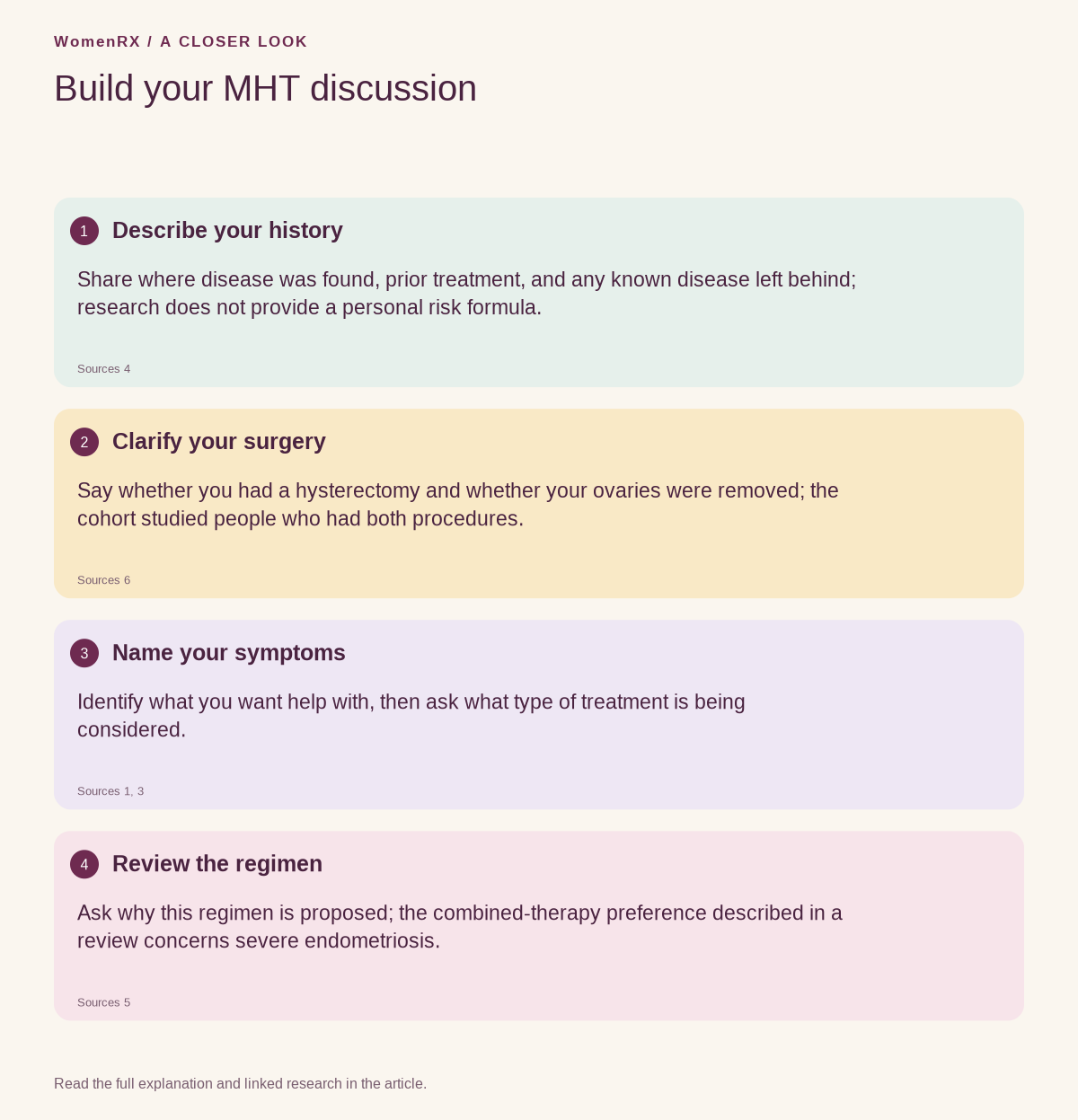
Build your MHT discussion
Describe your history: Share where disease was found, prior treatment, and any known disease left behind; research does not provide a personal risk formula.4
Clarify your surgery: Say whether you had a hysterectomy and whether your ovaries were removed; the cohort studied people who had both procedures.6
Name your symptoms: Identify what you want help with, then ask what type of treatment is being considered.13
Review the regimen: Ask why this regimen is proposed; the combined-therapy preference described in a review concerns severe endometriosis.5
Read the figure as text
Use these prompts to organize the visit. They guide a conversation, not a personal recurrence-risk estimate.- Describe your history: Share where disease was found, prior treatment, and any known disease left behind; research does not provide a personal risk formula.4
- Clarify your surgery: Say whether you had a hysterectomy and whether your ovaries were removed; the cohort studied people who had both procedures.6
- Name your symptoms: Identify what you want help with, then ask what type of treatment is being considered.13
- Review the regimen: Ask why this regimen is proposed; the combined-therapy preference described in a review concerns severe endometriosis.5
More questions, answered
Does having had a hysterectomy mean endometriosis can’t recur?
The available evidence doesn’t support treating hysterectomy as a guarantee against recurrence. In one cohort of women who had hysterectomy and removal of both ovaries for endometriosis, recurrence was reported during follow-up. That study describes a specific group and can’t estimate your personal risk. 46
What if I don’t want hormone therapy?
You can ask about nonhormonal treatments for the symptoms bothering you. A menopause position statement supports several options for vasomotor symptoms, including cognitive behavioral therapy, clinical hypnosis, and certain prescription treatments. 2
Sources you can check
- The 2022 hormone therapy position statement of The North American Menopause Society.“The 2022 Hormone Therapy Position Statement of The North American Menopause Society” Advisory Panel. · Menopause (New York, N.Y.) · 2022Return to first citation
- The 2023 nonhormone therapy position statement of The North American Menopause Society.Menopause (New York, N.Y.) · 2023Return to first citation
- Recommendations | Menopause: identification and management | Guidance | NICEAccessed 2026-09-25Return to first citation
- The management of menopause in women with a history of endometriosis: a systematic review.Gemmell LC, Webster KE, Kirtley S, Vincent K, Zondervan KT, Becker CM. · Human reproduction update · 2017Return to first citation
- Menopausal hormone therapy in women with benign gynaecological conditions and cancer.Brennan A, Rees M. · Best practice & research. Clinical endocrinology & metabolism · 2021Return to first citation
- Menopausal hormonal therapy in surgically menopausal women with underlying endometriosis.Tanmahasamut P, Rattanachaiyanont M, Techatraisak K, Indhavivadhana S, Wongwananuruk T, Chantrapanichkul P. · Climacteric : the journal of the International Menopause Society · 2022Return to first citation