Can Menopause Hormone Therapy Help With Anxiety?
Hormone therapy may ease anxiety symptoms during menopause, but the strongest reason to consider it is bothersome hot flashes or night sweats.
A review of randomized trials found that hormone therapy improved psychological symptoms in menopausal women, particularly mood and anxiety, though it did not quantify an anxiety-specific benefit. 6 If you also have bothersome hot flashes or night sweats, hormone therapy may be worth discussing for those symptoms. Persistent or overwhelming anxiety deserves care of its own. 41
What the anxiety finding means
A 2026 systematic review brought together 51 randomized trials of hormone therapy involving 41,821 participants. It reported improvement in psychological symptoms, particularly mood and anxiety. That’s encouraging if you’ve noticed anxiety alongside menopause symptoms. The finding does not, however, tell us how much anxiety improved specifically, and some significant findings in the review need further validation. 6
The trials included women in perimenopause and postmenopause. They do not establish that hormone therapy works differently for anxiety at one stage versus the other. Nor do findings about anxiety symptoms establish hormone therapy as treatment for a diagnosed anxiety disorder. 61
Where hot flashes change the conversation
Hormone therapy is the most effective treatment for vasomotor symptoms, meaning hot flashes and night sweats. If, for example, you’re waking with night sweats and also feeling anxious, there are two concerns worth naming: the night sweats you want relieved and the anxiety you want understood. Hormone therapy has an established role in treating the first. It is not established whether relief of hot flashes or disrupted sleep is what accounts for any improvement in anxiety. 46
That distinction gives you a practical way to frame a treatment discussion. If hot flashes or night sweats are substantially bothering you, ask whether hormone therapy makes sense for those symptoms, while describing the anxiety too. If anxiety is the main problem and menopause symptoms are mild, the evidence offers less reason to choose hormone therapy as the answer to it. 461
Why your medical history matters
The choice isn’t simply hormone therapy versus no help. Its benefit-risk balance varies with your age and time since menopause, medical history, hormone type, route, duration, and whether a progestogen is used. The North American Menopause Society’s 2022 position statement describes a generally favorable balance for bothersome hot flashes in women younger than 60 or within 10 years of menopause onset who have no contraindications; starting later has a less favorable balance because of higher absolute risks of conditions including stroke and blood clots. These are considerations for an individual decision, not a guarantee that treatment is right or wrong for you. 4
Your uterus also affects the treatment discussion. In a trial of postmenopausal women with a uterus, adding progesterone to estrogen reduced endometrial hyperplasia compared with estrogen alone. That’s one reason a conversation about hormone therapy involves more than choosing estradiol for a symptom. 3
If hormone therapy isn’t a good fit or you don’t want it, there are evidence-supported nonhormonal options for hot flashes, including cognitive behavioral therapy (CBT), certain antidepressants, and other treatments. Options for hot flashes and options for anxiety can overlap, but they should be chosen with the concern you want treated in mind. 51
Give anxiety its own attention when it needs it
Anxiety can feel like dread, tension, restlessness, or a racing heart. An anxiety disorder is more than an occasional anxious feeling: fear may be persistent or overwhelming. If anxiety is interfering with daily life, continues when other menopause symptoms are manageable, or feels hard to control, ask for an assessment rather than waiting to see whether menopause treatment fixes it. Psychotherapy, medication, or both are established treatments for anxiety disorders. 12
An assessment can also check whether something else is contributing to the symptoms. Thyroid problems and heart rhythm problems, for instance, are among the physical conditions that can be relevant when anxiety-like symptoms are evaluated. Treating bothersome menopause symptoms and getting anxiety-focused care can happen side by side. 1
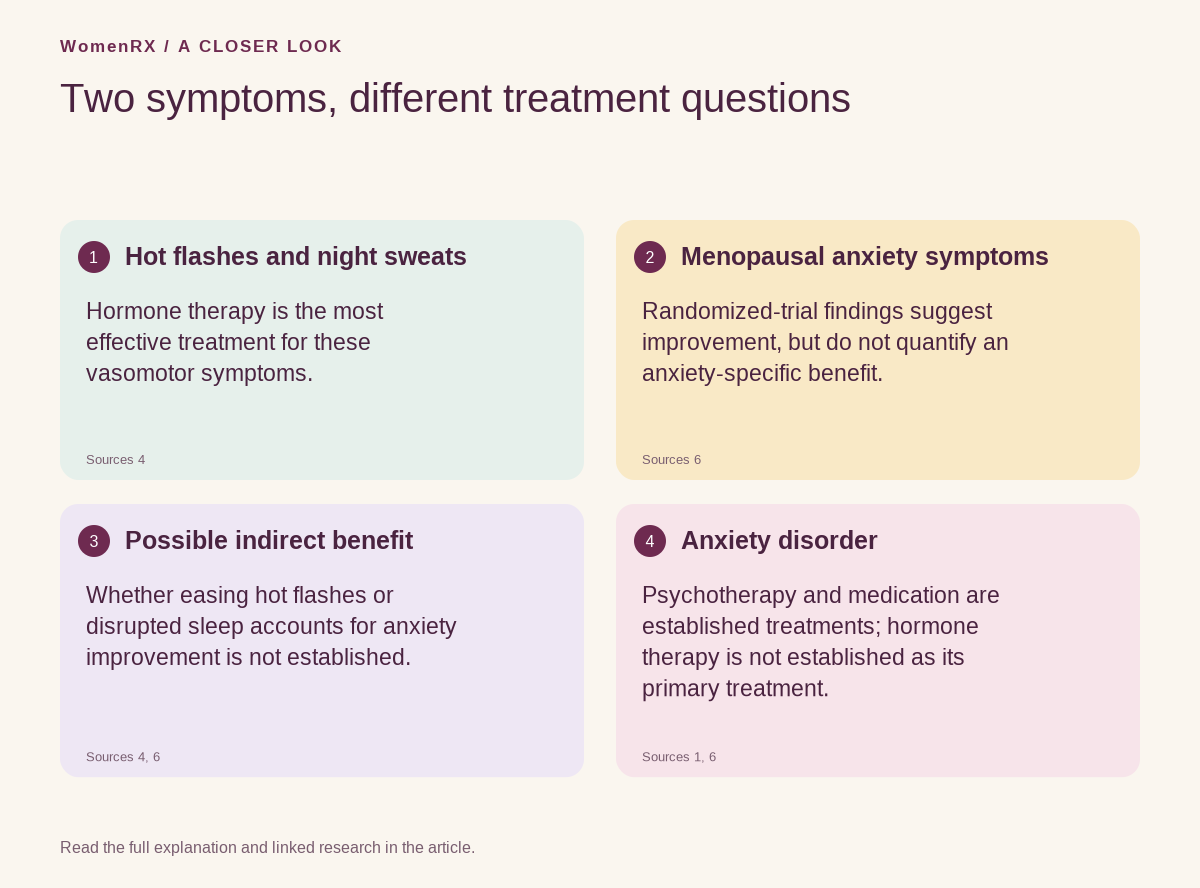
Two symptoms, different treatment questions
Hot flashes and night sweats: Hormone therapy is the most effective treatment for these vasomotor symptoms.4
Menopausal anxiety symptoms: Randomized-trial findings suggest improvement, but do not quantify an anxiety-specific benefit.6
Possible indirect benefit: Whether easing hot flashes or disrupted sleep accounts for anxiety improvement is not established.46
Anxiety disorder: Psychotherapy and medication are established treatments; hormone therapy is not established as its primary treatment.16
Read the figure as text
The evidence is stronger for treating hot flashes than for choosing hormone therapy primarily to treat anxiety.- Hot flashes and night sweats: Hormone therapy is the most effective treatment for these vasomotor symptoms.4
- Menopausal anxiety symptoms: Randomized-trial findings suggest improvement, but do not quantify an anxiety-specific benefit.6
- Possible indirect benefit: Whether easing hot flashes or disrupted sleep accounts for anxiety improvement is not established.46
- Anxiety disorder: Psychotherapy and medication are established treatments; hormone therapy is not established as its primary treatment.16
Sources you can check
- Anxiety: MedlinePlusAccessed 2026-09-25Return to first citation
- Mental Health: MedlinePlusAccessed 2026-09-25Return to first citation
- PROMETRIUM (PROGESTERONE) CAPSULE [ACERTIS PHARMACEUTICALS, LLC] | US prescribing information and patient instructionsAccessed 2026-09-25Return to first citation
- The 2022 hormone therapy position statement of The North American Menopause Society.“The 2022 Hormone Therapy Position Statement of The North American Menopause Society” Advisory Panel. · Menopause (New York, N.Y.) · 2022Return to first citation
- The 2023 nonhormone therapy position statement of The North American Menopause Society.Menopause (New York, N.Y.) · 2023Return to first citation
- Efficacy of hormone therapy and phytoestrogens on the psychological symptoms of menopausal women: a systematic review, meta-analysis, and trial sequential analysis.Shou M, Ye M, Lou C, Chen X, Yao Y, Yan J, Zhou W, Fu Z, Liu Z. · Frontiers in medicine · 2026Return to first citation