Can Hormone Therapy Help With Menopause Night Sweats?
Systemic hormone therapy can reduce menopause-related night sweats, but the best choice depends on what’s causing the sweating and your health history.
Yes. If your night sweats are menopause-related hot flashes that happen during sleep, systemic menopausal hormone therapy can help. It’s the most effective treatment for this group of symptoms. Whether it’s a good fit depends on your health history, age, time since menopause, and the treatment being considered. Effective nonhormone options are available too. 23
Start with what’s waking you
A night sweat can be a menopause-related vasomotor symptom, the same kind of symptom as a hot flash. These symptoms can occur during perimenopause and after menopause. When a sudden wave of heat and sweating wakes you, treating the vasomotor symptom may address an important cause of your broken sleep. 25
But sweating at night has other possible explanations. A hot room or heavy bedding can make anyone sweat. Anxiety, alcohol or drug use, and a tendency to sweat heavily are other possible contributors. Sometimes the cause isn’t clear. If you regularly wake with soaked clothes or sheets despite sleeping somewhere cool, it’s worth getting the sweating assessed rather than assuming it’s menopause. The same is true if it comes with fever or chills, a cough, diarrhea, or unexplained weight loss. 1
The distinction matters because a treatment for menopausal hot flashes won’t necessarily address another cause of sweating. It also helps to separate waking because you’re hot and sweaty from noticing sweat after waking for another reason. You don’t need to solve that puzzle alone, but describing which happens first can make the treatment conversation more useful.
What hormone therapy can, and can’t, promise
Systemic menopausal hormone therapy is the most effective treatment for vasomotor symptoms, including menopause-related night sweats. “Systemic” means the treatment is intended to act throughout the body, unlike low-dose vaginal estrogen, which has a different purpose. Systemic therapy may be taken orally or given through the skin; the treatment plan may also include a progestogen, such as progesterone. Which formulation makes sense is part of the individual decision. 247
Reducing night sweats may mean fewer sweat-related awakenings. It isn’t a promise that every sleep problem will go away. If you also struggle to fall asleep, wake without feeling hot, or can’t get back to sleep after a sweat, say so. Those are useful treatment goals to discuss separately from the sweating itself.
Timing and medical history change the tradeoff. The Menopause Society’s hormone therapy guidance describes a generally favorable benefit-risk balance for women younger than 60 or within 10 years of menopause onset who have bothersome vasomotor symptoms and no contraindications. Starting after age 60 or more than 10 years after menopause has a less favorable general balance because the absolute risks of coronary heart disease, stroke, blood clots in veins, and dementia are greater. That age-and-timing framework is a starting point, not a personal verdict. Risks also vary by treatment type, dose, route, duration, and whether a progestogen is used. 2
For example, a history of cardiovascular disease or an estrogen-dependent cancer can make hormone therapy unsuitable. Rather than asking only, “Can I take estrogen?”, ask which treatment is being considered, how your health history affects that choice, and what improvement in the sweats you’re hoping to see. 23
Compare treatments by the job they do
Systemic hormone therapy directly treats menopause-related vasomotor symptoms and is the most effective option for that purpose. Oral and through-the-skin formulations are available, but route is one of several factors in the risk-benefit decision. Neither route is automatically best for everyone. 27
Low-dose vaginal estrogen is a different conversation. It’s an option for bothersome vaginal or urinary symptoms of menopause when over-the-counter approaches haven’t helped and systemic hormone therapy isn’t indicated. If night sweats are your main concern, don’t assume a treatment aimed at vaginal symptoms is intended to relieve them. 2
Nonhormone treatments are real options if hormone therapy isn’t suitable or you’d rather not use it. The Menopause Society recommends cognitive behavioral therapy (CBT), clinical hypnosis, and several prescription options for vasomotor symptoms, including certain SSRIs or SNRIs, gabapentin, and fezolinetant. It also lists oxybutynin, with a different evidence rating. These choices differ in what they involve and what may fit your health history and preferences. 3
CBT is worth distinguishing from a promise to stop every sweat. A review of randomized trials of psychosocial approaches, particularly CBT, found the strongest and most consistent improvements in how bothersome hot flashes and night sweats felt and in sleep outcomes; effects on symptom frequency were smaller. If your main concern is how wiped out you feel after disrupted nights, that difference may matter to you. 6
Cooling your bedroom or changing bedding may help you feel more comfortable. Those steps aren’t established treatments for menopausal vasomotor symptoms in the 2023 nonhormone guidance, and that guidance doesn’t recommend supplements or herbal remedies for treating them. You can make your nights more comfortable while still asking for a treatment with evidence behind it. 3
Make the discussion about your nights
You can keep the conversation focused on three questions: Does the pattern sound like menopause-related night sweats, or does another cause need attention? If it is menopause-related, how do your age, time since menopause, and medical history affect the choice between systemic hormone therapy and nonhormone treatment? And what would count as a worthwhile result for you: fewer sweaty awakenings, better sleep, or both? 123
Those answers lead to a more useful choice than treating every sweaty night as the same problem.
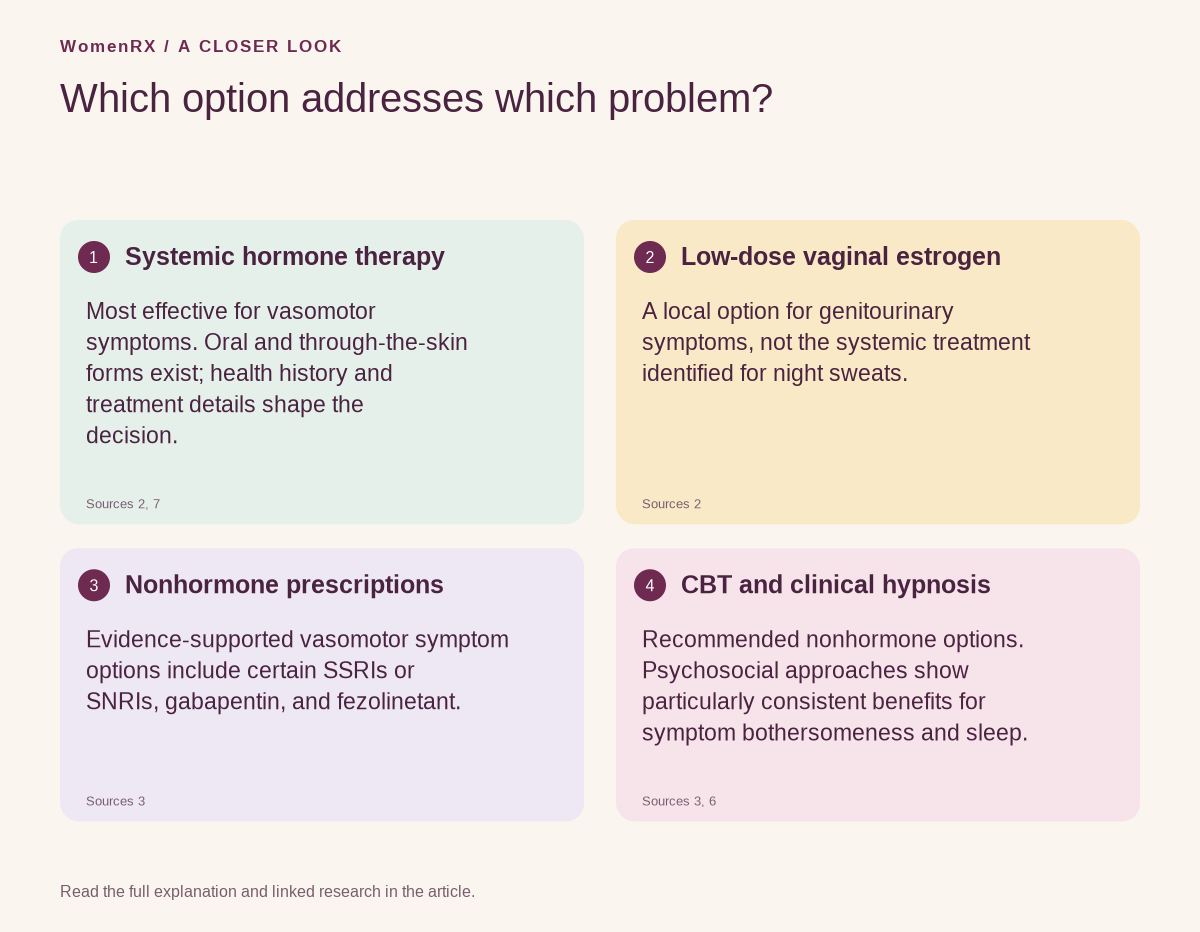
Which option addresses which problem?
Systemic hormone therapy: Most effective for vasomotor symptoms. Oral and through-the-skin forms exist; health history and treatment details shape the decision.27
Low-dose vaginal estrogen: A local option for genitourinary symptoms, not the systemic treatment identified for night sweats.2
Nonhormone prescriptions: Evidence-supported vasomotor symptom options include certain SSRIs or SNRIs, gabapentin, and fezolinetant.3
CBT and clinical hypnosis: Recommended nonhormone options. Psychosocial approaches show particularly consistent benefits for symptom bothersomeness and sleep.36
Read the figure as text
The main treatment choices differ in whether they target whole-body vasomotor symptoms, local vaginal symptoms, or the impact of sweats on sleep.- Systemic hormone therapy: Most effective for vasomotor symptoms. Oral and through-the-skin forms exist; health history and treatment details shape the decision.27
- Low-dose vaginal estrogen: A local option for genitourinary symptoms, not the systemic treatment identified for night sweats.2
- Nonhormone prescriptions: Evidence-supported vasomotor symptom options include certain SSRIs or SNRIs, gabapentin, and fezolinetant.3
- CBT and clinical hypnosis: Recommended nonhormone options. Psychosocial approaches show particularly consistent benefits for symptom bothersomeness and sleep.36
Sources you can check
- Night sweats - NHSAccessed 2026-09-25Return to first citation
- The 2022 hormone therapy position statement of The North American Menopause Society.“The 2022 Hormone Therapy Position Statement of The North American Menopause Society” Advisory Panel. · Menopause (New York, N.Y.) · 2022Return to first citation
- The 2023 nonhormone therapy position statement of The North American Menopause Society.Menopause (New York, N.Y.) · 2023Return to first citation
- Cognitive behavioural therapy for menopausal symptoms: a systematic review of efficacy in improving quality of life.Rukure H, Husted M. · BMC women's health · 2025Return to first citation
- Menopausal Hormone Therapy and Cardiovascular Risk in Midlife Women With Vasomotor Symptoms.Wang Z, Swanson SA, Brooks MM, Barinas-Mitchell E, Bertolet M, Magnani JW, Thurston RC, El Khoudary SR. · JAMA internal medicine · 2026Return to first citation
- The effectiveness of psychosocial interventions on physiological symptoms of menopause: a systematic review and meta-analysis.Robinson K, Hardy R, Melville M, Saidel S, Desai R, Spector A. · BMC women's health · 2026Return to first citation
- Hormone Therapy: Menopausal Hormone Therapy.Eubanks A. · FP essentials · 2023Return to first citation