Can Menopause Hormone Therapy Help Palpitations?
Palpitations can happen during menopause, but their timing alone can’t show whether they’re a hot-flash sensation, a heart rhythm problem, or something else.
Menopause hormone therapy has not been shown by the reported findings of one small KEEPS analysis to relieve palpitations specifically. Palpitations can occur with menopause, but also with triggers such as caffeine or alcohol, thyroid problems, anemia, or an arrhythmia. If they keep returning, get more frequent, or come with chest pain, shortness of breath, or fainting, respond based on those symptoms rather than assuming they’re hormonal. 1 3
Start with what’s happening now
An uncomfortable or unusual heartbeat, including a fluttering feeling, can occur during menopause. But feeling it around a hot flash doesn’t prove the hot flash caused it, and the sensation alone can’t tell you whether your heart rhythm is abnormal. Palpitations are a symptom, not a diagnosis. 1 2
Get emergency medical help now if palpitations are happening and don’t stop, or if they come with chest pain, shortness of breath, feeling faint, or fainting. These symptoms are listed as reasons for immediate assessment, not as a way to diagnose the cause. 1
If you feel well but the palpitations keep coming back or are happening more often, arrange a medical evaluation rather than writing them off as menopause. 1
Menopause is one possibility, not the only one
Menopause is one recognized context for palpitations, but several other explanations are possible. Caffeine, alcohol, nicotine, recreational drugs, and stress can be triggers. Palpitations can also occur with iron-deficiency anemia, an overactive thyroid, a heart rhythm problem, or other heart conditions such as valve disease. 1
A pattern can be useful to describe, but it can’t settle the cause. For example, if you notice fluttering during a hot flash, that timing is worth mentioning; it doesn’t establish that the sensation is harmless or hormonal. A clinician can consider your symptoms and health history and use an electrocardiogram (ECG) to check the heart’s electrical signals. If the cause remains unclear, further rhythm monitoring may be considered. 1 2
That distinction matters because treatment depends on the cause. Palpitations that aren’t due to a health condition may improve when a trigger is avoided, while palpitations caused by a heart problem may need treatment directed at that problem. 1
What hormone therapy evidence does and doesn’t show
A published analysis from the KEEPS study included 100 women who had been assigned to hormone therapy or placebo. They were healthy, recently postmenopausal women at one study site, all of European ancestry; several cardiovascular risk factors were grounds for exclusion. Participants reported symptoms, including palpitations, before treatment and at 48 months. The reported findings do not establish whether hormone therapy improved palpitations specifically. 3
So the practical answer is not that hormone therapy does or doesn’t work for every woman’s palpitations. It’s that this study’s reported results don’t answer the palpitation question. Hormone therapy shouldn’t be treated as a way to diagnose or control a heart rhythm problem. If it’s being considered for menopause symptoms, keep that decision separate from checking recurring or concerning palpitations. 1 3
A useful next step
When you describe the episodes, note what you were doing, whether a hot flash was happening, how the sensation felt, and whether you had other symptoms at the same time. Bring a list of medicines and supplements, too. These details can help guide an evaluation, but they aren’t a substitute for checking symptoms that are persistent, worsening, or accompanied by warning signs. History and ECG are central parts of assessing palpitations; a rhythm monitor may be used if the cause remains unclear. 1 2
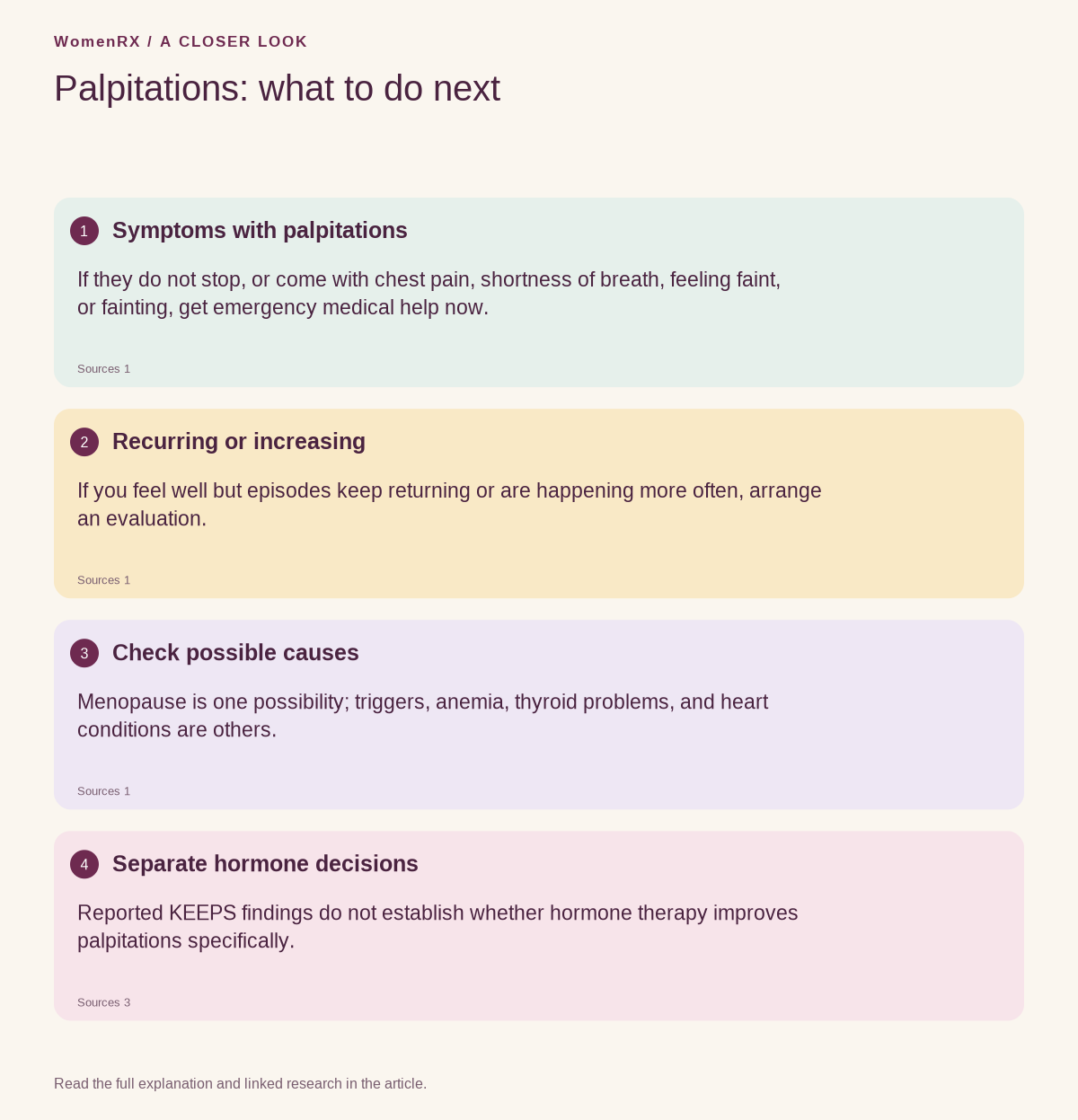
Palpitations: what to do next
Symptoms with palpitations: If they do not stop, or come with chest pain, shortness of breath, feeling faint, or fainting, get emergency medical help now.1
Recurring or increasing: If you feel well but episodes keep returning or are happening more often, arrange an evaluation.1
Check possible causes: Menopause is one possibility; triggers, anemia, thyroid problems, and heart conditions are others.1
Separate hormone decisions: Reported KEEPS findings do not establish whether hormone therapy improves palpitations specifically.3
Read the figure as text
Use the symptoms you have now to choose a response. Menopause timing alone cannot identify the cause.- Symptoms with palpitations: If they do not stop, or come with chest pain, shortness of breath, feeling faint, or fainting, get emergency medical help now.1
- Recurring or increasing: If you feel well but episodes keep returning or are happening more often, arrange an evaluation.1
- Check possible causes: Menopause is one possibility; triggers, anemia, thyroid problems, and heart conditions are others.1
- Separate hormone decisions: Reported KEEPS findings do not establish whether hormone therapy improves palpitations specifically.3
More questions, answered
Can I tell from the sensation whether I have an arrhythmia?
No. Palpitations describe a sensation, and the feeling alone doesn’t identify the heart rhythm. An ECG checks the heart’s electrical signals; additional monitoring may be considered if the cause remains unclear. 1 2
Sources you can check
- Heart palpitations - NHSAccessed 2026-09-25Return to first citation
- Palpitations: Evaluation and management by primary care practitioners.Govender I, Nashed KK, Rangiah S, Okeke S, Maphasha OM. · South African family practice : official journal of the South African Academy of Family Practice/Primary Care · 2022Return to first citation
- SLCO1B1 genetic variation and hormone therapy in menopausal women.Moyer AM, de Andrade M, Faubion SS, Kapoor E, Dudenkov T, Weinshilboum RM, Miller VM. · Menopause (New York, N.Y.) · 2018Return to first citation