Menopause Palpitations: What to Track and When to Act
Menopause can be one reason for a fluttering or pounding heartbeat, but recurring or warning-sign symptoms deserve more than a guess.
If palpitations are happening now and won’t stop, or come with chest pain, shortness of breath, feeling faint, or fainting, seek emergency care now. If they keep returning or are becoming more frequent, arrange a planned medical assessment. Menopause may be one cause, but thyroid problems, anemia, heart rhythm conditions, and stimulants can also play a role. 1
Start with what’s happening now
A racing, pounding, fluttering, or skipped-beat feeling can be unsettling. If it’s happening now and does not go away, or you also have chest pain, shortness of breath, feel faint, or faint, seek emergency care now. Don’t wait to finish a symptom log first. 1
If the episode has stopped and you feel well, recurring palpitations or episodes that are happening more often are a reason to arrange a planned assessment. Palpitations are common and often aren’t a sign of something serious, but they can also come from a heart rhythm problem or another health condition. 1
Menopause can be part of the picture, not the whole answer
Palpitations are sometimes associated with menopause. Other possible causes include caffeine, alcohol, nicotine, recreational drugs, iron deficiency anemia, an overactive thyroid, and heart rhythm or other heart problems. So an episode that happens during a hot flash may be useful context to share, but timing alone can’t tell you what caused it. 1
Keep a short, useful record
When an episode happens, jot down:
- When it started and stopped, and whether it felt fast, irregular, pounding, or fluttery.
- What you were doing, and whether it began during a hot flash or around a change in sleep.
- Other symptoms, especially chest pain, shortness of breath, feeling faint, or fainting.
- Possible triggers that day, such as caffeine, alcohol, nicotine, or recreational drugs.
- Medicines and supplements you take, including anything recently started or changed.
This is a record of what happened, not a way to diagnose the rhythm yourself. Bring the list, and your medicines or an up-to-date medication list, to the assessment. Common triggers and the range of sensations palpitations can cause are described in clinical guidance. 1
What an assessment may involve
An electrocardiogram (ECG) may help identify the cause of palpitations by checking your heart’s electrical signals. 1
A systematic review of 14 studies involving 4,617 people being followed for possible rhythm problems found that most studies reported more atrial fibrillation detection with mobile health devices than with standard follow-up. Results varied considerably, and the review cautioned that finding an episode on a device does not automatically establish what it means clinically. A recording from an ECG-capable device can be information to share, not a substitute for assessment or a reason to delay emergency care. 2
Be cautious about “natural” fixes
A supplement sold for menopause symptoms is not automatically a treatment for a heart rhythm problem. The North American Menopause Society’s statement on nonhormone treatment addresses vasomotor symptoms such as hot flashes; it does not establish supplements or herbal remedies as treatments for palpitations. Don’t use a remedy in place of getting recurring or warning-sign symptoms assessed. 3
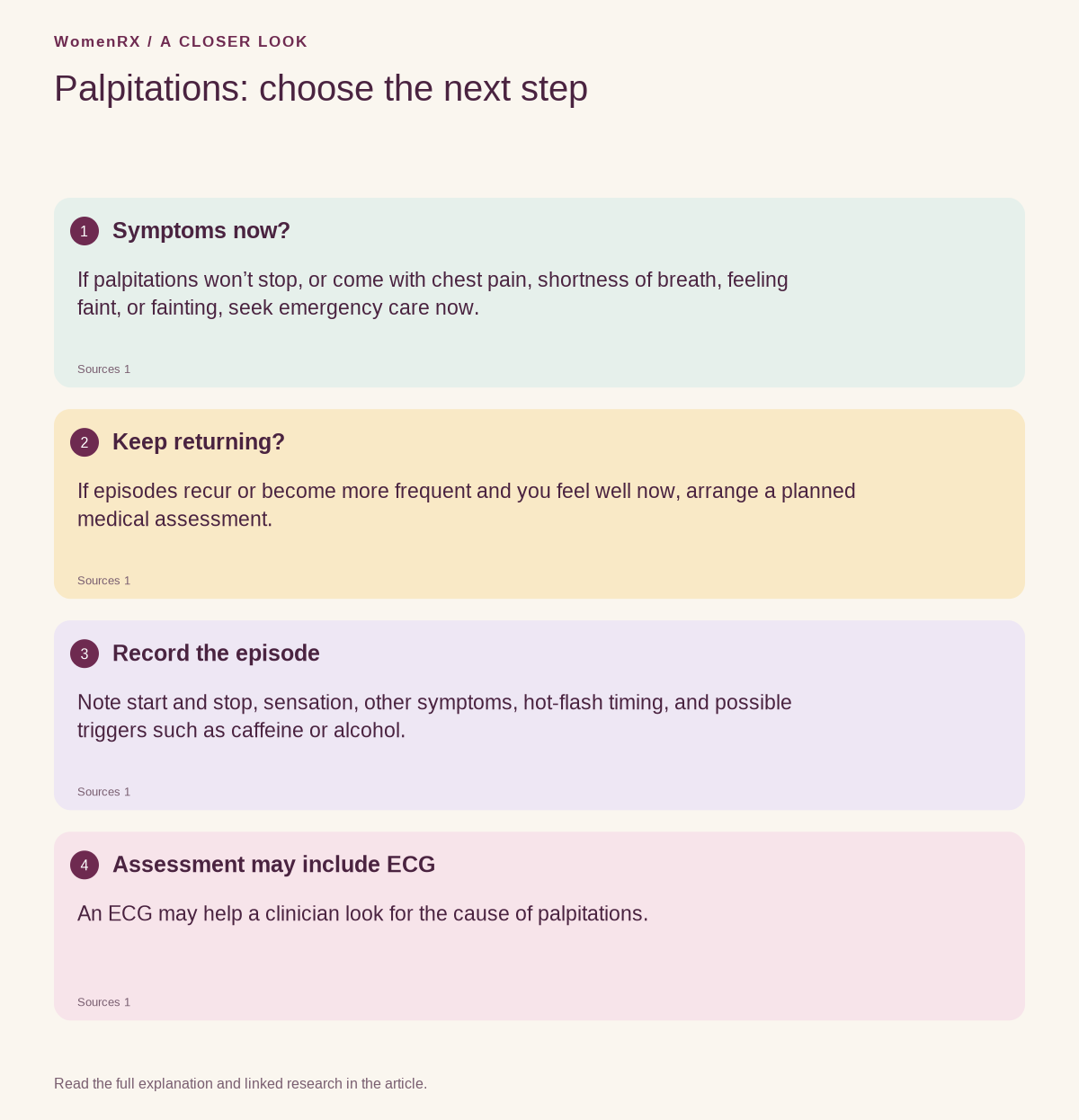
Palpitations: choose the next step
Symptoms now?: If palpitations won’t stop, or come with chest pain, shortness of breath, feeling faint, or fainting, seek emergency care now.1
Keep returning?: If episodes recur or become more frequent and you feel well now, arrange a planned medical assessment.1
Record the episode: Note start and stop, sensation, other symptoms, hot-flash timing, and possible triggers such as caffeine or alcohol.1
Assessment may include ECG: An ECG may help a clinician look for the cause of palpitations.1
Read the figure as text
Use current symptoms and episode pattern to distinguish emergency care from planned assessment and useful record-keeping.- Symptoms now?: If palpitations won’t stop, or come with chest pain, shortness of breath, feeling faint, or fainting, seek emergency care now.1
- Keep returning?: If episodes recur or become more frequent and you feel well now, arrange a planned medical assessment.1
- Record the episode: Note start and stop, sensation, other symptoms, hot-flash timing, and possible triggers such as caffeine or alcohol.1
- Assessment may include ECG: An ECG may help a clinician look for the cause of palpitations.1
More questions, answered
Should I trust a smartwatch reading during palpitations?
Treat a reading as information to share, not a diagnosis. The evidence reviewed for mobile health devices included ECG-capable tools, and study results varied; a device-detected rhythm still needs clinical interpretation. Seek emergency care for ongoing palpitations with chest pain, shortness of breath, feeling faint, or fainting, regardless of what a device shows. 12
Sources you can check
- Heart palpitations - NHSAccessed 2026-09-25Return to first citation
- Impact of Mobile Health Devices for the Detection of Atrial Fibrillation: Systematic Review.Biersteker TE, Schalij MJ, Treskes RW. · JMIR mHealth and uHealth · 2021Return to first citation
- The 2023 nonhormone therapy position statement of The North American Menopause Society.Menopause (New York, N.Y.) · 2023Return to first citation