Perimenopause and Heart Palpitations: What to Track and When to Get Help
If a fluttering or racing heartbeat appears during perimenopause, record its pattern rather than assuming the timing explains its cause.
Write down when the sensation starts and stops, how it feels, what you were doing, possible triggers, and any symptoms such as chest pain, shortness of breath, or feeling faint. Menopause can be associated with palpitations, but timing alone can’t identify the cause. Get emergency help for palpitations that don’t stop or come with chest pain, faintness, or fainting. 12
A flutter, skipped beat, or sudden racing sensation can be unsettling, especially when it appears during perimenopause. Menopause can be associated with palpitations, but the timing alone can’t tell you why they’re happening. Rhythm problems and other health conditions can also cause them, so notice the pattern rather than assuming hormones explain it. 12
Make a short, useful record
You don’t need to measure every heartbeat. A few specific details can help a clinician decide what to ask or test:
- When it happened: Note the date and time, whether you were resting or active, and how long the episode seemed to last.
- What it felt like: Was it fast, fluttering, pounding, or like a beat was skipped? Did it start and stop suddenly or build gradually? If you can tell, note whether it felt regular or irregular. 2
- What came with it: Record symptoms such as chest pain, shortness of breath, feeling faint, or fainting. Don’t wait to finish a diary if you have urgent symptoms. Shortness of breath is a relevant accompanying symptom in the assessment of palpitations. 12
- What might have been relevant: Note recent caffeine, alcohol, nicotine, recreational drugs, medicines, or a stressful moment. These can be associated with palpitations, but a connection in your notes doesn’t prove a cause. 13
- Whether it’s changing: Include how often episodes happen and whether they’re becoming more frequent. 1
An example entry might read: “After dinner, fluttering for a few minutes while sitting; no chest pain or faintness; had coffee earlier.” The aim is to make the episode easier to describe, not to diagnose yourself.
When to get help
Get emergency help now if palpitations are happening and don’t go away, or if they occur with chest pain, feeling faint, or fainting. 1
If chest pain, feeling faint, or fainting occurred with palpitations but has now stopped, seek urgent medical care rather than waiting for a routine visit. 1
Arrange a medical review if palpitations keep coming back or are happening more often, even if you feel well between episodes. A diary can help describe the pattern, but it can’t rule out a rhythm problem. 12
Why perimenopause isn’t the only explanation
Palpitations are a sensation, not a diagnosis. Menopause can be associated with them, and caffeine, alcohol, nicotine, and recreational drugs are other possible triggers. Health conditions including iron-deficiency anemia, an overactive thyroid, heart rhythm problems, and other heart problems can also be involved. The symptom by itself doesn’t distinguish among these possibilities. 1
Assessment may include questions about the episodes, an examination, and an electrocardiogram (ECG), which records the heart’s electrical signals. Because palpitations can come and go, the heartbeat may not be doing anything unusual during an appointment. Depending on the situation, a clinician may consider monitoring the rhythm over time or other tests. 123
Bring your notes and a list of medicines and supplements you take. A smartwatch ECG recording, if you already have one, may provide a record of an episode; it isn’t a substitute for assessing concerning symptoms or deciding what the recording means. Wearable ECG devices may help detect arrhythmias, but assessment still depends on the overall clinical picture. 3
The useful takeaway is simple: palpitations that appear during perimenopause aren’t automatically harmless or hormone-related. Track a few clear details, act on urgent symptoms, and get recurring or increasingly frequent episodes assessed.
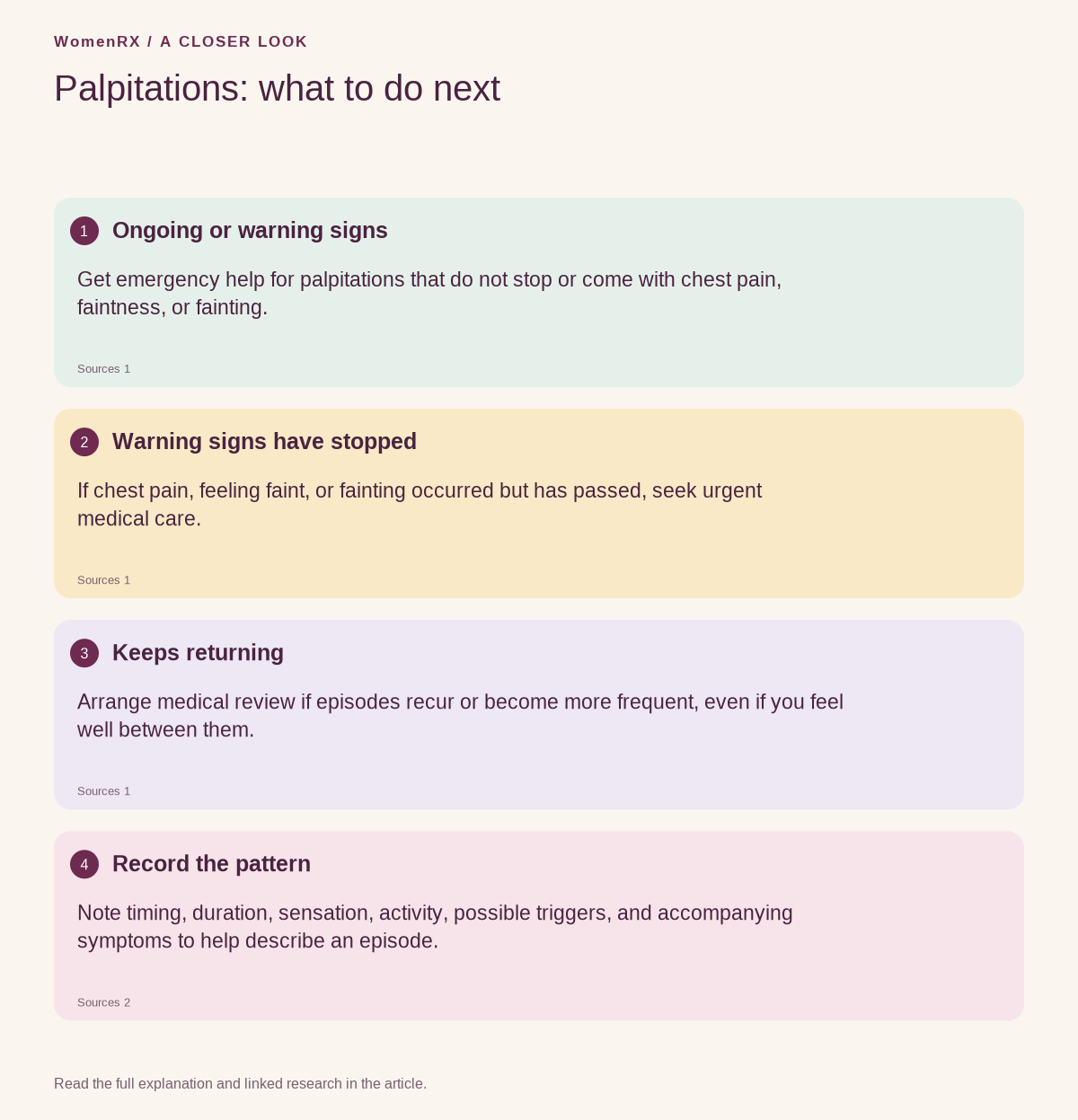
Palpitations: what to do next
Ongoing or warning signs: Get emergency help for palpitations that do not stop or come with chest pain, faintness, or fainting.1
Warning signs have stopped: If chest pain, feeling faint, or fainting occurred but has passed, seek urgent medical care.1
Keeps returning: Arrange medical review if episodes recur or become more frequent, even if you feel well between them.1
Record the pattern: Note timing, duration, sensation, activity, possible triggers, and accompanying symptoms to help describe an episode.2
Read the figure as text
Use symptoms and episode pattern to choose a next step; this flow does not identify the cause.- Ongoing or warning signs: Get emergency help for palpitations that do not stop or come with chest pain, faintness, or fainting.1
- Warning signs have stopped: If chest pain, feeling faint, or fainting occurred but has passed, seek urgent medical care.1
- Keeps returning: Arrange medical review if episodes recur or become more frequent, even if you feel well between them.1
- Record the pattern: Note timing, duration, sensation, activity, possible triggers, and accompanying symptoms to help describe an episode.2
More questions, answered
Can a normal ECG rule out an intermittent rhythm problem?
Not necessarily. If symptoms come and go, an ECG taken when you feel well may not capture the episode. Depending on the history and initial evaluation, a clinician may consider heart-rhythm monitoring or other tests. 23
Sources you can check
- Heart palpitations - NHSAccessed 2026-09-25Return to first citation
- Palpitations: A Practical Approach.Ribero-Vargas D, Jaramillo-Alvarez JC, Gandara-Ricardo J. · Cureus · 2025Return to first citation
- Palpitations: Evaluation, Management, and Wearable Smart Devices.Gauer RL, Thomas MF, McNutt RA. · American family physician · 2024Return to first citation