Heart Palpitations in Perimenopause: What Needs Checking
Palpitations can happen during the menopause transition, but their pattern and accompanying symptoms matter more than the timing.
Palpitations may feel like a fluttering or unusually noticeable heartbeat and can last seconds, minutes, or longer. Perimenopause is one possible explanation, not a diagnosis. Seek emergency care if palpitations are happening now and won’t stop, or are happening with chest pain, feeling faint, or fainting. If an episode with those warning symptoms has stopped, seek urgent assessment. Arrange routine assessment for recurring or increasingly frequent palpitations, or a family history of heart problems. 1
What the sensation can and can’t tell you
A palpitation is an uncomfortable or unusual awareness of your heartbeat. You may feel it in your chest, neck, or throat. It can last seconds, minutes, or longer. How it feels, or how quickly it passes, cannot tell you on its own what caused it. 1
Women do report palpitations during the menopause transition. In the multiethnic Study of Women’s Health Across the Nation (SWAN), researchers identified groups with different patterns of reported palpitations across perimenopause and postmenopause. These patterns weren’t associated with the study’s measures of carotid atherosclerosis or arterial stiffness. These population-level findings can’t identify the cause of an individual episode or rule out an abnormal heart rhythm. 2
Decide what needs attention now
Seek emergency care if you have palpitations now that won’t go away, or palpitations now with chest pain, feeling faint, or fainting. If an episode of palpitations with those warning symptoms has stopped, seek urgent medical assessment rather than waiting for a routine appointment. 1
Arrange a routine assessment if you feel well now but the palpitations keep coming back or are happening more often. A family history of heart problems is also a reason to arrange an assessment after palpitations, even if you’ve had only one episode. 1
If none of those descriptions fits and the episode has passed, make a note of it. If it happens again, you’ll have a clearer account of whether the pattern is changing. Tracking is not a substitute for assessment when one of the reasons above applies.
Why perimenopause isn’t the only possibility
Palpitations can occur around menopause, but they can also be linked to an abnormal heart rhythm, another heart problem, iron-deficiency anemia, or an overactive thyroid. Alcohol, caffeine, nicotine, and recreational drugs are among the possible triggers. Noticing a possible trigger doesn’t rule out another cause. 1
An electrocardiogram, or ECG, may help investigate palpitations by recording the heart’s electrical signals. Whether you need one or other assessment depends on your situation. 1
Make a short record you can use
For an episode that doesn’t call for urgent care, write down the time, roughly how long it lasted, and what you felt. Note whether you were resting or active, whether you had chest pain or felt faint, and anything you noticed beforehand, such as caffeine or alcohol. Keep the description simple: “a flutter in my chest for a few minutes” is more useful than trying to name a rhythm you can’t confirm.
The record helps you explain what happened and whether episodes are becoming more frequent. It cannot establish that your heart rhythm is normal. Don’t pause to document symptoms that need emergency care. 1
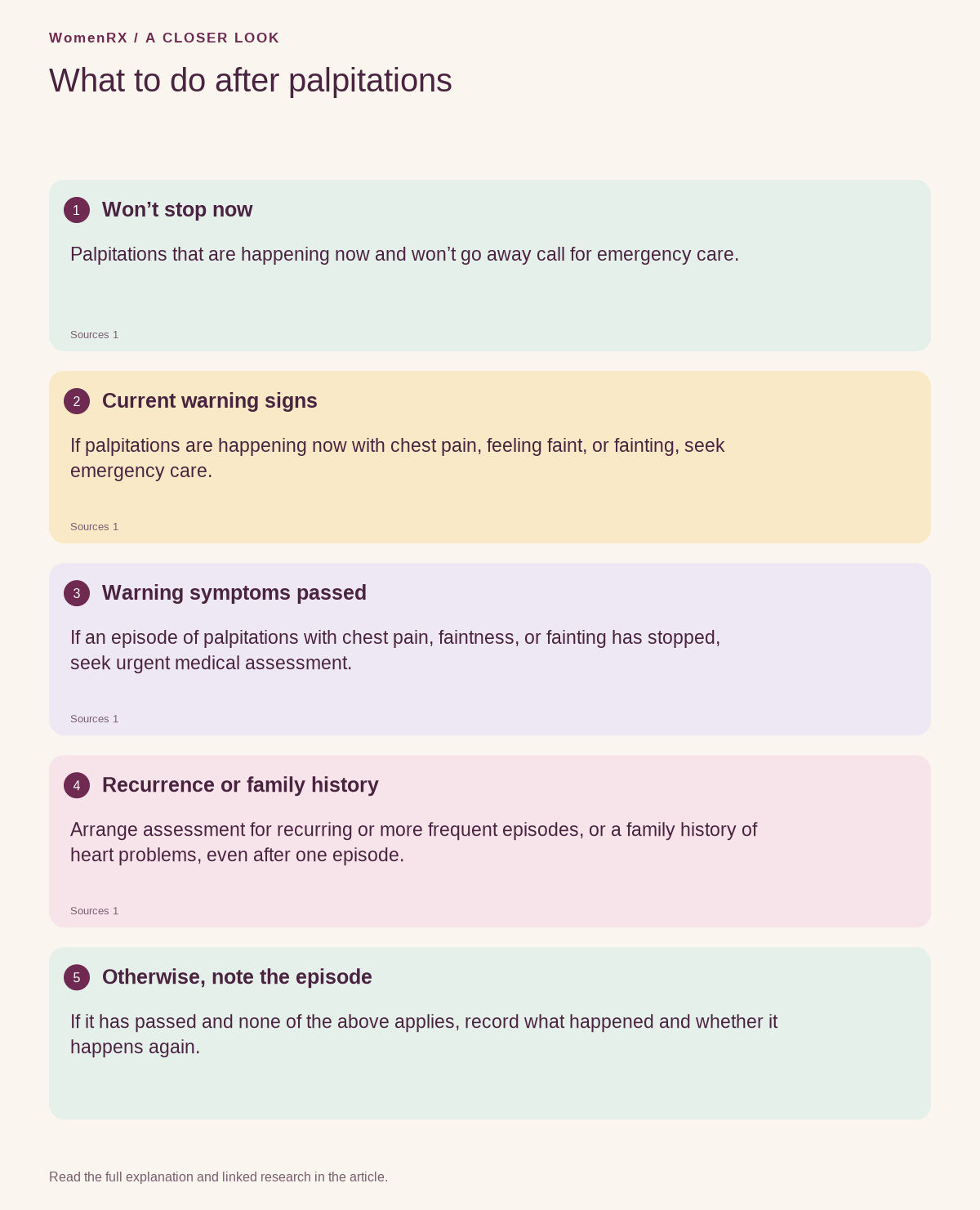
What to do after palpitations
Won’t stop now: Palpitations that are happening now and won’t go away call for emergency care.1
Current warning signs: If palpitations are happening now with chest pain, feeling faint, or fainting, seek emergency care.1
Warning symptoms passed: If an episode of palpitations with chest pain, faintness, or fainting has stopped, seek urgent medical assessment.1
Recurrence or family history: Arrange assessment for recurring or more frequent episodes, or a family history of heart problems, even after one episode.1
Otherwise, note the episode: If it has passed and none of the above applies, record what happened and whether it happens again.
Read the figure as text
Check current symptoms first. Once an episode has passed, recurrence and family history still affect the next step.- Won’t stop now: Palpitations that are happening now and won’t go away call for emergency care.1
- Current warning signs: If palpitations are happening now with chest pain, feeling faint, or fainting, seek emergency care.1
- Warning symptoms passed: If an episode of palpitations with chest pain, faintness, or fainting has stopped, seek urgent medical assessment.1
- Recurrence or family history: Arrange assessment for recurring or more frequent episodes, or a family history of heart problems, even after one episode.1
- Otherwise, note the episode: If it has passed and none of the above applies, record what happened and whether it happens again.
More questions, answered
Is there a normal length for perimenopause palpitations?
Palpitations can last seconds, minutes, or longer, but there isn’t a single episode length that identifies them as menopause-related. Palpitations happening now that won’t go away need emergency attention. If an episode of palpitations with chest pain, faintness, or fainting has stopped, seek urgent assessment. Recurrence or a family history of heart problems is a reason to arrange assessment. 1
Sources you can check
- Heart palpitations - NHSAccessed 2026-09-25Return to first citation
- Palpitations across the menopause transition in SWAN: trajectories, characteristics, and associations with subclinical cardiovascular disease.Carpenter JS, Cortés YI, Tisdale JE, Sheng Y, Jackson EA, Barinas-Mitchell E, Thurston RC. · Menopause (New York, N.Y.) · 2023Return to first citation