Perimenopause Period Changes: What Needs Checking?
Cycle timing can become less predictable during perimenopause, but bleeding between periods, disruptive heavy flow, and any bleeding after 12 months without a period deserve a closer look.
Periods may become less predictable during perimenopause, but don’t assume every change is part of the transition. Get bleeding between periods or after sex checked, and discuss heavy flow that affects daily life, persists, or comes with significant pain. Once you’ve gone 12 months without a period, any vaginal bleeding needs assessment, even if it happens only once. 1 2 4
A changing cycle isn’t a diagnosis
During perimenopause, the timing of periods may become less predictable. A change in timing by itself doesn’t tell you whether a particular bleeding pattern is harmless or what is causing it. 4
It helps to separate three things: when bleeding happens, how much there is, and whether you have reached the point of 12 months without a period. That last distinction matters because bleeding after that point is assessed differently from bleeding during the transition. 1 3
Timing: note what’s different
A period that comes earlier or later than you expected may fit with changing cycles, but keep track of dates and any bleeding between periods. Bleeding between periods, or after sex, is a reason to contact a clinician rather than automatically chalking it up to perimenopause. 2
A simple record can capture the first and last day of each period, any bleeding between periods or after sex, and whether the flow interfered with everyday activities. This isn’t a way to diagnose the cause. It gives you a clearer description of the pattern to share when you seek care.
Flow: judge the impact, not just the label
Heavy periods can occur around menopause, but heavy bleeding can also have other causes, including conditions affecting the uterus or ovaries and some medicines. Rarely, it can be a sign of cancer. 2
Consider asking for an assessment if heavy flow affects your daily life, has been going on for some time, or comes with severe period pain. Practical signs of heavy bleeding include needing to change a pad or tampon every one to two hours, using two types of period products together, or feeling tired or short of breath often. 2
You don’t need to wait until you can describe the bleeding perfectly. If it’s disrupting work, sleep, or other ordinary activities, that impact is worth mentioning. The aim of an assessment is to consider causes beyond the menopausal transition, not to presume that the bleeding signals a serious problem. 2
Bleeding after menopause is different
Menopause is marked by 12 months without a period. Vaginal bleeding after that point is called postmenopausal bleeding, and it needs assessment even if it happens once or you’re not sure whether it’s blood. 1 3
There are several possible causes. Common ones include thinning or inflammation of the vaginal or uterine lining and noncancerous polyps; less commonly, postmenopausal bleeding is caused by cancer. Getting it checked helps identify the cause. 1
A useful way to describe the pattern
When you contact a clinician, say whether the bleeding is part of a period, happens between periods or after sex, or began after 12 months without a period. Add how long it lasts, how heavy it is, and whether it affects daily life or comes with significant pain. These distinctions help make clear why you’re seeking an assessment. 1 2
A clinician may recommend further evaluation based on the pattern and suspected cause. For abnormal uterine or postmenopausal bleeding when tissue assessment is indicated, a joint professional guideline favors biopsy directed during hysteroscopy over blind sampling, particularly when a focal problem is suspected or earlier imaging or sampling is inconclusive. 3
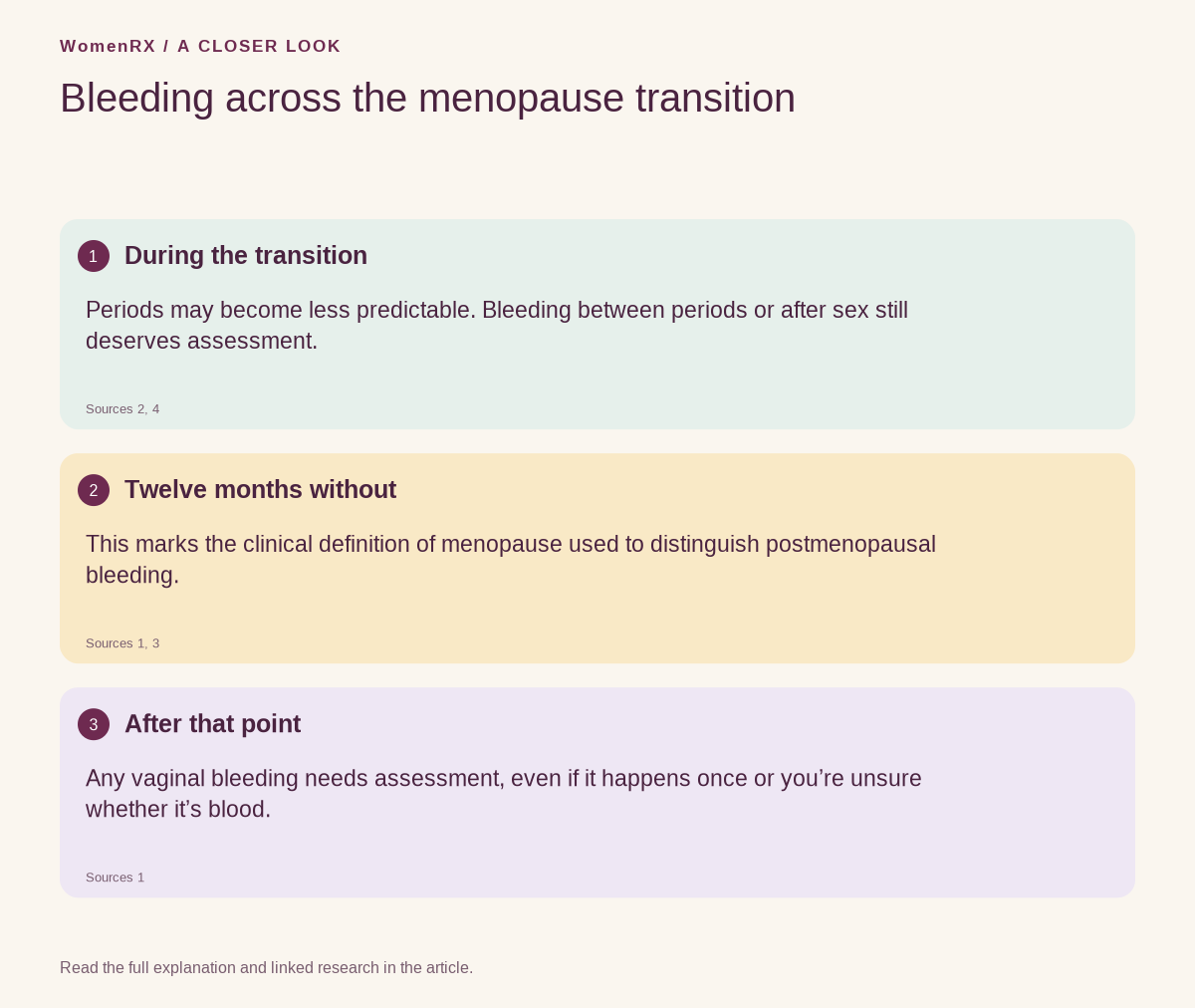
Bleeding across the menopause transition
During the transition: Periods may become less predictable. Bleeding between periods or after sex still deserves assessment.24
Twelve months without: This marks the clinical definition of menopause used to distinguish postmenopausal bleeding.13
After that point: Any vaginal bleeding needs assessment, even if it happens once or you’re unsure whether it’s blood.1
Read the figure as text
The key dividing point is not a particular symptom: it is 12 months without a period.- During the transition: Periods may become less predictable. Bleeding between periods or after sex still deserves assessment.24
- Twelve months without: This marks the clinical definition of menopause used to distinguish postmenopausal bleeding.13
- After that point: Any vaginal bleeding needs assessment, even if it happens once or you’re unsure whether it’s blood.1
More questions, answered
Can symptoms alone tell me that I’ve reached menopause?
No. The definition used in clinical guidance is 12 months without a period; bleeding before that point is not postmenopausal bleeding, and bleeding after it should be assessed. 1 3
Does heavy bleeding always mean something serious?
No. Heavy periods can occur around menopause and have several possible causes. But if the bleeding affects daily life, persists, or comes with severe pain, it’s worth getting assessed rather than assuming it’s just perimenopause. 2
Sources you can check
- Postmenopausal bleeding - NHSAccessed 2026-09-25Return to first citation
- Heavy periods - NHSAccessed 2026-09-25Return to first citation
- Visually directed hysteroscopic biopsy in the evaluation of abnormal uterine bleeding and postmenopausal bleeding: a Joint Society Practice Guideline. Joint Society Practice Guideline from AAGL-ESGE-GCH. · Facts, views & vision in ObGyn · 2026Return to first citation
- Clinical Evaluation of Effectiveness and Safety of Combined Use of Dietary Supplements Amberen® and Smart B® in Women with Climacteric Syndrome in Perimenopause.Kachko VA, Shulman LP, Kuznetsova IV, Uspenskaya YB, Burchakov DI. · Advances in therapy · 2024Return to first citation