Fibrocystic Breast Changes: What Needs Checking?
Breast tenderness that follows your period is common, but timing alone can’t tell you what a new lump is.
Breast pain that starts before a period and eases when it ends often follows a hormonal pattern. “Fibrocystic changes” can describe benign cystic or fibrous tissue, but you can’t identify a new lump by its timing or feel alone. Arrange an assessment for a breast lump, and seek prompt care for redness, fever, nipple discharge, or a new skin or shape change.651
What the timing of pain can tell you
If your breasts feel heavy or achy before your period, then settle afterward, that timing is worth noticing. Period-linked breast pain can begin up to two weeks before bleeding starts, worsen as the period approaches, and go away when it ends. It often affects both breasts and may extend toward the armpits.6
That pattern helps describe the pain. It doesn’t identify the cause of a particular lump. If you feel a new, distinct lump, have it assessed even if it’s tender or you first noticed it before your period. Breast lumps have more than one possible cause, and symptoms alone aren’t a reliable way to name one.12
What “fibrocystic” does and doesn’t mean
Fibrocystic changes is a broad description of benign changes in breast tissue, including fibrous areas and cysts. A cyst is a fluid-filled area that may cause a lump or pain, but it can also cause no symptoms. The word “fibrocystic” isn’t a diagnosis you can make from how your breast feels.5
Breast pain also has other possible explanations. Pregnancy, hormone changes around menopause, some medicines, and pain referred from the neck, shoulder, or back can all be involved. Infection is another possibility, particularly when a breast is red, hot, or swollen.6 This is why it helps to separate two questions: Does the soreness follow a familiar pattern? and Is there a new change that needs its own assessment?
How life stage changes the conversation
If you have periods: Tell the clinician when the pain begins relative to bleeding and whether it eases when your period ends. For example, soreness in both breasts before several periods is different information from pain that stays in one spot throughout the month. Neither pattern, on its own, rules a lump in or out.62
If you might be pregnant: Pregnancy can cause breast pain. Mention that possibility when describing a new symptom, but don’t assume it explains a lump. A breast lump still needs assessment.61
If you’re breastfeeding: Say so when you seek care. Pain studies that exclude pregnant and breastfeeding women don’t tell us how often a particular diagnosis explains symptoms during lactation. More immediately, a red, hot, swollen breast or pain with a high temperature or shivering calls for prompt medical attention rather than waiting to see whether it settles.46
Around or after menopause: Hormone changes during menopause can be associated with breast pain. Once periods stop, there’s no monthly bleeding pattern to compare symptoms against. Report a new lump or other new breast change rather than attributing it to menopause.61
What happens when a change is checked
A clinician can ask about the timing and location of symptoms, examine the breast, and decide whether imaging is needed. Ultrasound and mammography are among the tools used to investigate breast findings; sometimes a tissue sample is needed to clarify what a finding is.13 The next step depends on the finding, not on whether the breast hurts. In a retrospective study of people who came to a surgical clinic with breast pain, diagnoses included fibrocystic changes, fibroadenomas, and infections, as well as a small number of cancers. That clinic group cannot predict what your lump is.2
Make an appointment for a breast lump, including one that seems to change with your cycle. Seek prompt care if the breast is red, hot, or swollen; you feel feverish or shivery; there’s nipple discharge; or you notice a new change in breast shape, dimpling, a nipple rash, or a nipple turning inward.16 If pain is the only symptom but it isn’t improving, that also deserves a conversation.6
Easing pain while you get answers
A properly fitted bra may make soreness easier to live with. For breast pain, guidance also lists common pain relievers and pain-relieving gel as options.6 There’s little evidence that vitamin E tablets or evening primrose oil help breast pain.6 Comfort measures can help with soreness, but they don’t replace assessment of a new lump or skin or nipple change.16
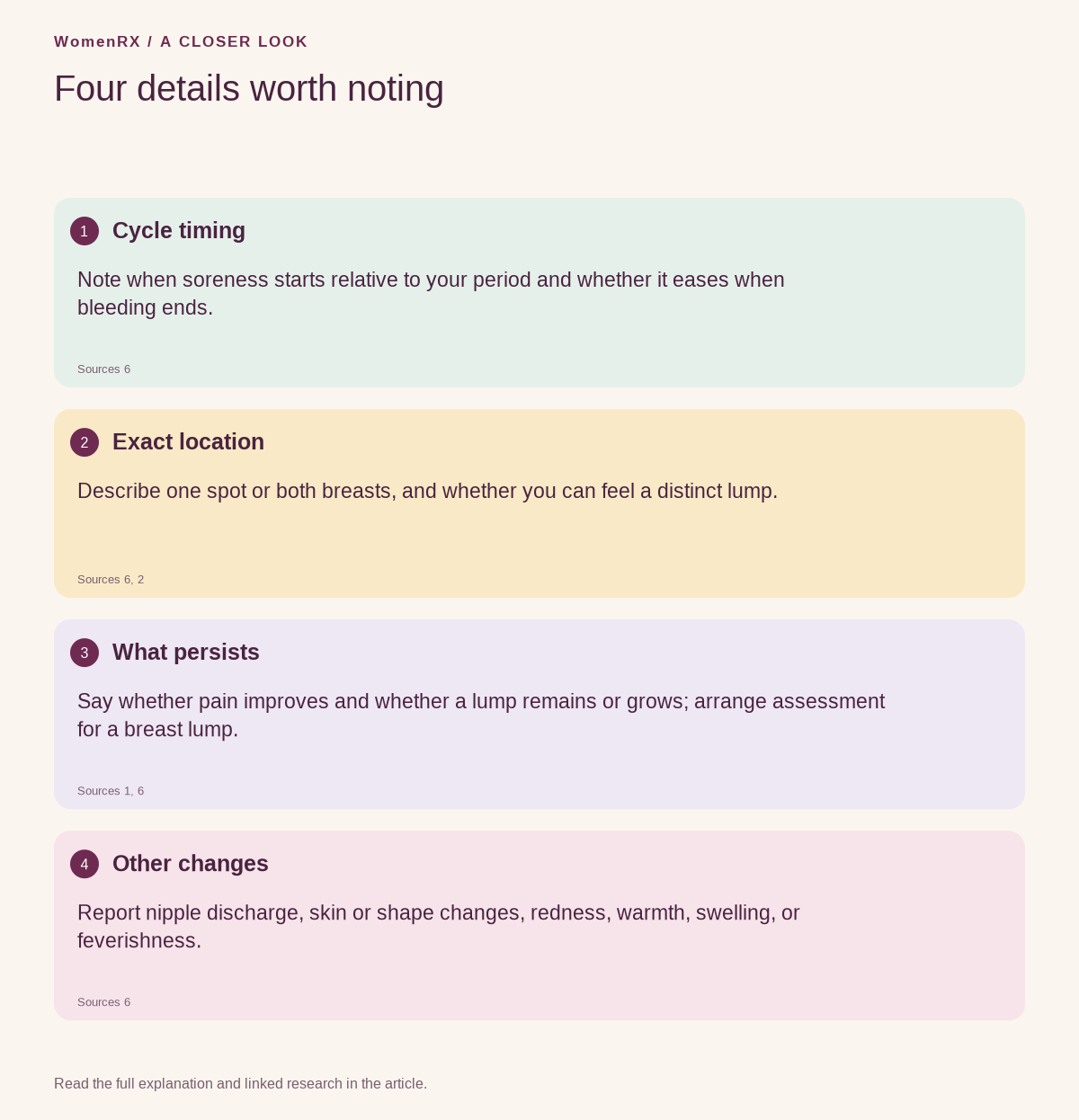
Four details worth noting
Cycle timing: Note when soreness starts relative to your period and whether it eases when bleeding ends.6
Exact location: Describe one spot or both breasts, and whether you can feel a distinct lump.62
What persists: Say whether pain improves and whether a lump remains or grows; arrange assessment for a breast lump.16
Other changes: Report nipple discharge, skin or shape changes, redness, warmth, swelling, or feverishness.6
Read the figure as text
These details help describe a breast change; they are not a test for whether it is benign.- Cycle timing: Note when soreness starts relative to your period and whether it eases when bleeding ends.6
- Exact location: Describe one spot or both breasts, and whether you can feel a distinct lump.62
- What persists: Say whether pain improves and whether a lump remains or grows; arrange assessment for a breast lump.16
- Other changes: Report nipple discharge, skin or shape changes, redness, warmth, swelling, or feverishness.6
More questions, answered
Do fibrocystic changes raise breast cancer risk?
“Fibrocystic changes” covers different tissue findings, so the label alone doesn’t settle a person’s risk. Simple cysts are benign, while atypical changes found on tissue testing are a different finding that needs individual interpretation. A new lump should be evaluated regardless of what you think is causing it.51
Sources you can check
- Lumps - NHSAccessed 2026-09-25Return to first citation
- Assessing and managing benign breast lesions leading to mastalgia: A review of 840 patients.Doğan Y, Dede AM, Çapar M, Salimoğlu Coşkun S, Dede EC. · Turkish journal of surgery · 2025Return to first citation
- Fibrocystic Breast DiseaseMalherbe K, Khan M, Fatima S. · 2026Return to first citation
- Retrospective Analysis of Women with Only Mastalgia.Arslan M, Küçükerdem HS, Can H, Tarcan E. · The journal of breast health · 2016Return to first citation
- Breast Cyst (Archived)Kowalski A, Okoye E. · 2023Return to first citation
- Breast pain - NHSAccessed 2026-09-25Return to first citation