Fibrocystic Breast Changes: How Symptoms Are Assessed
“Fibrocystic changes” is a broad description, not a guarantee that every lump or tender spot has the same cause.
Fibrocystic changes can include several benign findings, such as fluid-filled cysts and changes in breast tissue; the term doesn’t identify what a particular new lump is. A clinician may use your symptoms and imaging findings together, and sometimes a biopsy, to clarify a finding. Note whether tenderness or lumpiness changes with your menstrual cycle, but don’t use that pattern to diagnose a new or changing lump yourself. 2 4 8
What the term describes
“Fibrocystic changes” is an umbrella description for several kinds of benign breast findings, rather than one specific condition. These can include fluid-filled cysts, fibrous tissue changes, and other tissue patterns. The term may be used differently by radiologists and pathologists, which is one reason it doesn’t tell you exactly what a particular lump is. 2
A simple cyst is a fluid-filled pocket in breast tissue. Cysts can be small or larger, singular or multiple, and may cause a lump, pain, or nipple discharge, though some cause no symptoms. A palpable lump can also have another cause, so “fibrocystic” shouldn’t be assumed just because you have had breast lumpiness before. 2 4
How symptoms and images are put together
Tenderness, lumps, and nipple discharge can occur with fibrocystic findings, especially in premenopausal women. Symptoms alone can’t identify the underlying tissue finding. 2
Assessment is about matching what you notice with what an examination and, when needed, imaging show. Ultrasound and MRI can reveal different patterns, but some benign and concerning findings can look similar. For example, fibrocystic changes may appear as an area of altered tissue on ultrasound or as enhancement on MRI. An image finding therefore needs to be interpreted in context, not labeled by appearance alone. 2 5
If a cystic finding has solid components or other features that make its nature uncertain, it is different from simply knowing that you have a cyst. In those situations, further evaluation may be needed. When the diagnosis remains in doubt, a tissue sample can help distinguish benign changes from lesions that need different management. 6 8
What to note when symptoms recur
If your symptoms come and go, jot down when they occur, where you feel them, and whether the area changes over time. If you menstruate, noting the timing in relation to your cycle can help describe your personal pattern. Monthly hormonal changes may contribute to fibrocystic changes, but a cyclical pattern doesn’t establish that a new or changing lump is benign. 1 2
If you’re pregnant or breastfeeding, mention that when arranging an assessment rather than assuming a new finding is part of that stage. If you’re past menopause, say when your periods stopped and whether you use menopausal hormone therapy. A Swedish observational study found that hormone therapy use was associated with some benign breast findings after menopause; that association cannot identify the cause of an individual lump. 7
When you seek an assessment, describe what feels different from your usual pattern and mention any relevant breast imaging or biopsy history. A prior fibrocystic finding may be useful context, but it doesn’t automatically explain a new finding. Clinicians need to assess the finding in front of them and decide whether imaging or, in some cases, tissue sampling is appropriate. 2 8
The label doesn’t tell the whole risk story
Many findings grouped under fibrocystic changes are benign, but the risk associated with benign breast disease varies by the specific tissue finding. A simple cyst is not the same as a proliferative change or a finding with atypia. The name “fibrocystic” alone can’t establish the risk category; the specific imaging or pathology result matters. 3 4
If a report uses a term you don’t recognize, ask what exact finding was seen, whether it was considered benign or uncertain, and what follow-up, if any, was recommended. That gives you more useful information than the broad label by itself.
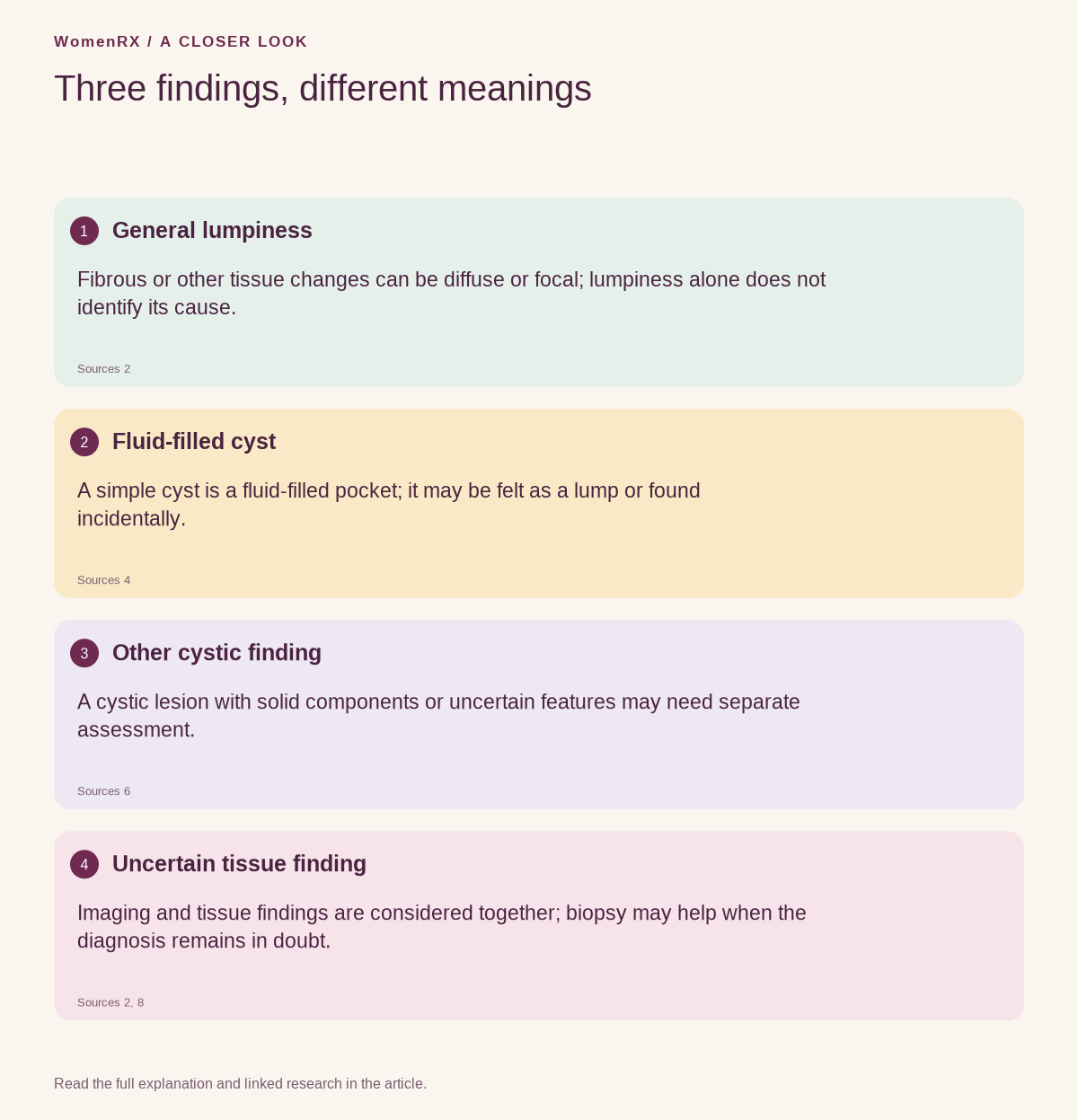
Three findings, different meanings
General lumpiness: Fibrous or other tissue changes can be diffuse or focal; lumpiness alone does not identify its cause.2
Fluid-filled cyst: A simple cyst is a fluid-filled pocket; it may be felt as a lump or found incidentally.4
Other cystic finding: A cystic lesion with solid components or uncertain features may need separate assessment.6
Uncertain tissue finding: Imaging and tissue findings are considered together; biopsy may help when the diagnosis remains in doubt.28
Read the figure as text
The same broad label can refer to different tissue findings. This comparison shows why the exact finding, rather than the umbrella term, guides interpretation.- General lumpiness: Fibrous or other tissue changes can be diffuse or focal; lumpiness alone does not identify its cause.2
- Fluid-filled cyst: A simple cyst is a fluid-filled pocket; it may be felt as a lump or found incidentally.4
- Other cystic finding: A cystic lesion with solid components or uncertain features may need separate assessment.6
- Uncertain tissue finding: Imaging and tissue findings are considered together; biopsy may help when the diagnosis remains in doubt.28
More questions, answered
Does having breast cysts mean I have fibrocystic changes?
Cysts are one type of finding that may be included under the broad term “fibrocystic changes,” but the terms aren’t interchangeable in every report. Ask which specific finding was identified. 2 4
Can breast tenderness tell me whether a lump is benign?
No. Tenderness can occur with benign breast findings, but symptoms alone don’t identify the tissue causing a lump. Assessment may involve imaging and, when a finding remains uncertain, biopsy. 2 8
Sources you can check
- The evaluation of the effect of metformin on breast fibrocystic disease.Talaei A, Moradi A, Rafiei F. · Breast disease · 2017Return to first citation
- Fibrocystic Changes of the Breast: Radiologic-Pathologic Correlation of MRI.Choe AI, Kasales C, Mack J, Al-Nuaimi M, Karamchandani DM. · Journal of breast imaging · 2022Return to first citation
- Polycystic Ovary Syndrome and Fibrocystic Breast Disease: An Updated Review.Kunicki M, Smolarczyk R. · Hormone and metabolic research = Hormon- und Stoffwechselforschung = Hormones et metabolisme · 2021Return to first citation
- Breast Cyst (Archived)Kowalski A, Okoye E. · 2023Return to first citation
- Nonmass Lesions on Breast US: An International Perspective on Clinical Use and Outcomes.Choi JS, Tsunoda H, Moon WK. · Journal of breast imaging · 2024Return to first citation
- Outcomes in Sonographically Categorized Complex Cystic Breast Lesions.Kulali F, Guner G. · Journal of ultrasound in medicine : official journal of the American Institute of Ultrasound in Medicine · 2022Return to first citation
- Characterization of Benign Breast Diseases and Association With Age, Hormonal Factors, and Family History of Breast Cancer Among Women in Sweden.Johansson A, Christakou AE, Iftimi A, Eriksson M, Tapia J, Skoog L, Benz CC, Rodriguez-Wallberg KA, Hall P, Czene K, Lindström LS. · JAMA network open · 2021Return to first citation
- Benign Breast Disease in Women.Stachs A, Stubert J, Reimer T, Hartmann S. · Deutsches Arzteblatt international · 2019Return to first citation