What Causes Fibrocystic Breast Changes?
Hormone shifts across the menstrual cycle may affect breast tissue and tenderness, but fibrocystic changes describe several findings, not one proven cause.
Fibrocystic breast changes are a broad term for tissue patterns such as cysts and fibrosis, not a single condition with one established cause. Breast tissue responds to hormonal fluctuations, and tenderness or lumpiness may follow a menstrual pattern. That connection doesn’t prove that hormones explain every lump: a new or changing finding needs assessment rather than a guess based on timing or feel. 3 4 5
What the term means
Fibrocystic changes describe a range of breast-tissue findings, including cysts and areas of fibrosis. The term is used for several different benign conditions, rather than one single disease with one predictable feel. 3 4
That range helps explain why people use “lumpy” to describe different things. Some notice a generally uneven or nodular texture; a cyst may feel like a distinct, rounded lump; and fibrous tissue may feel firm. But a cyst and a solid lump can’t be reliably distinguished by touch alone. 3
What may contribute, and what remains unclear
There isn’t one established cause that explains every finding grouped under “fibrocystic changes.” The term covers different tissue patterns, including cysts and fibrosis, so it isn’t a precise explanation of why a particular lump appeared. 3 4
Hormones may be part of the picture. Breast tissue responds to hormonal fluctuations during the reproductive years, and cyclical breast pain is associated with fibrocystic changes. This helps explain why some people notice tenderness or lumpiness around their periods. It does not show that hormones cause every fibrocystic finding, or that a new lump is hormone-related. 3 5
When breast tenderness follows your cycle
Breast pain linked to periods commonly starts in the weeks before bleeding, may affect both breasts, and eases when the period ends. Pain can also have other causes, including pregnancy, menopause-related hormone changes, some medicines, or an injury to the neck, shoulder, or back. A familiar timing pattern can be useful to describe, but it doesn’t prove that a particular lump is fibrocystic. 1
Breast pain on its own is unlikely to be a sign of cancer, according to NHS guidance. Still, pain and a lump are different findings: a new lump deserves attention even if the breast is also sore or your period is approaching. 1 2
A practical way to describe a change
If you’ve noticed a change, make a note of what you actually feel and see. For example, you might report that a lump is in one specific area, whether it seems new, and whether it changes or becomes tender around your period. Note whether one or both breasts are affected, and mention any nipple or skin changes. These details help make your description clearer; they can’t establish the cause on their own.
Arrange a clinical evaluation for a new breast lump or a change that’s growing or persisting. Don’t wait for it to match a familiar cycle pattern before mentioning it. A clinician may examine the area and, if the cause isn’t clear, recommend imaging such as ultrasound or other tests. 2
Seek prompt medical attention for a breast change with red, hot, or swollen skin, a hard lump that doesn’t move, bloody nipple discharge, a change in breast shape, skin dimpling, or a new nipple rash or inward turning. If you also have a very high temperature or feel feverish or shivery, seek urgent care. 1
The useful distinction isn’t “Does this feel like fibrocystic change?” It’s “Is this a familiar, general pattern, or is there a new, focal, or changing finding that needs assessment?” Feel and timing can guide what you report, but they can’t replace an evaluation.
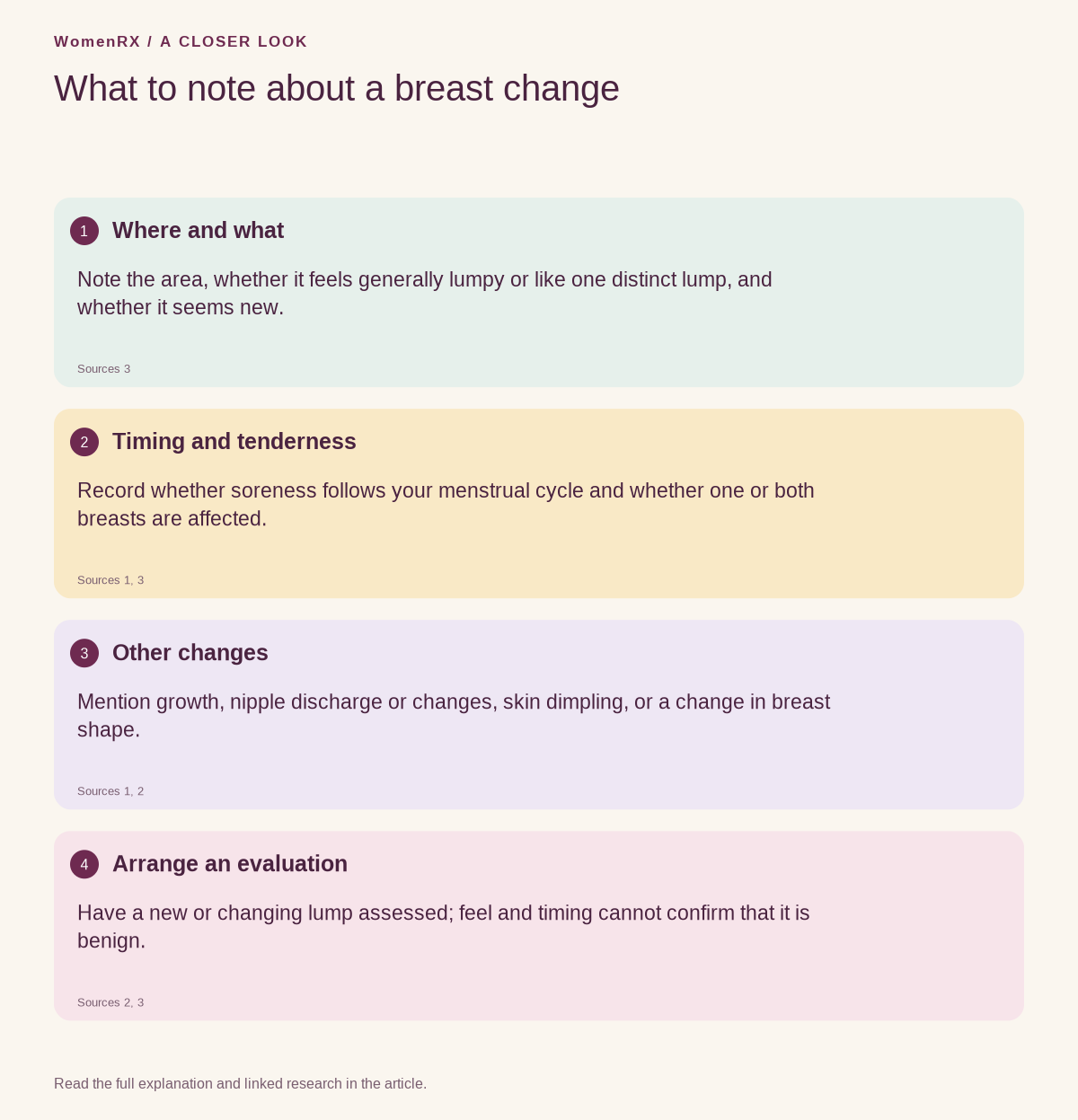
What to note about a breast change
Where and what: Note the area, whether it feels generally lumpy or like one distinct lump, and whether it seems new.3
Timing and tenderness: Record whether soreness follows your menstrual cycle and whether one or both breasts are affected.13
Other changes: Mention growth, nipple discharge or changes, skin dimpling, or a change in breast shape.12
Arrange an evaluation: Have a new or changing lump assessed; feel and timing cannot confirm that it is benign.23
Read the figure as text
Use these observations to describe what has changed. They can help you explain the finding, but they cannot diagnose its cause.- Where and what: Note the area, whether it feels generally lumpy or like one distinct lump, and whether it seems new.3
- Timing and tenderness: Record whether soreness follows your menstrual cycle and whether one or both breasts are affected.13
- Other changes: Mention growth, nipple discharge or changes, skin dimpling, or a change in breast shape.12
- Arrange an evaluation: Have a new or changing lump assessed; feel and timing cannot confirm that it is benign.23
More questions, answered
Can you tell whether a breast lump is a cyst by feel?
No. A cyst may feel rounded, but cysts and solid lumps can’t be reliably distinguished by touch alone. A new lump should be evaluated rather than identified by feel. 3 2
Does breast pain mean cancer?
Breast pain by itself is unlikely to be a cancer sign, but pain doesn’t explain away a new lump or other breast change. Have a new or changing finding assessed. 1 2
Sources you can check
- Breast pain - NHSAccessed 2026-09-25Return to first citation
- Lumps - NHSAccessed 2026-09-25Return to first citation
- A Randomized Controlled Multicenter Trial of an Investigational Liquid Nutritional Formula in Women with Cyclic Breast Pain Associated with Fibrocystic Breast Changes.Mansel RE, Das T, Baggs GE, Noss MJ, Jennings WP, Cohen J, Portman D, Cohen M, Voss AC. · Journal of women's health (2002) · 2018Return to first citation
- Fibrocystic Changes of the Breast: Radiologic-Pathologic Correlation of MRI.Choe AI, Kasales C, Mack J, Al-Nuaimi M, Karamchandani DM. · Journal of breast imaging · 2022Return to first citation
- Fibrocystic Breast DiseaseMalherbe K, Khan M, Fatima S. · 2026Return to first citation