Breast Pain: What Its Pattern Can Tell You
Timing and location can offer clues, but pain patterns alone can’t identify the cause or rule out a problem.
Pain that worsens before your period and eases when it begins often follows a cyclic pattern. Pain that doesn’t track your cycle may relate to a breast condition, a medication, or a nearby muscle or chest-wall source. Pregnancy and menopause can also be associated with breast pain. Notice what changes the pain, how long it lasts, and whether you have other symptoms; seek care if pain does not improve or you notice concerning breast changes. 1 4
Start with timing and location
Breast pain can feel like tenderness, aching, burning, or a sharper discomfort. The pattern is a useful clue, not a diagnosis. Note whether the pain is in one breast or both, spread across the breast or in one particular area, and whether it comes and goes or stays. 2 4
Cyclic pain is linked to the menstrual cycle. It often starts in the weeks before a period, may affect both breasts, and eases when the period ends. Some people feel it toward the armpit, too. This pattern is thought to reflect sensitivity to normal hormonal changes, rather than necessarily an abnormal hormone level. 1 4
Noncyclic pain doesn’t follow that menstrual pattern. It may be in one area or come and go without a clear connection to your cycle. That makes it worth paying attention to, but it doesn’t by itself reveal the cause or mean something serious is happening. 4
When the source may be outside the breast
A muscle strain or an issue in the neck, shoulder, or back can be felt as breast pain. Pain may also come from the chest wall or nearby structures rather than breast tissue itself. This is one reason location alone can be misleading. 1 4
Think about whether the discomfort began after an injury or strain, and whether you also have pain in a nearby area. Those details can help distinguish a possible chest-wall source from pain centered in the breast, but they can’t confirm the cause on their own. 1 4
Cycle changes, pregnancy, lactation, and menopause
Breast pain can be associated with pregnancy and with hormonal changes during menopause. If pregnancy is possible, consider that context rather than assuming the pain is part of your usual cycle. Timing and symptoms still can’t establish the cause by themselves. 1
During lactation, breast engorgement and breast pain are recognized discomforts in postpartum women. A review of randomized trials in postpartum women found that breast massage reduced both engorgement and pain compared with control interventions; that finding doesn’t establish that massage is right for every person or every cause of breast pain. 3
If you’re breastfeeding, seek prompt medical advice for a red, hot, or swollen breast area, even without a fever. Breast pain with a very high temperature or feeling hot, cold, or shivery also needs prompt assessment, even if you can’t see a breast change. These symptoms can occur with breast infection or another problem that needs assessment. 1
Medication and other context
Some medicines, including the contraceptive pill and some antidepressants, can be associated with breast pain. If the pain began after starting or changing a medicine, mention the timing to the clinician who prescribed it. 1
When to seek care
Arrange an assessment if the pain isn’t improving. Seek prompt care for a hard lump that does not move, nipple discharge, a change in breast shape, dimpling of the skin, or a new nipple change such as the nipple pulling inward or a rash on or around it. A red, hot, or swollen breast area needs prompt attention even without a fever. So does breast pain with a very high temperature or feeling hot, cold, or shivery, even without a visible breast change. 1
Breast pain by itself is unlikely to be a sign of cancer, but that isn’t a reason to ignore a new lump or other breast changes. Pain patterns can help organize what to tell a clinician; they can’t rule out a serious cause. 1 4
A useful note to bring is simple: when the pain started, where it is, whether it changes with your period, and whether you’ve noticed a lump, skin or nipple change, fever, recent strain, pregnancy possibility, or a medication change.
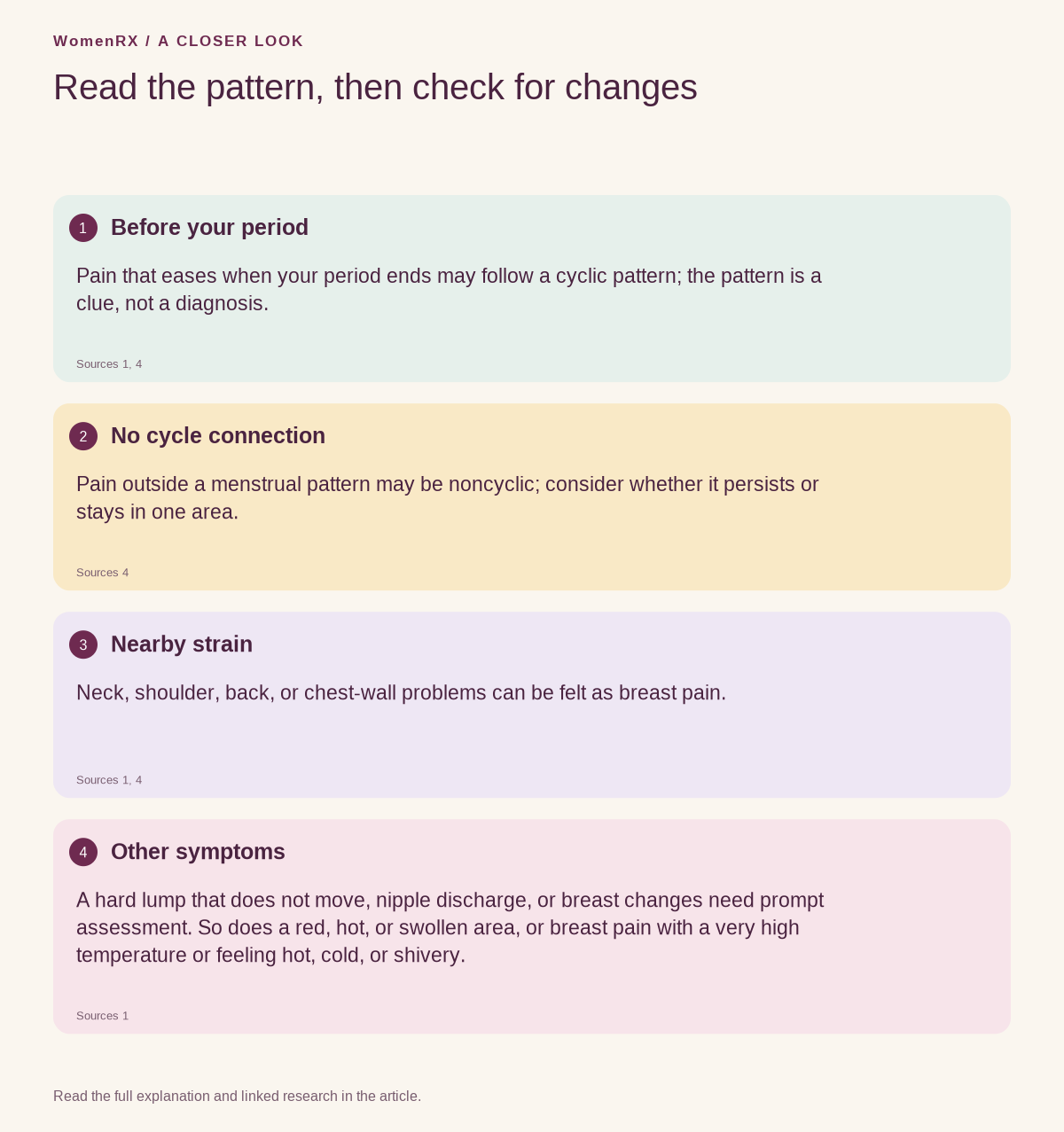
Read the pattern, then check for changes
Before your period: Pain that eases when your period ends may follow a cyclic pattern; the pattern is a clue, not a diagnosis.14
No cycle connection: Pain outside a menstrual pattern may be noncyclic; consider whether it persists or stays in one area.4
Nearby strain: Neck, shoulder, back, or chest-wall problems can be felt as breast pain.14
Other symptoms: A hard lump that does not move, nipple discharge, or breast changes need prompt assessment. So does a red, hot, or swollen area, or breast pain with a very high temperature or feeling hot, cold, or shivery.1
Read the figure as text
Timing and location offer clues, while accompanying symptoms help decide whether to seek assessment.- Before your period: Pain that eases when your period ends may follow a cyclic pattern; the pattern is a clue, not a diagnosis.14
- No cycle connection: Pain outside a menstrual pattern may be noncyclic; consider whether it persists or stays in one area.4
- Nearby strain: Neck, shoulder, back, or chest-wall problems can be felt as breast pain.14
- Other symptoms: A hard lump that does not move, nipple discharge, or breast changes need prompt assessment. So does a red, hot, or swollen area, or breast pain with a very high temperature or feeling hot, cold, or shivery.1
More questions, answered
Does breast pain alone mean I have breast cancer?
Breast pain by itself is unlikely to be a sign of cancer, but pain can’t rule out a problem. Get an assessment for a new lump, skin or nipple changes, nipple discharge, or pain that doesn’t improve. Seek prompt care for a red, hot, or swollen breast area, or for breast pain with a very high temperature or feeling hot, cold, or shivery. Neither warning requires the other to be present. 1
Can a medication contribute to breast pain?
Yes. The contraceptive pill and some antidepressants are among the medicines associated with breast pain. If the timing seems connected, tell the prescriber when the pain began. 1
Sources you can check
- Breast pain - NHSAccessed 2026-09-25Return to first citation
- Pain | MedlinePlusAccessed 2026-09-25Return to first citation
- Effectiveness of Breast Massage on Enhancing Breast Milk Production in Postpartum Women: A Systematic Review and Meta-Analysis of Randomized Controlled Trials.Chaloemram C, Phimarn W, Poowanna R, Winyupan S, Ngenkummoon N. · Breastfeeding medicine : the official journal of the Academy of Breastfeeding Medicine · 2026Return to first citation
- Identification of Risk Factors for Mastalgia and Its Relationship with Benign or Malignant Breast Diseases.Yigit B, Kilicarslan G, Citgez B. · Sisli Etfal Hastanesi tip bulteni · 2023Return to first citation