Midlife Irritability: What the Pattern Can Tell You
When irritability shows up, how long it lasts, and what else is happening can help you decide what support may help.
Irritability that repeatedly rises before a period and eases after menstruation begins may be cycle-linked. Mood symptoms can also persist in early perimenopause, and irritability may occur alongside low mood, anxiety, exhaustion, sleep problems, or ongoing stress. These patterns can point to useful questions, but they don’t identify one cause by themselves. 2 3 6 4 1
Start with the timing
A difficult day is one piece of information. A pattern across days or weeks can tell you more. Notice whether irritability appears in a recurring window before your period and eases after bleeding starts, or whether it continues through much of the month.
Premenstrual dysphoric disorder (PMDD) involves a recurring cluster of symptoms in the premenstrual phase that fully remits in the week after menstruation begins. Irritability or anger can be part of that pattern, but irritability on its own does not establish PMDD. 2
Mood changes do not always follow a clear premenstrual pattern. In a US community cohort of women aged 42-52, persistent irritability, nervousness, and frequent mood changes were more common in early perimenopause than before it. This was an association, not proof that perimenopause caused any one woman’s symptoms. 3
Look at the company irritability keeps
Irritability may be one part of a broader change in how you feel. In an international app survey, women who reported being in perimenopause also reported more depressive mood, anxiety, exhaustion, and irritability than those who reported being premenopausal. Because the survey was cross-sectional and relied on self-reports, it cannot show what caused those symptoms. But persistent low mood, anxiety, or exhaustion alongside irritability is a reason to consider the whole picture, rather than assume the transition explains everything. 6
Sleep is another useful part of that picture. In a separate international app survey, sleep problems and irritability were both commonly reported by participants aged 35 and older. That overlap doesn’t tell us whether poor sleep contributes to irritability, mood affects sleep, or something else affects both. If you have sleep problems, note them alongside your mood, and include hot flashes or night sweats in your notes if you’re experiencing them. 4
Ongoing stress can also leave people feeling sad, angry, or easily upset, according to MedlinePlus. It may help to ask whether pressures at work, at home, or elsewhere have been continuing, rather than treating each irritable moment as an isolated event. Regular exercise, avoiding too much caffeine, sorting what needs attention now from what can wait, and asking trusted people for support are examples of stress-management steps described by MedlinePlus. 1
If irritability began after starting or changing a hormone-based therapy, include that timing in the picture. A review notes that hormone-based therapies may be associated with irritability, depressed mood, or anxiety for some women; that possibility alone can’t establish that a treatment caused your symptoms. 5
Make a simple pattern check
For a few weeks, jot down when the mood change happens and whether it eases or continues. Include cycle timing if you menstruate, sleep problems, hot flashes or night sweats if present, and any sustained stress. You don’t need a detailed diary. A short record can help you describe whether symptoms are brief and recurring or more persistent, and whether they’re affecting daily life.
When it’s time to get more support
MedlinePlus advises seeking help for severe symptoms that last two weeks or more. Examples include changes in eating that lead to unwanted weight changes, trouble getting out of bed because of your mood, difficulty focusing, or being unable to do your usual activities. Persistent irritability with low mood or anxiety deserves attention too, especially when it is interfering with daily life. A care professional can help assess whether stress, a mood concern, the menopause transition, a treatment, or more than one factor may be involved. 1 6
Get help right away if you’re having thoughts of suicide. MedlinePlus also advises getting help right away if stress is leading you to use drugs or alcohol more often than usual. 1
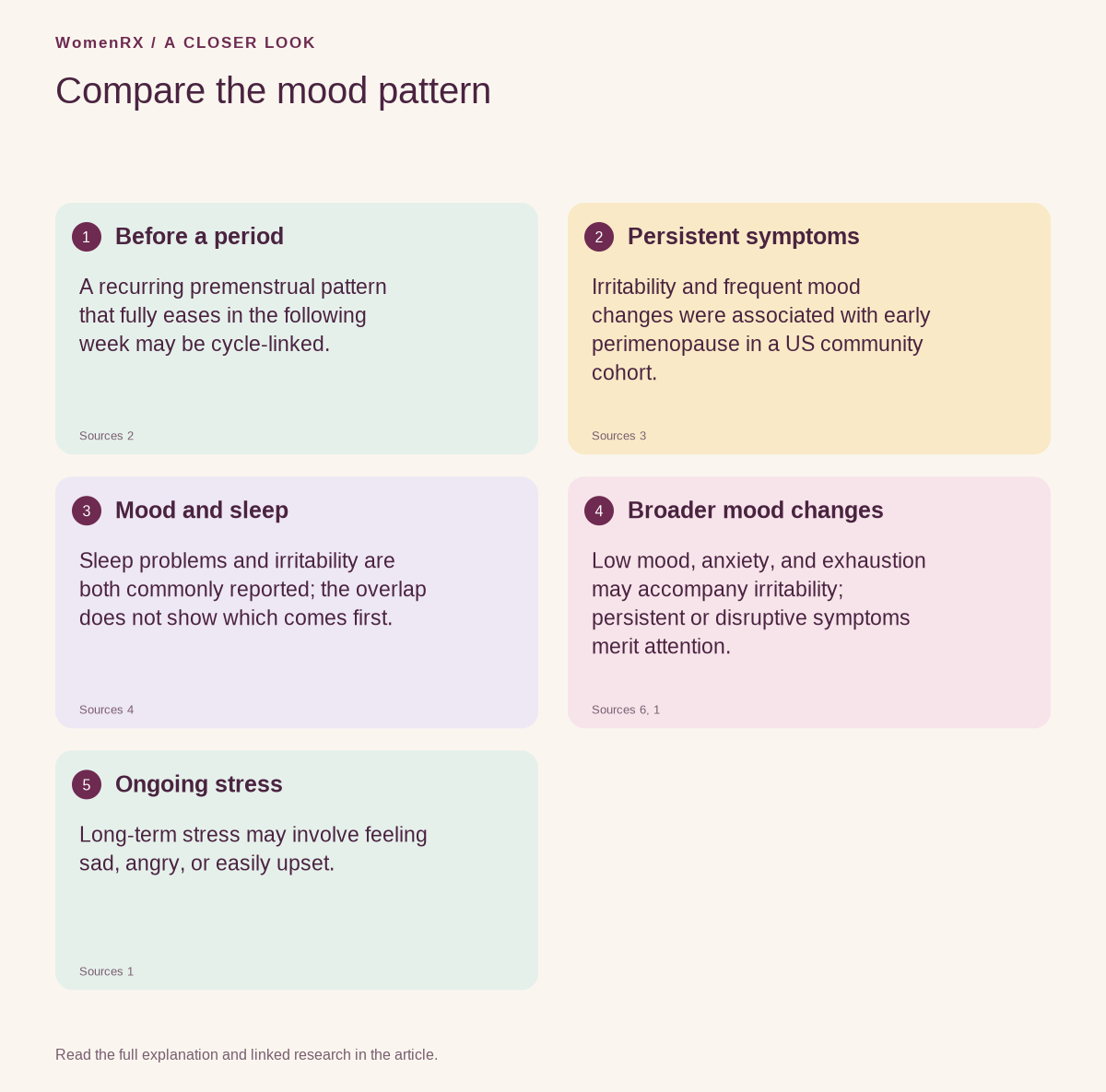
Compare the mood pattern
Before a period: A recurring premenstrual pattern that fully eases in the following week may be cycle-linked.2
Persistent symptoms: Irritability and frequent mood changes were associated with early perimenopause in a US community cohort.3
Mood and sleep: Sleep problems and irritability are both commonly reported; the overlap does not show which comes first.4
Broader mood changes: Low mood, anxiety, and exhaustion may accompany irritability; persistent or disruptive symptoms merit attention.61
Ongoing stress: Long-term stress may involve feeling sad, angry, or easily upset.1
Read the figure as text
Timing and accompanying symptoms can help you describe what is happening without assuming a single cause.- Before a period: A recurring premenstrual pattern that fully eases in the following week may be cycle-linked.2
- Persistent symptoms: Irritability and frequent mood changes were associated with early perimenopause in a US community cohort.3
- Mood and sleep: Sleep problems and irritability are both commonly reported; the overlap does not show which comes first.4
- Broader mood changes: Low mood, anxiety, and exhaustion may accompany irritability; persistent or disruptive symptoms merit attention.61
- Ongoing stress: Long-term stress may involve feeling sad, angry, or easily upset.1
More questions, answered
Does irritability mean I’m in perimenopause?
No. Irritability was more common among women in early perimenopause in a US community study, but the study found an association, not a way to identify the cause of an individual’s symptoms. Cycle-linked symptoms, stress, and broader mood concerns can also be relevant. 3 2 1
What if irritability mainly happens before my period?
A recurring premenstrual pattern that fully eases in the week after menstruation begins may fit the timing described for PMDD. PMDD involves a recurring symptom pattern, not irritability alone. 2
Sources you can check
- Stress: MedlinePlusAccessed 2026-09-25Return to first citation
- The effects of intermittent escitalopram treatment on impulsivity and inattention in women with premenstrual irritability and anger.Gröndal M, Englund C, Näslund J, Ask K, Eriksson E, Winblad S. · Psychological medicine · 2025Return to first citation
- Persistent mood symptoms in a multiethnic community cohort of pre- and perimenopausal women.Bromberger JT, Assmann SF, Avis NE, Schocken M, Kravitz HM, Cordal A. · American journal of epidemiology · 2003Return to first citation
- Global perspectives on perimenopause: a digital survey of knowledge and symptoms using the Flo application.Hedges MS, Hewings-Martin Y, Karam J, Castaneda R, Cunningham AC, Xu Y, Zhaunova L, Faubion SS, Shufelt CL. · Menopause (New York, N.Y.) · 2026Return to first citation
- Intrauterine devices, contraception, and mood changes: what to watch for.Soares CN. · Menopause (New York, N.Y.) · 2026Return to first citation
- Psychological symptoms during perimenopause: a global perspective.Cunningham AC, Hedges MS, Hewings-Martin Y, Castaneda R, Karam J, Zhaunova L, Faubion SS, Shufelt CL. · Menopause (New York, N.Y.) · 2026Return to first citation