Perimenopause Anger and Irritability: What May Help
New irritability can happen during perimenopause, but hormones aren’t the only possible explanation, and anger isn’t inevitable.
Irritability is reported more often by some women during perimenopause, but that doesn’t mean hormones alone explain it or that every woman will experience it. Notice what happens around an episode, including sleep, hot flashes, menstrual changes, stress, mood, and medication changes. If symptoms are severe, disrupt daily life, or raise safety concerns, seek support rather than trying to manage them alone. 5 6 1
“Menopause rage” is a description, not a diagnosis
Anger can feel sudden or out of proportion, or you might notice that small frustrations are harder to shrug off. Irritability is one of several mood symptoms reported during perimenopause, but it doesn’t happen to everyone and doesn’t point to one cause by itself.
In a US community study of 3,302 women ages 42 to 52, persistent irritability, nervousness, and frequent mood changes were more common among early-perimenopausal participants than among premenopausal participants. The study found a group-level association, not proof that perimenopause caused any one woman’s symptoms. 6
A smaller study followed 50 mildly depressed perimenopausal women for eight weeks. Irritability varied considerably from week to week. Depression severity had the strongest association with irritability in that study, while hot flashes were also associated with it. The researchers did not find a simple pattern in which more variable estradiol meant more irritability. That’s a good reason not to assume that anger is simply a readout of hormone levels. 5
Look for patterns without deciding the cause in advance
For a few weeks, make a brief note after a noticeable episode. Record when it happened, how you slept, whether you had a hot flash or night sweat, where you were in your menstrual cycle if you’re still cycling, what was happening in your day, and how your mood had been. Note new or changed medicines too. This isn’t a diagnostic test; it’s a way to see whether anything consistently comes before the anger.
Stress is another possible piece. Long-lasting stress can leave people feeling angry or easily upset, and major life changes or ongoing demands can contribute to it. 1 Tracking stress alongside symptoms may help you see whether irritability follows a difficult day, poor rest, hot flashes, or no clear pattern. A coincidence in your notes doesn’t prove a cause, but it can help make the next step more specific.
If you use an estradiol patch or recently changed a medication, include that timing in your notes. The prescribing information for one estradiol patch lists irritability and mood swings among reported reactions. That listing doesn’t establish that the patch caused an individual’s symptoms, but it’s a relevant detail to discuss when reviewing a new or worsening mood change. 2
Choose support for the pattern you’re seeing
If hot flashes are waking you or dominating your days, ask about treating those symptoms directly. Menopause hormone therapy is an effective treatment for vasomotor symptoms, and nonhormonal options also have evidence for those symptoms. These recommendations address hot flashes and night sweats; they don’t establish that hormone therapy or a nonhormonal hot-flash treatment is a treatment for anger itself. 3 4
If stress is a clear part of the picture, small changes may help with stress management: MedlinePlus suggests regular exercise, avoiding too much caffeine, deciding what needs attention now versus later, and asking friends or family for support. These are general stress-management suggestions, not proven treatments specifically for perimenopausal irritability. 1
Persistent low mood, anxiety, or past depression also deserve attention. In the small perimenopause study, depression severity was more closely associated with irritability than the other factors measured. That doesn’t mean anger is depression, but it does make it worth noticing whether you’ve also lost interest, felt persistently down, or struggled to function. 5
When it’s more than a passing rough patch
Reach out for help if mood symptoms make it hard to do your usual activities or get out of bed, or if severe symptoms continue for two weeks or more. MedlinePlus identifies those as reasons to seek help for stress-related symptoms. If you’re thinking about suicide, get help right away. 1
The useful question isn’t “Is this just hormones?” It’s “What else is happening, how much is this affecting me, and what support fits the pattern?”
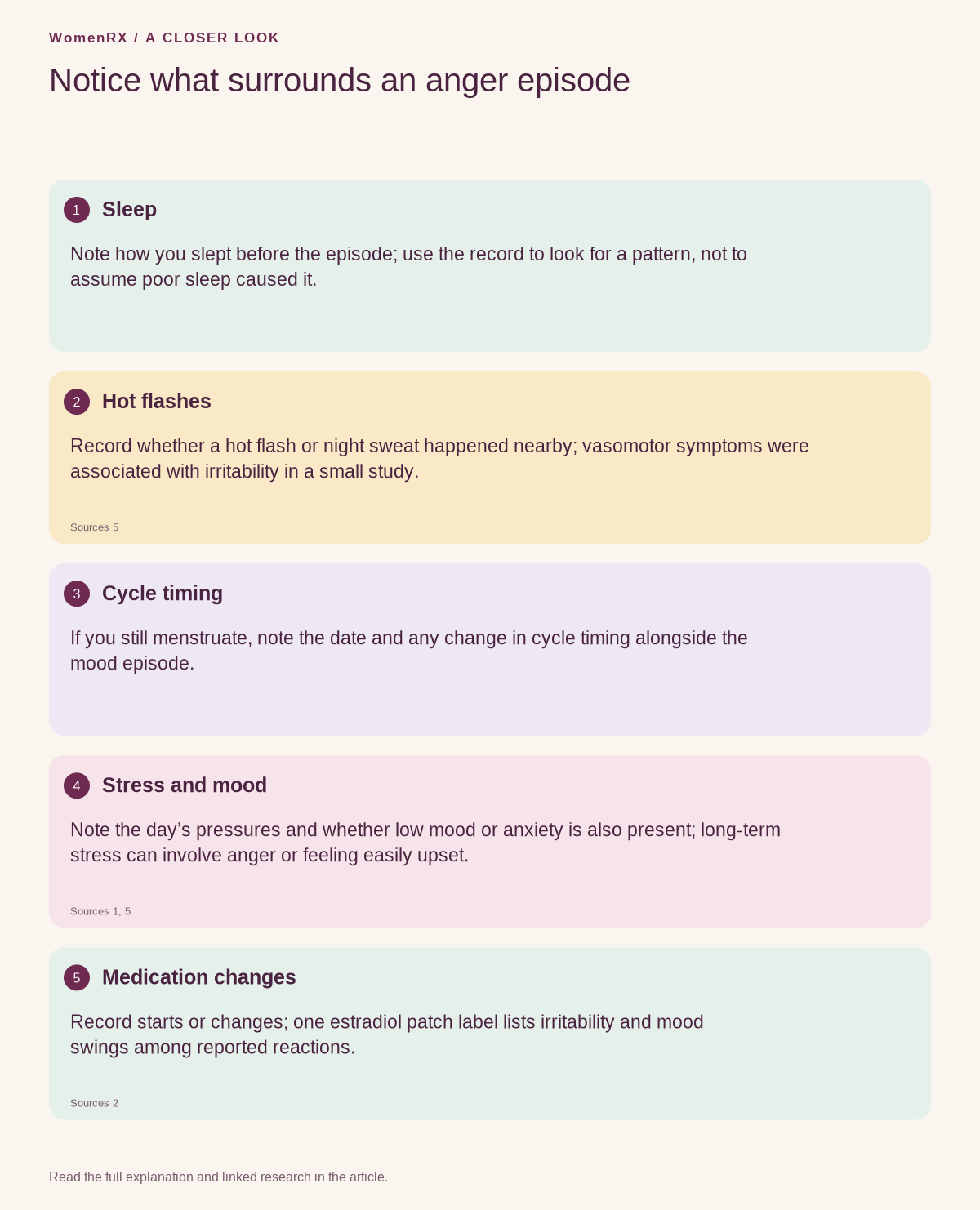
Notice what surrounds an anger episode
Sleep: Note how you slept before the episode; use the record to look for a pattern, not to assume poor sleep caused it.
Hot flashes: Record whether a hot flash or night sweat happened nearby; vasomotor symptoms were associated with irritability in a small study.5
Cycle timing: If you still menstruate, note the date and any change in cycle timing alongside the mood episode.
Stress and mood: Note the day’s pressures and whether low mood or anxiety is also present; long-term stress can involve anger or feeling easily upset.15
Medication changes: Record starts or changes; one estradiol patch label lists irritability and mood swings among reported reactions.2
Read the figure as text
A short record can help you spot patterns without treating a possible connection as proof of cause.- Sleep: Note how you slept before the episode; use the record to look for a pattern, not to assume poor sleep caused it.
- Hot flashes: Record whether a hot flash or night sweat happened nearby; vasomotor symptoms were associated with irritability in a small study.5
- Cycle timing: If you still menstruate, note the date and any change in cycle timing alongside the mood episode.
- Stress and mood: Note the day’s pressures and whether low mood or anxiety is also present; long-term stress can involve anger or feeling easily upset.15
- Medication changes: Record starts or changes; one estradiol patch label lists irritability and mood swings among reported reactions.2
More questions, answered
Does irritability mean my estradiol is low?
No. Irritability alone can’t tell you your estradiol level or establish that hormones are the cause. In one small study of mildly depressed perimenopausal women, irritability was associated with several factors, and the researchers did not find a straightforward link between greater estradiol variability and worse irritability. 5
Can menopause hormone therapy treat anger?
The position statement summarized here supports hormone therapy for bothersome hot flashes and night sweats, not as a specific treatment for anger. If vasomotor symptoms are part of your pattern, treating them may be worth discussing, while mood symptoms still deserve their own assessment. 3
Sources you can check
- Stress: MedlinePlusAccessed 2026-09-25Return to first citation
- CLIMARA (ESTRADIOL) PATCH [BAYER HEALTHCARE PHARMACEUTICALS INC.] | US prescribing information and patient instructionsAccessed 2026-09-25Return to first citation
- The 2022 hormone therapy position statement of The North American Menopause Society.“The 2022 Hormone Therapy Position Statement of The North American Menopause Society” Advisory Panel. · Menopause (New York, N.Y.) · 2022Return to first citation
- The 2023 nonhormone therapy position statement of The North American Menopause Society.Menopause (New York, N.Y.) · 2023Return to first citation
- Predictors of irritability symptoms in mildly depressed perimenopausal women.de Wit AE, Giltay EJ, de Boer MK, Nathan M, Wiley A, Crawford S, Joffe H. · Psychoneuroendocrinology · 2021Return to first citation
- Persistent mood symptoms in a multiethnic community cohort of pre- and perimenopausal women.Bromberger JT, Assmann SF, Avis NE, Schocken M, Kravitz HM, Cordal A. · American journal of epidemiology · 2003Return to first citation