Lower Desire in Perimenopause: What May Be Behind It
A change in desire can have more than one explanation, and you don’t need to meet anyone else’s standard for sex to decide whether it’s worth addressing.
Yes, desire can decrease during perimenopause, but there isn’t one amount of desire that’s normal for everyone. In a US longitudinal study, desire decreased by late perimenopause, while several other aspects of sexual function were not independently linked to the transition. Pain, vaginal dryness, health, psychological wellbeing, medicines, and relationship circumstances can also matter, so it helps to identify what has changed and what bothers you most. 6 1
A lower interest in sex can be part of perimenopause, but it isn’t automatically a problem or a diagnosis. What matters is whether the change feels upsetting to you, affects intimacy in a way you don’t want, or comes with another concern such as pain. There’s no required level of desire or sexual frequency you have to reach.
A US longitudinal study followed 3,302 women as they moved through the menopausal transition. Desire decreased by late perimenopause, and reports of vaginal or pelvic pain increased. But after accounting for other factors, the transition wasn’t independently associated with several other outcomes, including arousal, how often women had intercourse, or emotional satisfaction with a partner. The findings point to change for some women, not a single experience for everyone. 6
Desire, arousal, and pain are different questions
Sexual wellbeing includes several parts: desire, arousal and lubrication, orgasm, satisfaction, and pain. One can change without all the others changing in the same way. For example, you might feel less interested in sex but still enjoy it once you’re aroused; or you might want intimacy but find that dryness or pain gets in the way. The distinction helps you describe the concern more precisely, rather than treating every change as “low libido.” 4
Pain deserves attention in its own right. It can affect enjoyment and relationships, and identifying its cause can help guide what to do about it. Vaginal dryness was associated with sexual functioning in the US study, though that association alone can’t show what caused an individual woman’s change in desire. 2 6
What might be contributing?
Perimenopause is one possible piece, not necessarily the whole explanation. In the US study, health and psychological functioning were related to sexual-function outcomes, as were relationship changes and vaginal dryness. Medicines and chronic conditions can also affect sexual desire or performance. These connections don’t prove that any one factor caused your change, but they can help you decide what to look at first. 6 1
Sleep may be another part of the picture. In a study of partnered midlife women in China, sleep disorder was associated with low sexual frequency. That finding doesn’t establish that sleep problems cause low desire, and it may not apply equally across different populations or relationships. Still, if poor sleep is affecting your energy or mood, it may be worth raising alongside the sexual concern. 5
Dryness or other bothersome genitourinary symptoms can be discussed separately from desire. Menopause guidance describes options for bothersome genitourinary symptoms that aren’t relieved by over-the-counter approaches, including low-dose vaginal estrogen for some women. That’s a conversation about symptoms and suitability, not a guarantee that treating dryness will restore desire. 3
Start with the part you want to change
You don’t have to untangle every possible cause before asking for help. Choose the part that matters most to you, if anything does. These prompts can help you describe it to a clinician, a partner, or both, depending on what feels relevant:
- Desire: Is wanting sex less frequent, or has it changed in a way that bothers you?
- Arousal or comfort: Do you want intimacy but have trouble with arousal, lubrication, or physical comfort?
- Pain: Does sexual activity hurt? If so, where and in what situations?
- Other influences: Did the change happen alongside sleep problems, mood changes, a health condition, a medicine change, or a shift in a relationship?
It can also help to say what you’re hoping for: less pain, more comfort, a better understanding of what changed, or simply reassurance that your current level of desire is acceptable to you. Sexual concerns can involve biological, psychological, and relationship factors, so the most useful next step may depend on which part you want to address. 4
When the change is worth bringing up
Consider talking it through if the change is distressing, if pain or dryness is limiting intimacy, or if you suspect a health condition or medicine may be playing a role. You can ask for the discussion to focus on the concern you chose, rather than assuming that more sex is the goal. A change in desire can be real without meaning that anything is wrong with you.
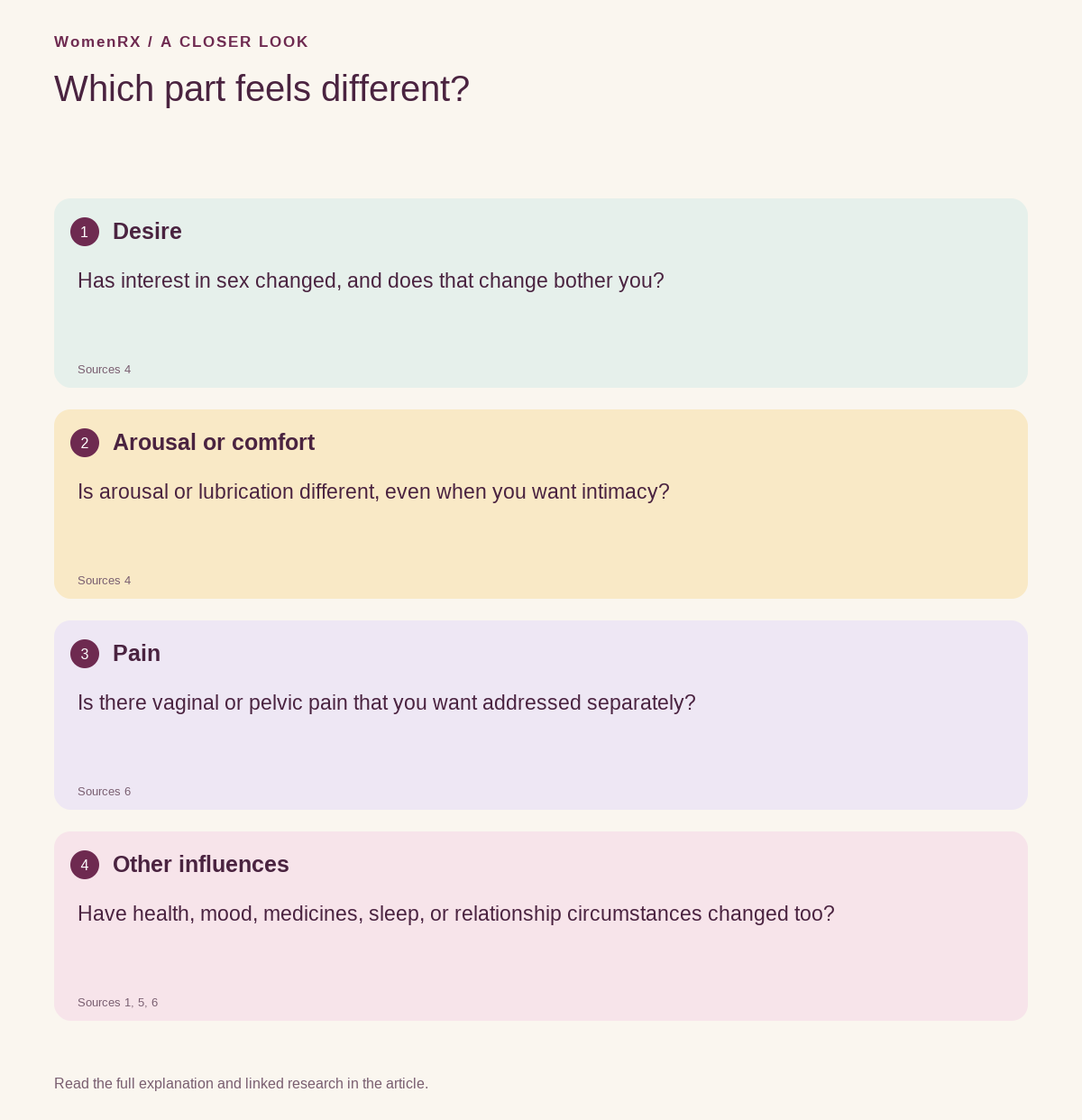
Which part feels different?
Desire: Has interest in sex changed, and does that change bother you?4
Arousal or comfort: Is arousal or lubrication different, even when you want intimacy?4
Pain: Is there vaginal or pelvic pain that you want addressed separately?6
Other influences: Have health, mood, medicines, sleep, or relationship circumstances changed too?156
Read the figure as text
Separate the concern into areas you can choose to raise. More than one may apply, and the checklist is a conversation aid, not a diagnostic tool.- Desire: Has interest in sex changed, and does that change bother you?4
- Arousal or comfort: Is arousal or lubrication different, even when you want intimacy?4
- Pain: Is there vaginal or pelvic pain that you want addressed separately?6
- Other influences: Have health, mood, medicines, sleep, or relationship circumstances changed too?156
More questions, answered
Does lower desire mean I’m not aroused?
Not necessarily. Desire and arousal are separate parts of sexual function, and either can change without the other changing in the same way. Describing which one feels different can make the concern clearer. 4
Could vaginal dryness be part of the problem?
It could contribute to discomfort, and vaginal dryness was associated with sexual functioning in a US study of women moving through menopause. That finding doesn’t establish the cause of an individual change in desire. If dryness is bothersome, it can be discussed as its own concern. 6 3
Sources you can check
- Sexual Health | MedlinePlusAccessed 2026-09-25Return to first citation
- Pain | MedlinePlusAccessed 2026-09-25Return to first citation
- The 2022 hormone therapy position statement of The North American Menopause Society.“The 2022 Hormone Therapy Position Statement of The North American Menopause Society” Advisory Panel. · Menopause (New York, N.Y.) · 2022Return to first citation
- Sexual Function Through Menopause: A Review of Basic Evaluation and Treatment.Pope R. · BJOG : an international journal of obstetrics and gynaecology · 2025Return to first citation
- Prevalence and predictors of sexual function in midlife partnered Chinese women assessed by two simple indicators: Sexual frequency and sexual desire.Zhou Y, Li C, Jin F, Shao H, Teng Y, Tao M. · The journal of obstetrics and gynaecology research · 2019Return to first citation
- Longitudinal changes in sexual functioning as women transition through menopause: results from the Study of Women's Health Across the Nation.Avis NE, Brockwell S, Randolph JF, Shen S, Cain VS, Ory M, Greendale GA. · Menopause (New York, N.Y.) · 2009Return to first citation