Perimenopause Rage: What May Be Behind the Irritability?
Irritability can increase during perimenopause, but intense anger deserves attention in its own right, not an automatic explanation of “just hormones.”
Irritability is more common for some women during perimenopause, but rage isn’t universal and doesn’t identify a cause by itself. Estradiol patterns, depression symptoms, hot flashes, stress, medicines, or another health condition may be relevant. Sleep changes are also worth noting and discussing. Notice when the anger occurs, what else changes, and how it affects daily life. Seek help when symptoms are severe, disrupt relationships or responsibilities, or include thoughts of self-harm. 1 2 5 6

Perimenopause can be part of the picture, not the whole explanation
Some women notice more irritability, nervousness, or mood changes as their menstrual cycles become less predictable. In a U.S. community study of 3,302 women ages 42 to 52, persistent mood symptoms were more common in early perimenopause than before it; the difference showed up for irritability, nervousness, and frequent mood changes, but not for feeling “blue.” This is an association, not proof that perimenopause caused a particular person’s anger. And it doesn’t mean every woman will experience it. 6
A larger comparison of app users also found higher reports of irritability, anxiety, depressive mood, and exhaustion in the perimenopause group than in the premenopause group. Because this was a comparison of self-reported symptoms, it can’t establish what caused them. 7
The word rage describes how an experience feels; it isn’t a diagnosis. A hormonal explanation should not be used to dismiss distress or delay help when anger is harming your life.
Hormones may be involved, but the pattern isn’t simple
Estradiol changes during the transition may be one part of the story, but the research doesn’t support a simple rule like “more hormone fluctuation equals more rage.” In a small study that followed 50 mildly depressed perimenopausal women weekly for eight weeks, greater irritability was associated with less variability in estradiol, as well as more severe depression symptoms and more frequent vasomotor symptoms such as hot flashes. Depression severity explained the largest share of variation in irritability, but no more than 20.3%. The findings describe associations in this particular group; they don’t show that estradiol caused irritability or predict what is happening for you. 5
That’s one reason a mood symptom alone can’t tell you whether hormones, depression, or something else is involved. Sleep changes are worth noting too. Nor does irritability by itself establish that hormone therapy is the right response. The appropriate next step depends on the full pattern and what is affecting you. 4 5
Look for clues in the pattern and the impact
For a short stretch, note when the anger comes up and what else is happening around it. For example, you might notice whether it clusters around menstrual changes, follows nights of poor sleep, appears alongside hot flashes, or persists regardless of cycle timing. Also record whether you’re feeling low, anxious, unusually exhausted, or less interested in things you usually enjoy. These are observations to help explain the pattern, not a test that can diagnose its cause. 1 2 5
Ask yourself two practical questions: Is this a change from my usual self? And is it affecting my relationships, work, caregiving, sleep, or ability to get through daily tasks? Severe mood swings that cause relationship problems, changes in sleeping habits, or difficulty managing daily tasks are reasons to take a possible mental health concern seriously. Depression can include irritability, and certain medicines or health conditions, including thyroid disorders, can produce symptoms that resemble depression. 1 2
Sleep changes are worth noticing without assuming they explain the anger. A change in sleeping habits can be a warning sign of a mental health problem, while hot flashes and irritability occurred together in the small perimenopause study described above. Recording both can give a clearer picture than labeling the experience “hormonal” on its own. 1 5
When to reach out
If anger is intense or recurring, is straining important relationships, or is making work or ordinary responsibilities difficult, contact a primary care or mental health provider. You don’t need to prove that the cause is hormonal before asking for help. A provider can hear the timeline, consider depression and other possible contributors, and discuss what kind of support fits. Talk therapy and medicines are among the treatments used for mental disorders; the right choice depends on the problem being addressed. 1 2
If you’re having thoughts of hurting yourself or attempting suicide, get help right away. If it’s an emergency, call 911. 2
There’s no single meaning to “perimenopause rage.” The useful next step is to take the change seriously, look at its timing and impact, and get support when it’s disrupting your life or putting you at risk.
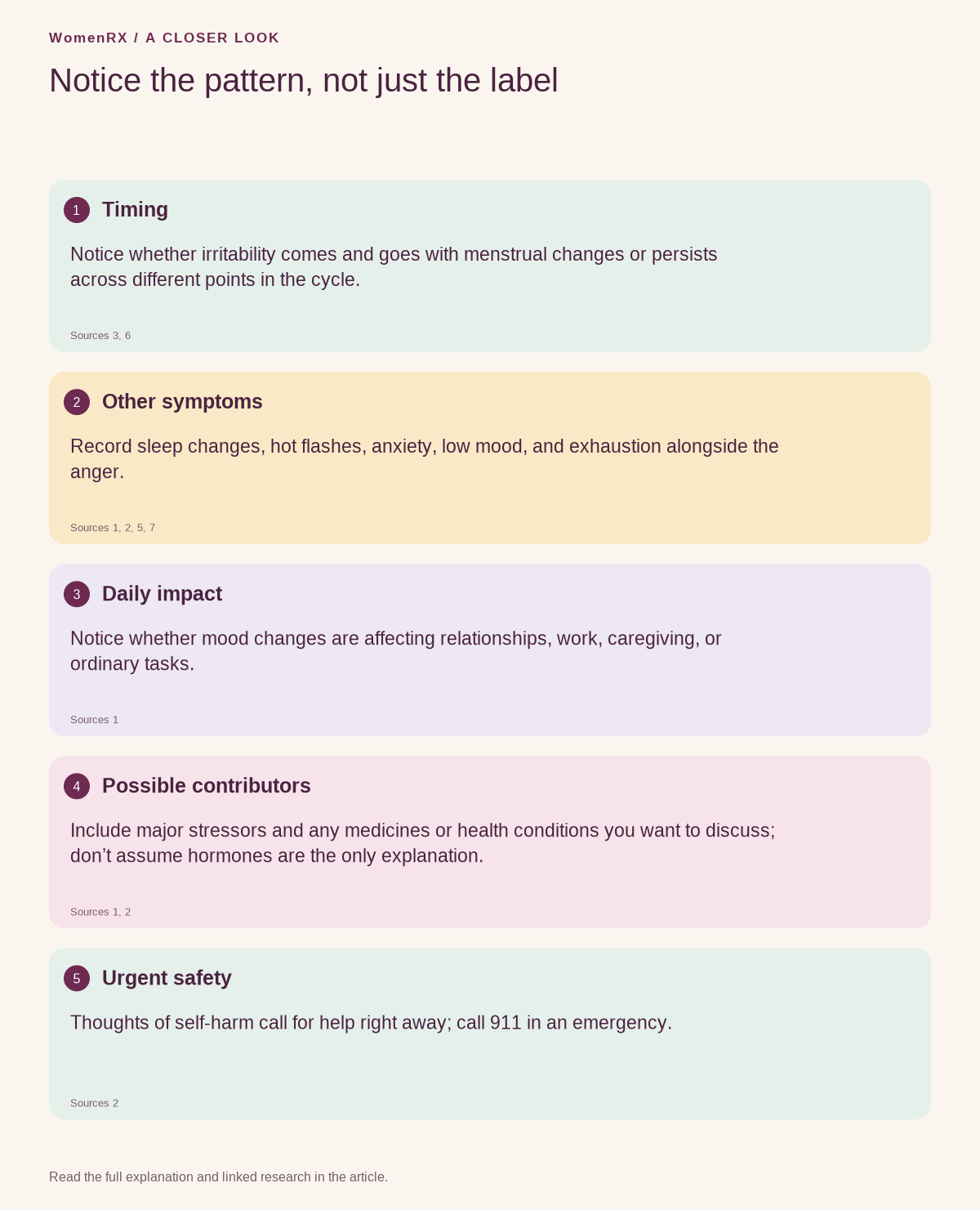
Notice the pattern, not just the label
Timing: Notice whether irritability comes and goes with menstrual changes or persists across different points in the cycle.36
Other symptoms: Record sleep changes, hot flashes, anxiety, low mood, and exhaustion alongside the anger.1257
Daily impact: Notice whether mood changes are affecting relationships, work, caregiving, or ordinary tasks.1
Possible contributors: Include major stressors and any medicines or health conditions you want to discuss; don’t assume hormones are the only explanation.12
Urgent safety: Thoughts of self-harm call for help right away; call 911 in an emergency.2
Read the figure as text
Use these prompts to describe what is happening and how much it is affecting you. They organize observations; they do not diagnose the cause.- Timing: Notice whether irritability comes and goes with menstrual changes or persists across different points in the cycle.36
- Other symptoms: Record sleep changes, hot flashes, anxiety, low mood, and exhaustion alongside the anger.1257
- Daily impact: Notice whether mood changes are affecting relationships, work, caregiving, or ordinary tasks.1
- Possible contributors: Include major stressors and any medicines or health conditions you want to discuss; don’t assume hormones are the only explanation.12
- Urgent safety: Thoughts of self-harm call for help right away; call 911 in an emergency.2
More questions, answered
Does irritability mean I have depression?
No. Irritability can occur with depression, but it can also have other contributors. Depression is assessed using the broader pattern of symptoms, how long they last, and how they affect daily life; a clinician may also consider medicines or health conditions that can resemble depression. 2
Should I ask for hormone therapy because I feel rage?
Irritability alone doesn’t establish that hormone therapy is appropriate. The cited menopause guidance describes hormone therapy as a treatment for bothersome vasomotor symptoms and other specific indications, with benefits and risks considered individually; it does not establish that it is a treatment for rage by itself. 4
Sources you can check
- Mental Health: MedlinePlusAccessed 2026-09-25Return to first citation
- Depression: MedlinePlusAccessed 2026-09-25Return to first citation
- Period problems - NHSAccessed 2026-09-25Return to first citation
- The 2022 hormone therapy position statement of The North American Menopause Society.“The 2022 Hormone Therapy Position Statement of The North American Menopause Society” Advisory Panel. · Menopause (New York, N.Y.) · 2022Return to first citation
- Predictors of irritability symptoms in mildly depressed perimenopausal women.de Wit AE, Giltay EJ, de Boer MK, Nathan M, Wiley A, Crawford S, Joffe H. · Psychoneuroendocrinology · 2021Return to first citation
- Persistent mood symptoms in a multiethnic community cohort of pre- and perimenopausal women.Bromberger JT, Assmann SF, Avis NE, Schocken M, Kravitz HM, Cordal A. · American journal of epidemiology · 2003Return to first citation
- Psychological symptoms during perimenopause: a global perspective.Cunningham AC, Hedges MS, Hewings-Martin Y, Castaneda R, Karam J, Zhaunova L, Faubion SS, Shufelt CL. · Menopause (New York, N.Y.) · 2026Return to first citation