Bloating on Zepbound: What May Be Behind It
Zepbound can cause abdominal distension, gas, and constipation, but what comes with the bloating matters when deciding what to do next.
Yes. In adult weight-management trials, abdominal distension and flatulence were reported more often with Zepbound than placebo, and constipation was also more common. The medicine is one possible explanation, not a certainty: food, gas, and menstrual-cycle changes may also play a part. Contact your prescriber if bloating persists or keeps returning. Bloating with vomiting, diarrhea, constipation, or stomach pain warrants urgent clinical assessment. 123
Could Zepbound be the reason?
It could be. In pooled weight-management trials in adults with overweight or obesity, abdominal distension was reported by 3% of people taking Zepbound 5 mg or 10 mg and 4% taking 15 mg, compared with 2% taking placebo. Flatulence was reported by 3% to 4% across Zepbound groups, compared with 2% on placebo. Constipation was more common too: 11% to 17% across Zepbound groups versus 5% with placebo. These trial percentages show that the symptoms can occur during treatment; they can't tell you whether Zepbound caused your own bloating. 1
Some digestive symptoms may be more noticeable during dose escalation. In adult trials of Mounjaro, which also contains tirzepatide, most reports of nausea, vomiting, and diarrhea occurred during dose escalation and decreased over time. That finding is not specifically about bloating, and it comes from Mounjaro trials rather than Zepbound weight-management trials, so use it as context rather than a prediction. 4
Look at what comes with the fullness
Bloating often means your abdomen feels full or larger than usual, sometimes with more gas. Constipation can be part of the picture; so can certain foods and fizzy drinks. If you are eating differently since starting treatment, consider whether a change in your usual meals, bowel habits, or gas-triggering foods coincided with the symptom. That pattern may help explain what is happening, but it does not establish the cause. 12
A simple first step is to notice whether you are having bowel movements less often or passing harder stool, and whether the bloating follows particular foods or drinks. Gentle, regular movement, chewing with your mouth closed, and cutting back on fizzy drinks or foods you already know trigger gas are general measures suggested for bloating. You don't need to eliminate a long list of foods if you haven't noticed a connection. 2
Your cycle can offer another clue
If the bloating comes and goes in a familiar pattern before your period, it may be related to premenstrual symptoms. The NHS lists bloating among possible PMS symptoms and notes that symptoms are linked to changing hormone levels during the menstrual cycle. A brief note of when bloating occurs in relation to your period can help you see whether there is a repeat pattern. 3
A late or missed period is a separate clue: pregnancy is one possible reason for a missed period. Don't treat a cycle change as proof that the medicine is responsible. 3
When to contact your prescriber
Contact your prescriber if bloating is frequent or does not go away. Seek urgent clinical assessment if it comes with vomiting, diarrhea, constipation, or stomach pain; those combinations call for assessment rather than home troubleshooting alone. 2
Bloating with vomiting blood or vomit that looks like coffee grounds calls for urgent medical help. Severe difficulty breathing is also an urgent warning sign. These symptoms are not reasons to wait and see whether the bloating settles. 2
The useful distinction is not simply “medicine side effect” versus “not a side effect.” A familiar, mild pattern that tracks with gas or your cycle may offer a clue, but it does not settle the cause. Persistent or worsening symptoms, or bloating paired with other concerning symptoms, deserve a closer look instead of being written off as routine. 123
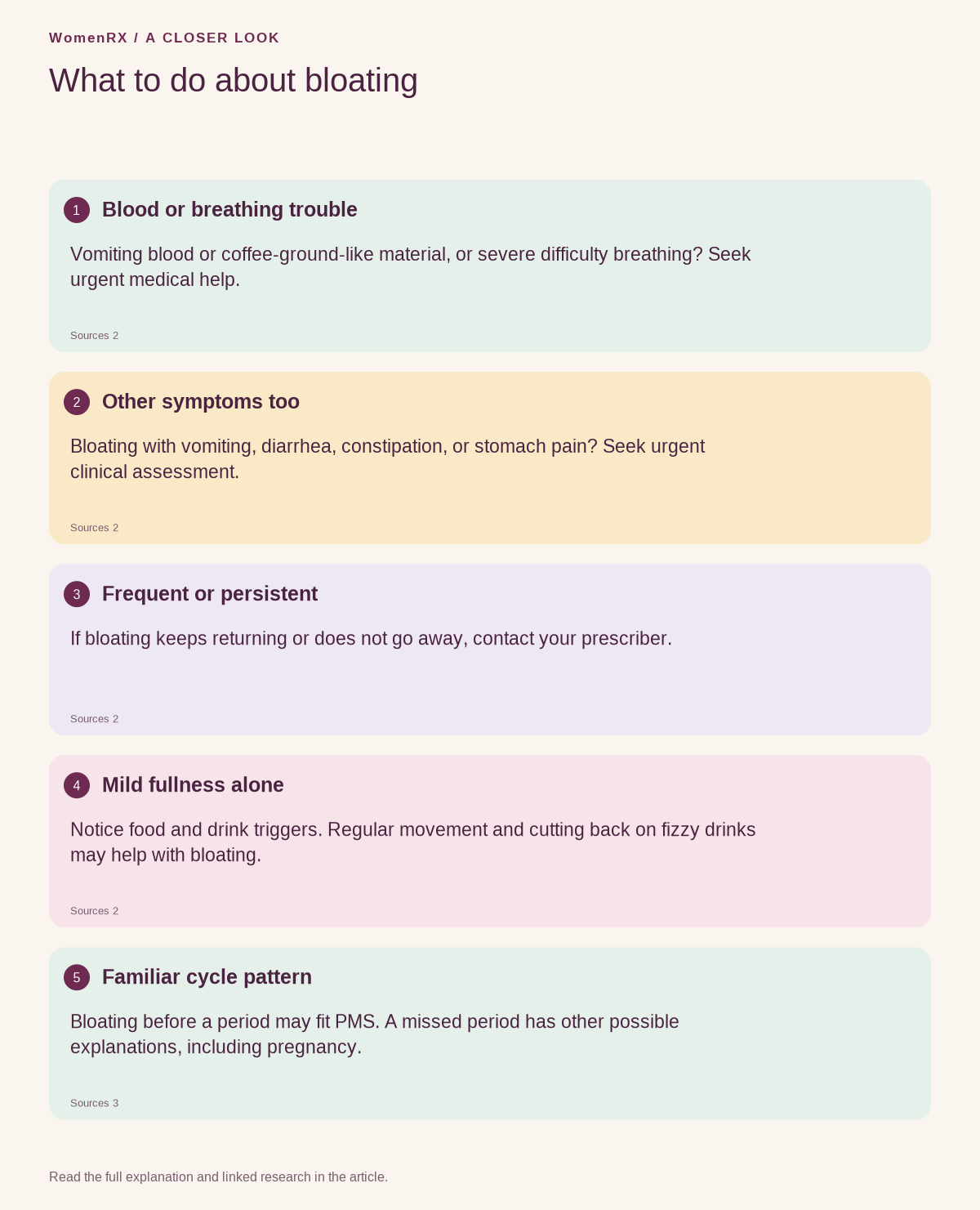
What to do about bloating
Blood or breathing trouble: Vomiting blood or coffee-ground-like material, or severe difficulty breathing? Seek urgent medical help.2
Other symptoms too: Bloating with vomiting, diarrhea, constipation, or stomach pain? Seek urgent clinical assessment.2
Frequent or persistent: If bloating keeps returning or does not go away, contact your prescriber.2
Mild fullness alone: Notice food and drink triggers. Regular movement and cutting back on fizzy drinks may help with bloating.2
Familiar cycle pattern: Bloating before a period may fit PMS. A missed period has other possible explanations, including pregnancy.3
Read the figure as text
Start with the symptoms that need urgent attention, then consider whether the bloating persists or fits a familiar, mild pattern.- Blood or breathing trouble: Vomiting blood or coffee-ground-like material, or severe difficulty breathing? Seek urgent medical help.2
- Other symptoms too: Bloating with vomiting, diarrhea, constipation, or stomach pain? Seek urgent clinical assessment.2
- Frequent or persistent: If bloating keeps returning or does not go away, contact your prescriber.2
- Mild fullness alone: Notice food and drink triggers. Regular movement and cutting back on fizzy drinks may help with bloating.2
- Familiar cycle pattern: Bloating before a period may fit PMS. A missed period has other possible explanations, including pregnancy.3
More questions, answered
Does bloating mean Zepbound is causing constipation?
Not necessarily. Constipation is a reported Zepbound side effect, and it can contribute to bloating, but gas, food triggers, and menstrual-cycle symptoms are other possibilities. Notice whether your bowel habits have changed. If you have bloating with constipation, seek urgent clinical assessment rather than assuming it is a routine side effect. 123
Can bloating happen around a menstrual period?
Yes. Bloating is listed as a possible PMS symptom and may follow a pattern related to the menstrual cycle. If it is new, persistent, or different from your usual pattern, don't assume your cycle or Zepbound explains it. 23
Sources you can check
- ZEPBOUND (TIRZEPATIDE) INJECTION, SOLUTION ZEPBOUND (TIRZEPATIDE) INJECTION, SOLUTION ZEPBOUND KWIKPEN (TIRZEPATIDE) INJECTION, SOLUTION [ELI LILLY AND COMPANY] | US prescribing information and patient instructionsAccessed 2026-09-25Return to first citation
- Bloating - NHSAccessed 2026-09-25Return to first citation
- Period problems - NHSAccessed 2026-09-25Return to first citation
- MOUNJARO (TIRZEPATIDE) INJECTION, SOLUTION MOUNJARO KWIKPEN (TIRZEPATIDE) INJECTION, SOLUTION [ELI LILLY AND COMPANY] | US prescribing information and patient instructionsAccessed 2026-09-25Return to first citation