Low Desire in Perimenopause: Causes and Options
A change in desire can have more than one contributor, so the most useful next step is to identify whether the main concern is desire itself, discomfort, or another part of life.
Perimenopause doesn’t make one level of sexual desire normal, and a change doesn’t automatically mean hormones are the cause. Pain or dryness, medication effects, sleep and mood, and relationship context may all be worth considering. Urinary symptoms deserve their own discussion rather than being treated as low desire. For distressing low desire, testosterone has its strongest evidence after menopause; evidence during perimenopause is less certain. 5 7
Start with what has changed
A lower level of desire isn’t automatically a disorder or something that needs treatment. What matters is whether the change bothers you, what else is happening, and what kind of support you want. Low desire and distressing low desire are not the same thing; treatment guidance for hypoactive sexual desire disorder (HSDD) focuses on a broader assessment, not a hormone result alone. 7 8
It can help to separate three concerns: wanting sex less often, finding sex uncomfortable, or having less energy or emotional space for intimacy. They can overlap, but they don’t point to the same option.
If desire itself is the main concern
A discussion about low desire can include mood, stress, relationship satisfaction, physical health, sexual pleasure, and medicines. These factors show up as possible predictors in research, but that doesn’t mean any one factor explains your experience. 8 Sexual health references also identify medicines as a possible influence on desire or sexual function. 2
If you take an SSRI antidepressant, it’s reasonable to ask whether it could be contributing. A review describes possible effects on desire, arousal, lubrication, and orgasm, while also explaining that the relationship is difficult to separate from other influences. Ask the prescriber about possible medication changes and the benefits of the medication for the condition it treats. 9
Sleep may matter indirectly: poor-quality sleep can affect energy, mood, thinking, and daily functioning. That can make intimacy feel like less of a priority, but sleep trouble by itself doesn’t establish the cause of a desire change. 1
Where testosterone fits
Testosterone isn’t a general fix for low desire, and a blood testosterone level can’t diagnose HSDD. A clinical guideline supports considering systemic testosterone for some postmenopausal women with distressing HSDD after a biopsychosocial assessment. It describes the evidence for late-reproductive-age premenopausal women as limited. 7
A 2026 systematic review found only two randomized trials in premenopausal women, compared with seven in postmenopausal women. The premenopausal trials reported improvements in some sexual-function outcomes, but the smaller evidence base means the result is less established for someone in perimenopause. Perimenopause isn’t a study category that can simply be treated as identical to either group. 5
If you discuss testosterone, ask how the clinician will assess distress and other contributors, what benefit is realistic, and how treatment would be monitored. Guidance describes use as off-label, recommends a baseline testosterone measure for monitoring rather than diagnosis, and notes that long-term safety has not been established. Compounded products lack adequate evidence for efficacy and safety in the guideline. 6 7
If pain, dryness, or urinary symptoms are the bigger problem
When vaginal dryness or irritation makes sex uncomfortable, treating those symptoms may be a more direct first discussion than treating desire. Vaginal estrogen is a local treatment used for menopause-related vaginal dryness and irritation; it is not a treatment for every menopause symptom. Vaginal moisturizers and lubricants are other options to discuss. 3 4
Improving discomfort may help remove one obstacle to intimacy, but it doesn’t guarantee that desire will change. If sex hurts, say where and when it hurts, and whether dryness or irritation is also present. Pain shouldn’t automatically be treated as dryness: the options above address vaginal dryness and irritation, not every possible source of pain. 3 4
If urinary symptoms are also affecting how you feel about sex, mention them as a separate concern. A discussion focused only on desire or vaginal dryness might miss what you want help with. The evidence for the dryness treatments described here doesn’t establish what would help a particular urinary symptom.
Make the conversation match your concern
You might describe the change in everyday terms: “I want intimacy less than I used to,” “I want it but sex is uncomfortable,” or “Urinary symptoms are part of what’s putting me off.” If tiredness or distraction feels more central, say that instead. Then mention when the change began, any medication changes, and whether it’s distressing to you. This isn’t a test with a right answer. It helps keep the discussion focused on the problem you actually want help with, rather than assuming every change in desire is hormonal.
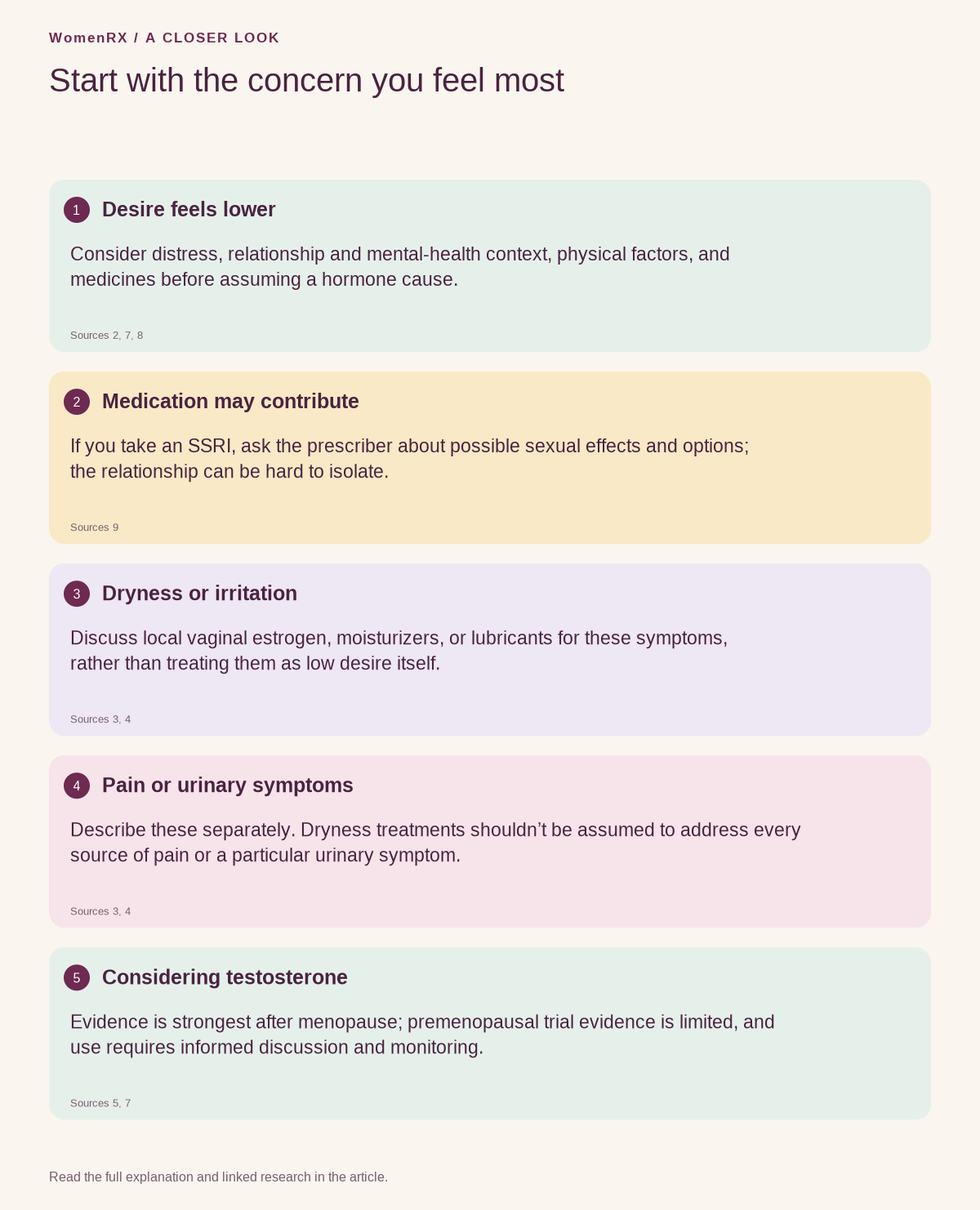
Start with the concern you feel most
Desire feels lower: Consider distress, relationship and mental-health context, physical factors, and medicines before assuming a hormone cause.278
Medication may contribute: If you take an SSRI, ask the prescriber about possible sexual effects and options; the relationship can be hard to isolate.9
Dryness or irritation: Discuss local vaginal estrogen, moisturizers, or lubricants for these symptoms, rather than treating them as low desire itself.34
Pain or urinary symptoms: Describe these separately. Dryness treatments shouldn’t be assumed to address every source of pain or a particular urinary symptom.34
Considering testosterone: Evidence is strongest after menopause; premenopausal trial evidence is limited, and use requires informed discussion and monitoring.57
Read the figure as text
These concerns can overlap. The paths separate supported options for dryness and distressing low desire from pain or urinary symptoms that need their own discussion.- Desire feels lower: Consider distress, relationship and mental-health context, physical factors, and medicines before assuming a hormone cause.278
- Medication may contribute: If you take an SSRI, ask the prescriber about possible sexual effects and options; the relationship can be hard to isolate.9
- Dryness or irritation: Discuss local vaginal estrogen, moisturizers, or lubricants for these symptoms, rather than treating them as low desire itself.34
- Pain or urinary symptoms: Describe these separately. Dryness treatments shouldn’t be assumed to address every source of pain or a particular urinary symptom.34
- Considering testosterone: Evidence is strongest after menopause; premenopausal trial evidence is limited, and use requires informed discussion and monitoring.57
More questions, answered
Does a testosterone test show whether low desire is caused by low testosterone?
No. The clinical guideline says a testosterone level shouldn’t be used to diagnose HSDD. If testosterone is considered, a baseline measure is used for monitoring rather than as a test that explains desire. 7
Can vaginal estrogen treat low desire?
It is used for vaginal dryness and irritation, not as a general treatment for low desire or other menopause symptoms such as sleep problems. If discomfort is reducing your interest in sex, treating the discomfort may address one part of the problem. 3
Sources you can check
- Sleep Disorders | MedlinePlusAccessed 2026-09-25Return to first citation
- Sexual Health | MedlinePlusAccessed 2026-09-25Return to first citation
- About vaginal oestrogen - NHSAccessed 2026-09-25Return to first citation
- Common questions about vaginal oestrogen - NHSAccessed 2026-09-25Return to first citation
- Testosterone therapy for female sexual dysfunction: a systematic review of the literature demonstrating outcomes in premenopausal and postmenopausal women.Furlan VA, Hammad MAM, Quesada S, Nguyen S, Yih J. · The journal of sexual medicine · 2026Return to first citation
- Androgen therapy in midlife and older women: a position statement of the Latin American Association of Gynecological Endocrinology (ALEG).Pilnik S, Belardo A, Marchesan LB, Camero-Lascano A, Acuña-San Martín M, Elizalde-Cremonte A, Ojeda E, Manzur A, Chedraui P. · Climacteric : the journal of the International Menopause Society · 2025Return to first citation
- International Society for the Study of Women's Sexual Health Clinical Practice Guideline for the Use of Systemic Testosterone for Hypoactive Sexual Desire Disorder in Women.Parish SJ, Simon JA, Davis SR, Giraldi A, Goldstein I, Goldstein SW, Kim NN, Kingsberg SA, Morgentaler A, Nappi RE, Park K, Stuenkel CA, Traish AM, Vignozzi L. · The journal of sexual medicine · 2021Return to first citation
- Incidence and Predictors of Low Sexual Desire and Hypoactive Sexual Desire Disorder in Women: A Systematic Review and Meta-Analysis.Tetik S, Yalçınkaya Alkar Ö. · Journal of sex & marital therapy · 2023Return to first citation
- Serotonin Selective Reuptake Inhibitors (SSRIs) and Female Sexual Dysfunction (FSD): Hypothesis on its Association and Options of Treatment.Rappek NAM, Sidi H, Kumar J, Kamarazaman S, Das S, Masiran R, Baharuddin N, Hatta MH. · Current drug targets · 2018Return to first citation