Perimenopause Mood Swings: Track Patterns, Know When to Seek Support
Mood symptoms may become more common during perimenopause, but group-level research can’t tell you how long an individual mood shift will last.
Studies find a higher risk of depressive symptoms during the menopause transition, but they describe group patterns, not the duration of one person’s mood changes. A brief shift and persistent low mood or anxiety are different experiences. Note mood alongside bleeding, sleep, stress, and effects on daily life; seek support if symptoms keep returning, worsen, or interfere with your usual activities. 35
What research can say about mood and timing
Mood changes can happen during perimenopause, but they aren’t inevitable, and they aren’t automatically caused by hormones. A systematic review of four longitudinal studies found a higher risk of depression symptoms and depressive disorders during perimenopause and postmenopause than before menopause. That’s a group-level finding, not a forecast for any one woman or a measure of how long a mood shift lasts. 3
A US community cohort study compared reports from 3,302 women ages 42 to 52 at study entry. Persistent mood symptoms were more common among women classified as early perimenopausal than among premenopausal women. The comparison shows an association, not that perimenopause caused symptoms or how long an individual episode lasted. 5
Most women don’t become depressed during the transition, and researchers haven’t identified one ovarian hormone pattern that distinguishes women who develop depression from those who don’t. 4 So rather than waiting for a particular number of days or cycles, pay attention to whether your symptoms are easing, recurring, getting worse, or affecting your life.
Keep a record that’s easy to use
A tracker can help you describe what’s happening; it can’t diagnose depression or anxiety or prove a cause. Keep the notes brief. Once a day, or when you notice a meaningful change, record:
- Mood: Describe what you felt, such as irritability, worry, or low mood. Note whether it passed or kept returning.
- Cycle timing: Write down the date and any bleeding. You’re looking for a pattern, not trying to force one.
- Sleep and other symptoms: Note sleep disruption, hot flashes, or night sweats. Sleep problems and mood symptoms can occur in the same period of perimenopause, but overlap alone doesn’t show what caused what. 6
- Life context: Jot down major pressures or changes. Long-lasting stress can affect mood and concentration, though those experiences aren’t specific to stress or menopause. 1
- Impact: Note whether the change affected work, relationships, concentration, or your ability to get through usual tasks.
For example, if you notice irritability after a run of poor sleep, record both. That observation may help you explain the pattern, but it doesn’t establish that sleep was the cause. If your periods are irregular, recording dates and symptoms may still help you notice whether changes seem to cluster around bleeding or persist at other times.
When to get support
Consider reaching out to a primary care or mental health clinician if low mood, anxiety, or irritability keeps returning, worsens, causes distress, or interferes with daily life. You don’t need to know whether perimenopause is the cause before asking for help. Depression and anxiety are not the same as occasional mood shifts, and menopause guidance discusses antidepressants as a treatment option when depression or anxiety has been diagnosed. 2
If you’ve had depression or anxiety before, mention that history, along with current stress and sleep disruption. These details can help make the conversation more complete; they don’t prove what’s behind your current mood. Perimenopause may be one part of the picture, while other circumstances can matter too. 146
The purpose of tracking isn’t to monitor yourself perfectly. It’s to give yourself a clearer account of what’s changing and how much it’s affecting you, so you can decide whether you’d like support.
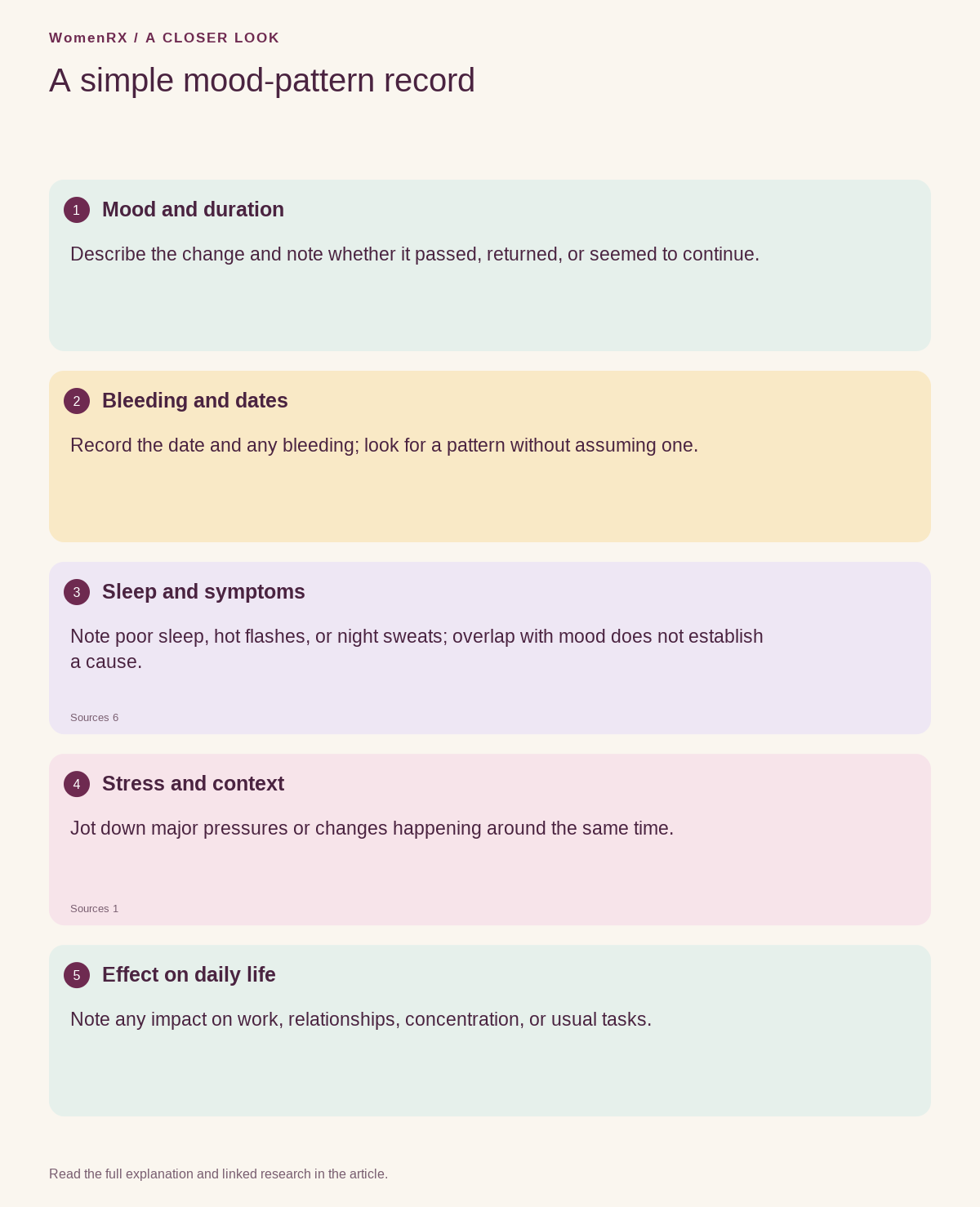
A simple mood-pattern record
Mood and duration: Describe the change and note whether it passed, returned, or seemed to continue.
Bleeding and dates: Record the date and any bleeding; look for a pattern without assuming one.
Sleep and symptoms: Note poor sleep, hot flashes, or night sweats; overlap with mood does not establish a cause.6
Stress and context: Jot down major pressures or changes happening around the same time.1
Effect on daily life: Note any impact on work, relationships, concentration, or usual tasks.
Read the figure as text
Use these prompts to make your own notes clearer. They’re a practical aid, not a diagnostic checklist.- Mood and duration: Describe the change and note whether it passed, returned, or seemed to continue.
- Bleeding and dates: Record the date and any bleeding; look for a pattern without assuming one.
- Sleep and symptoms: Note poor sleep, hot flashes, or night sweats; overlap with mood does not establish a cause.6
- Stress and context: Jot down major pressures or changes happening around the same time.1
- Effect on daily life: Note any impact on work, relationships, concentration, or usual tasks.
More questions, answered
Can tracking tell me whether hormones caused my mood changes?
No. A record may show when mood changes overlap with bleeding, poor sleep, stress, or other symptoms, but timing alone can’t establish a cause. Research points to increased group-level vulnerability to depression for some women during the transition, not one hormone pattern that explains every person’s experience. 46
Sources you can check
- Stress: MedlinePlusAccessed 2026-09-25Return to first citation
- Other medicines for menopause symptoms - NHSAccessed 2026-09-25Return to first citation
- Cognition and mood in perimenopause: a systematic review and meta-analysis.Weber MT, Maki PM, McDermott MP. · The Journal of steroid biochemistry and molecular biology · 2014Return to first citation
- Sex hormones and mood in the perimenopause.Schmidt PJ, Rubinow DR. · Annals of the New York Academy of Sciences · 2009Return to first citation
- Persistent mood symptoms in a multiethnic community cohort of pre- and perimenopausal women.Bromberger JT, Assmann SF, Avis NE, Schocken M, Kravitz HM, Cordal A. · American journal of epidemiology · 2003Return to first citation
- Sleep Disturbance and Perimenopause: A Narrative Review.Troìa L, Garassino M, Volpicelli AI, Fornara A, Libretti A, Surico D, Remorgida V. · Journal of clinical medicine · 2025Return to first citation